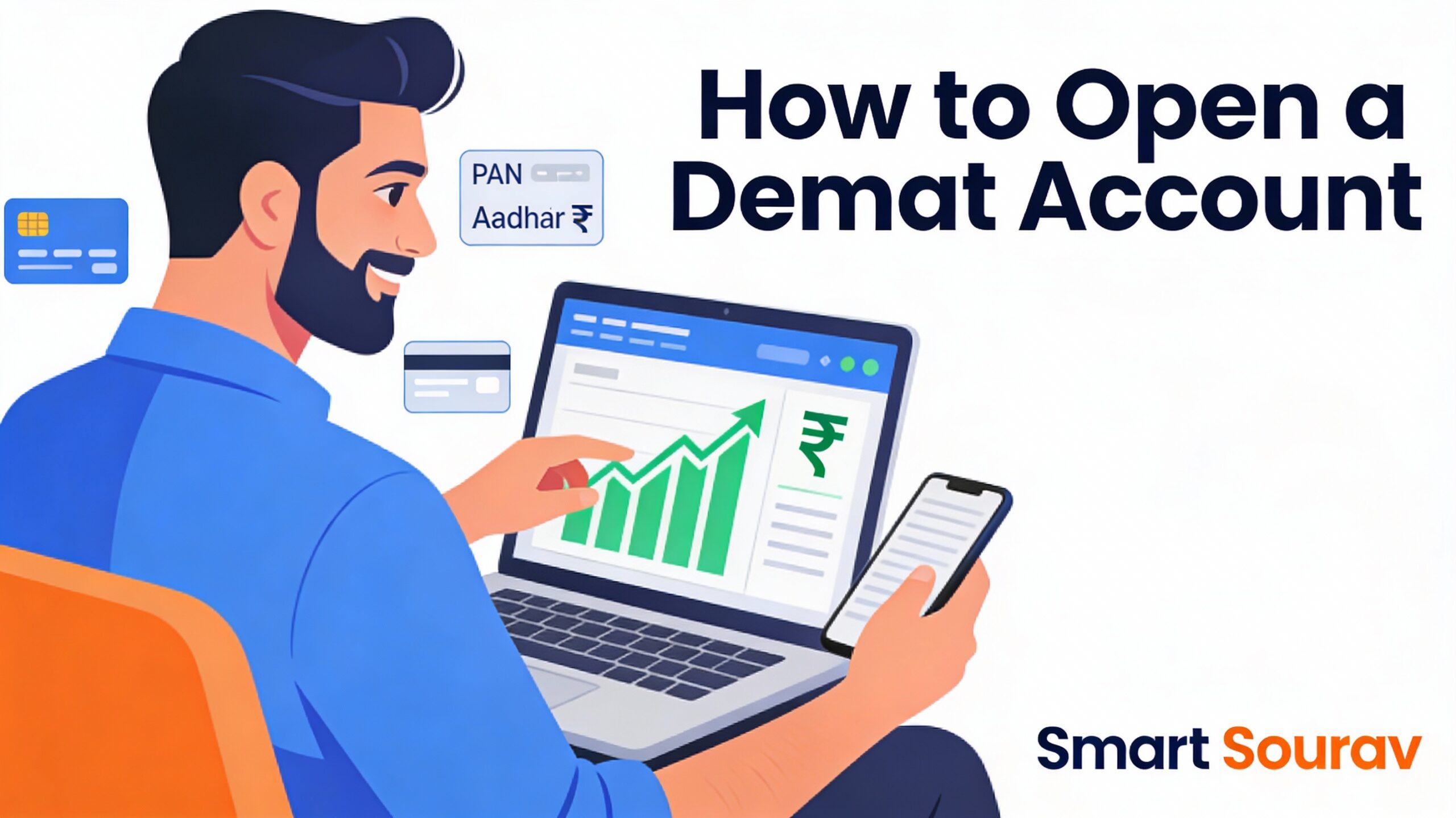
How to Open a Demat Account: The Ultimate Step-by-Step Guide 2026
How to Open a Demat Account: Your Gateway to Wealth Creation
If you are reading this, you have likely decided to take control of your financial future. Whether you want to buy your first share of Tata Motors, invest in an IPO, or build a long-term retirement corpus, there is one non-negotiable first step: You must open a Demat Account.
In the past, stock trading was a chaotic mess of physical paper certificates, stamped forms, and weeks of waiting. Today, thanks to digitization, you can open an account in under 10 minutes from the comfort of your sofa.
However, for a beginner, the jargon can be intimidating. What is a DP? Why do you need a Trading account and a Demat account? What are the hidden fees?
This guide cuts through the noise. We will walk you through how to open a Demat account step-by-step, explain the costs involved, and help you choose the right broker so you don’t lose money on unnecessary fees.
Table of Contents
What is a Demat Account? (The Simple Explanation)
Think of a Demat (short for Dematerialized) account as a “Digital Wallet” for your financial assets.
- Your Bank Account: Holds your Cash.
- Your Demat Account: Holds your Shares, Mutual Funds, Bonds, and ETFs.
Before 1996, investors held share certificates in physical paper form. This was risky—paper could be stolen, forged, or destroyed. Today, the NSDL and CDSL (India’s two central depositories) hold your shares electronically, making investing safe and paperless.
The Vital Distinction: Demat vs. Trading Account
Most beginners use these terms interchangeably, but they are different. To buy a stock, you actually need three things working together:
- Bank Account: Where your money sits.
- Trading Account: The interface (App/Website) where you buy or sell.
- Demat Account: The “locker” where the shares are stored after you buy them.
You rarely open these separately. When you sign up with a broker (like Zerodha, Groww, or ICICI), they automatically open a “2-in-1 Account” (Demat + Trading) for you.
Pre-Opening Checklist: Are You Ready?
Before you jump into the application form, it is crucial to verify your eligibility and have your documents organized. Most rejected applications happen because of mismatched names on documents or unclear scans.
Eligibility Criteria
- Resident Individuals (18+): The most common category. Fully digital process via Aadhaar e-Sign.
- Minors (Below 18): Can invest for the long term but cannot trade (Intraday/F&O). Requires a Guardian to operate the account.
- NRIs (Non-Resident Indians): Must comply with FEMA rules and choose between NRE (Repatriable) or NRO (Non-Repatriable) accounts.
Essential Documents (Keep These Handy)
Ensure your Mobile Number is linked to your Aadhaar. If not, you cannot use the online process.
- Proof of Identity: PAN Card (Mandatory). Ensure the photo is clear.
- Proof of Address: Aadhaar Card (Preferred for fastest KYC), Voter ID, Passport, or Driving License.
- Proof of Bank Account:
- Cancelled Cheque: A cheque leaf with your name printed and “CANCELLED” written across it.
- Bank Statement: Showing Name, Account Number, IFSC, and MICR code.
- Income Proof (Optional): Only required for F&O/Commodities. (Salary slip, ITR acknowledgment, or 6-month bank statement).
- Photograph & Signature: Digital passport-sized photo and a photo of your signature on plain white paper.
Choosing the Right Broker (Depository Participant)
You don’t open a Demat account directly with the central depositories. You go through an intermediary called a Depository Participant (DP)—commonly known as a stockbroker.
Types of Brokers
- Discount Brokers (e.g., Zerodha, Groww, Angel One):
- Best For: DIY investors and beginners.
- Pros: Very low fees (often ₹0 for investments), fast apps.
- Cons: No physical branches, no advisory.
- Full-Service Brokers (e.g., Motilal Oswal, Sharekhan):
- Best For: Investors needing hand-holding/tips.
- Pros: Research reports, Relationship Managers.
- Cons: Higher fees (percentage-based).
- Banks (e.g., ICICI Direct, HDFC Securities):
- Best For: Convenience.
- Pros: 3-in-1 Account (Bank+Demat+Trading).
- Cons: Usually the most expensive option.
Fee Comparison: Top 5 Brokers
| Feature | Zerodha | Groww | Angel One | Upstox | ICICI Direct |
| Account Opening | ₹200 | ₹0 | ₹0 | ₹0 | ₹0 – ₹999 |
| AMC (Yearly) | ₹300 | ₹0 | ₹240 (Free 1st Yr) | ₹300 (Free 1st Yr) | ₹300 – ₹700 |
| Delivery Brokerage | ₹0 (Free) | ₹20 or 0.05% | ₹0 (Free) | ₹20 or 2.5% | 0.55% |
| Intraday Brokerage | ₹20 | ₹20 | ₹20 | ₹20 | ₹20 |
The Online Opening Process (10-Minute Method)
If your mobile is linked to Aadhaar, follow these steps:
- Registration: Visit the broker’s website/app. Enter your mobile number and verify the OTP.
- PAN Verification: Enter PAN and DOB. The system fetches your details from the KRA database.
- DigiLocker Integration: Log in to DigiLocker to securely share your Aadhaar details (Proof of Address) with the broker.
- Bank Linking: Enter Account Number and IFSC. The broker will deposit ₹1 (Penny Drop) to verify the account is active.
- Personal Details: Fill in occupation, income, and Nominee details (Crucial to avoid legal issues later).
- In-Person Verification (IPV):
- Write the OTP code shown on the screen on a piece of paper.
- Record a short video/selfie holding the paper, ensuring your face and the code are visible.
- e-Sign: Verify with Aadhaar OTP on the NSDL/CDSL portal.
- Activation: You will receive your Client ID (BOID) and Password via email within 2-24 hours.
The Offline Opening Process (Traditional)
Use this method if your mobile is not linked to Aadhaar or for Minor Accounts.
- Visit the Branch: Go to the broker’s local branch (or download forms from their website).
- Fill Forms: Fill out the Trading and Demat account opening forms.
- Attach Documents: Attach “Self-Attested” (signed) photocopies of PAN, Aadhaar, and Bank Proof.
- Sign DDPI: Sign the Demat Debit and Pledge Instruction (replaces the old Power of Attorney). This authorizes the broker to debit shares when you sell them.
- Submit: Hand over the forms. Activation takes 5–7 working days.
Special Categories: Minors & NRIs
For Minors (Under 18)
- Purpose: Long-term investment only (No Intraday/F&O).
- Process: Often requires offline forms. The Guardian (Parent) operates the account.
- Documents: Minor’s PAN + Birth Certificate; Guardian’s PAN + KYC docs.
For NRIs (Non-Resident Indians)
- NRE Account: For repatriable funds (money earned abroad). Tax-free interest.
- NRO Account: For non-repatriable funds (money earned in India).
- Requirement: You need a PIS (Portfolio Investment Scheme) permission letter from the RBI (via your bank) to trade.
Understanding the Cost Sheet (The Hidden Fees)
Do not be fooled by “Zero Brokerage” ads. Here is what you actually pay:
| Charge Type | Cost | Note |
| AMC | ₹300 – ₹800/yr | Free if holding value is < ₹50,000 (BSDA Rule). |
| DP Charges | ~₹15 per sell | Charged per company, per day when you sell shares. |
| Auto Square-off | ₹50 + GST | Charged if you forget to close an Intraday position by 3:20 PM. |
| Payment Gateway | ~₹9 + GST | Charged for Netbanking transfers. Use UPI for free transfers. |
Common Mistakes to Avoid
- Skipping Nomination: Always add a nominee. If you don’t, your account can be frozen, and claiming assets becomes a legal nightmare for your family.
- Ignoring BSDA: If you are a small investor (<₹50k holdings), ensure your broker classifies you as a BSDA user to save on AMC fees.
- Fearing the DDPI: If you don’t sign the DDPI/PoA, you will have to enter a T-PIN every single time you try to sell a share.
- Linking Joint Accounts: Always link an individual bank account where you are the primary holder to avoid dividend credit failures.
Conclusion & 3-Day Action Plan
Opening a Demat account is the first step toward financial freedom. It is a one-time process that unlocks a lifetime of wealth creation opportunities.
Your Quick Start Plan:
- Day 1: Gather documents (PAN, Aadhaar, Cancelled Cheque). Ensure the mobile is linked to Aadhaar.
- Day 2: Choose a broker (Discount for value, Bank for convenience) and complete the 10-minute online process.
- Day 3: Log in, transfer your first ₹500 via UPI, and buy your first share or ETF to test the waters.
Don’t wait for the “perfect” time. Start small, stay consistent, and let compounding do the rest.
Frequently Asked Questions (FAQs)
Q1: Can I open a Demat account without a PAN card?
A: No. A PAN card is mandatory for all financial market transactions in India as per SEBI regulations.
Q2: Is it safe to provide my Aadhaar details online?
A: Yes. Reputable brokers use DigiLocker, a government-backed platform. They only get “read-only” access to verify your identity and do not store your biometrics.
Q3: Can I have multiple Demat accounts?
A: Yes, you can open multiple accounts with different brokers (e.g., one with Zerodha for investing, one with Angel One for trading). However, you must pay AMC for each account separately.
Q4: What is the minimum money required to open an account?
A: Most brokers offer free account opening (₹0). You can start investing with as little as ₹50 (the price of a cheap stock) once the account is active.
Q5: How long does it take to activate the account?
A: If done online via Aadhaar e-Sign, it typically takes 2 to 24 hours. Offline applications take 5 to 7 working days.
Note: This guide is for informational purposes only and is not investment advice. Brokerage fees and SEBI rules are subject to change. Investments are subject to market risks. Please do your own research or consult a certified financial advisor before investing.

You may also like

Price to Sales Ratio (P/S): Formula, Meaning & Calculation

What Is the Price-to-Book Ratio? Formula, Meaning & Examples