NSE vs BSE: Difference, Comparison, Which Is Better in 2026
The Indian stock market operates through two main stock exchanges: NSE (National Stock Exchange) and BSE (Bombay Stock Exchange). If you are learning about the stock market, it is natural to feel confused when you see the same stock available on both exchanges.
Understanding NSE vs BSE helps you learn how the Indian stock market works, how trades are executed, and why liquidity and volumes matter. As a learner, this knowledge builds a strong foundation before you move deeper into investing or trading concepts.
Table of Contents
Why Understanding NSE vs BSE Matters
A stock exchange is a platform where buyers and sellers come together to trade shares. In India, NSE and BSE perform this role under the same regulatory framework.
The exchange you select can influence how easily your order gets executed and how active trading is in that stock. For someone learning the markets, knowing this difference avoids common confusion and misinformation.
What Is NSE? (National Stock Exchange)
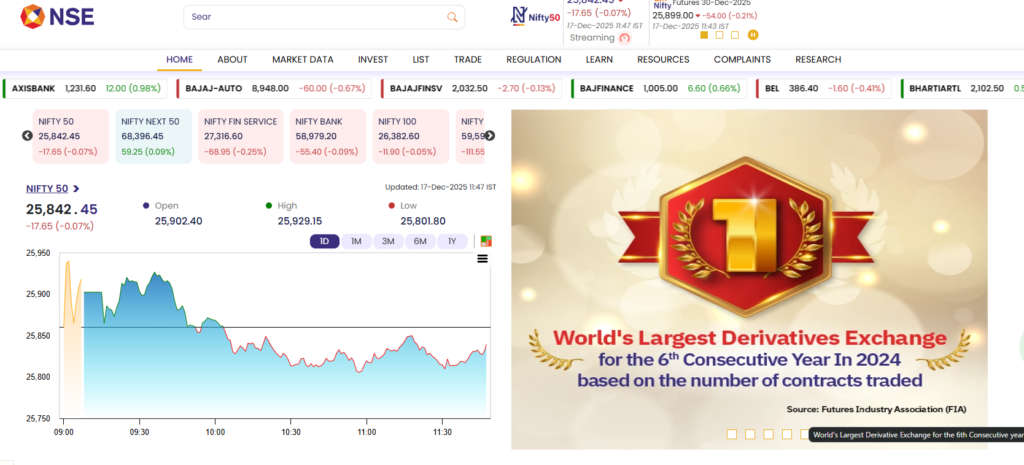
The NSE full form is National Stock Exchange of India. It was established in 1992 to modernize the Indian stock market by introducing fully electronic trading.
NSE replaced manual systems with screen-based trading, which improved transparency and speed. Over time, it became the exchange with the highest trading activity in India.
The benchmark index of NSE is Nifty 50, which tracks the top 50 large and established Indian companies across different sectors. Movements in Nifty are often used to understand the overall direction of the market.
Because of higher participation and liquidity, NSE is widely used by market participants for equity and derivatives trading.
What Is BSE? (Bombay Stock Exchange)
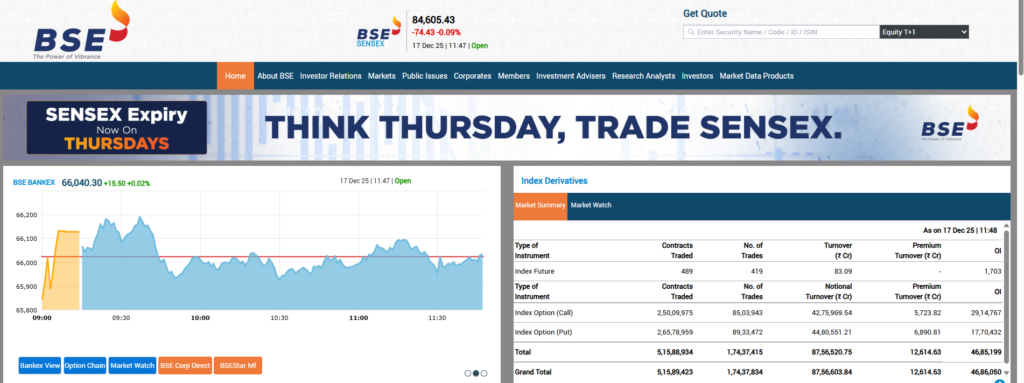
The BSE full form is Bombay Stock Exchange. Established in 1875, BSE is the oldest stock exchange in India and Asia.
BSE introduced India’s first stock market index, Sensex, in 1986. Sensex tracks the top 30 financially strong companies and is often referenced while discussing India’s economic and market trends.
One important feature of BSE is the large number of listed companies, including many small and mid-sized businesses. Today, BSE operates through modern electronic systems like any other global exchange.
NSE vs BSE: Key Differences
Although both exchanges operate in the same country and follow the same regulations, there are practical differences between them.
| Factor | NSE | BSE |
|---|---|---|
| Full Form | Companies in the Index | Bombay Stock Exchange |
| Year Established | 1992 | 1875 |
| Benchmark Index | Nifty 50 | Sensex |
| Companies in Index | 50 | 30 |
| Listed Companies | Around 2000+ | Around 5000+ |
| Trading Volume | Higher | Lower than NSE |
| Regulation | SEBI | SEBI |
In simple terms, NSE has higher trading activity, while BSE has a longer history and more listed companies.
NSE vs BSE for Beginners: How to Think About the Choice
For beginners, it is important to understand that both exchanges are equally regulated and follow the same settlement rules. The exchange itself does not decide profit or loss.
What matters more is liquidity and participation. Stocks with higher trading activity generally have smoother execution. That is why many beginners notice that NSE is used more frequently for regular trading activity.
For long-term holding, the exchange choice becomes less important because shares are held in the Demat account.
Can the Same Stock Be Traded on Both NSE and BSE?
Yes, many well-known Indian companies are listed on both NSE and BSE. You can choose either exchange when buying such stocks.
Sometimes, a small price difference may be visible between the two exchanges. This happens due to differences in demand and supply at that moment. Such differences are normal and usually very small.
One important rule to remember is that shares must be sold on the same exchange where they were purchased.
Which Exchange Is Commonly Used for Trading?
In practice, NSE sees higher participation for active trading because of higher volumes and tighter bid-ask spreads. This makes execution smoother, especially for frequent trades.
BSE also allows trading, but volumes are comparatively lower in many stocks. This difference is related to market participation, not safety or regulation.
Which Exchange Is Used for Long-Term Investing?
For long-term investing, both NSE and BSE work in the same way. Once shares are purchased, they are reflected in your Demat account.
Long-term outcomes depend on the company’s performance, industry conditions, and economic factors. The exchange used for buying the shares does not change ownership or fundamentals.
Nifty vs Sensex: Are They the Same?
Nifty and Sensex are both stock market indices, but they are not the same.
Nifty 50 represents top 50 companies listed on NSE, offering broader market coverage. Sensex represents top 30 companies listed on BSE and is known for its long history.
Both indices move in similar directions most of the time and are used to track market trends.
Role of SEBI in NSE and BSE
Both NSE and BSE are regulated by the Securities and Exchange Board of India (SEBI). SEBI sets rules related to trading, settlement, margins, and investor protection.
Because of SEBI’s oversight, both exchanges operate under uniform standards, ensuring transparency and market integrity.
Common Misunderstandings About NSE and BSE
A common misunderstanding is that one exchange offers better returns than the other. In reality, returns depend on the company, not the exchange.
Another misconception is that an older exchange is outdated. Both NSE and BSE use modern technology and operate under current regulatory norms.
Final Thoughts
NSE and BSE are India’s two main stock exchanges. NSE is known for higher trading activity, while BSE is known for its history and large number of listed companies. Both exchanges are regulated by SEBI and operate under the same rules.
For learning and understanding the stock market, it is important to know how both exchanges work rather than worrying about which one is “better.”
Common FAQs
1. What is the main difference between NSE and BSE?
The main difference between NSE and BSE is trading activity. NSE generally has higher trading volume and liquidity, while BSE is older and has a larger number of listed companies. Both exchanges follow the same rules and regulations.
2. Which is bigger, NSE or BSE?
NSE is bigger in terms of daily trading volume, while BSE is bigger in terms of the total number of listed companies. The meaning of “bigger” depends on what aspect is being compared.
3. Why does the same stock have different prices on NSE and BSE?
Small price differences occur because demand and supply can vary on each exchange. These differences are usually minor and temporary and do not affect long-term ownership of the stock.
4. Does the exchange matter for long-term investing?
No, the exchange does not matter for long-term investing. Once shares are purchased, they are held in the Demat account, and long-term results depend on the company’s performance, not the exchange.
5. What is the difference between Nifty and Sensex?
Nifty represents top 50 companies listed on NSE, while Sensex represents top 30 companies listed on BSE. Both are benchmark indices used to track the overall direction of the Indian stock market.
Disclaimer: This content is for educational and informational purposes only. It should not be considered as investment, trading, or financial advice. Readers are advised to consult a SEBI-registered financial advisor before making any investment decisions.

You may also like

Price to Sales Ratio (P/S): Formula, Meaning & Calculation
What Is the Price-to-Book Ratio? Formula, Meaning & Examples