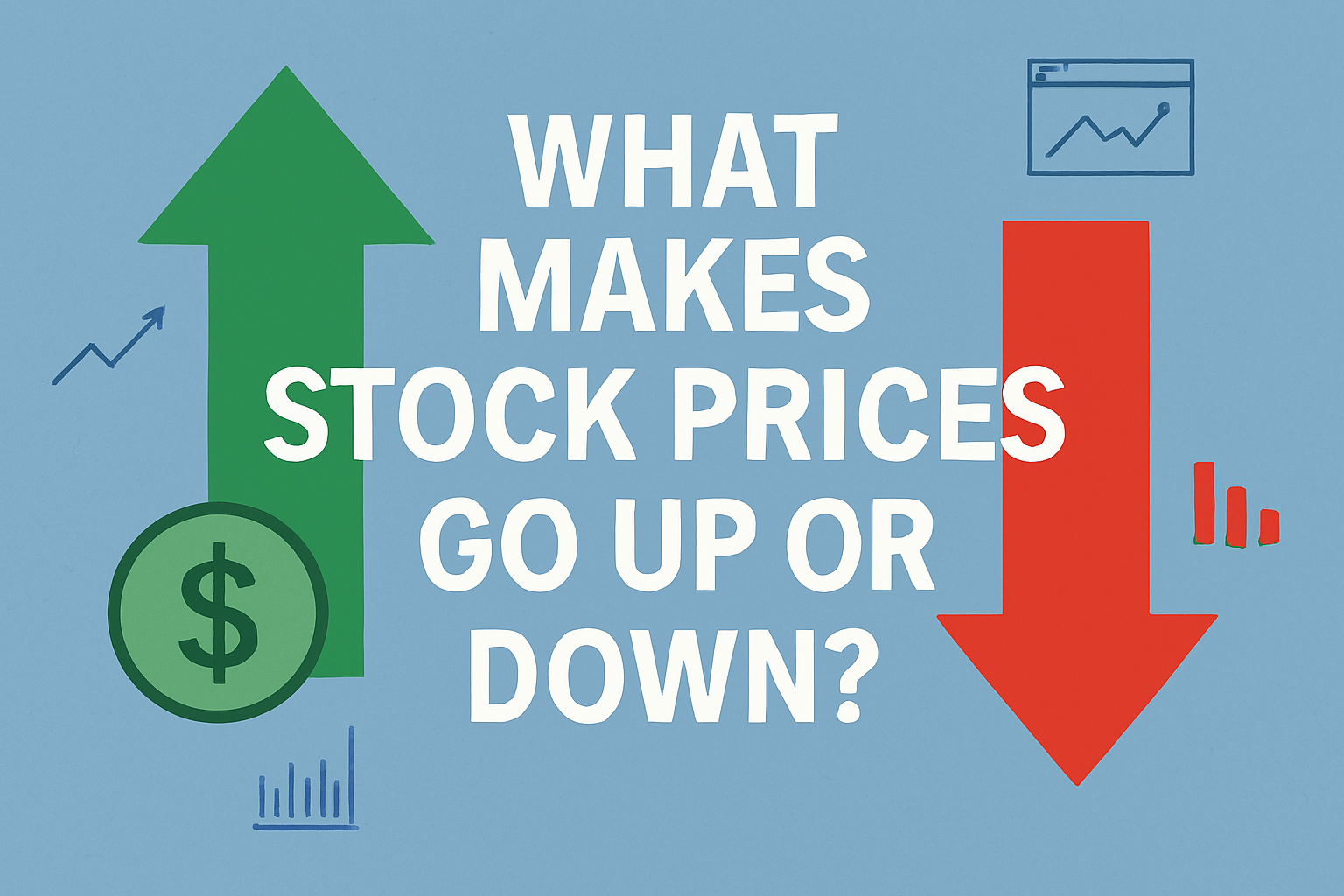
What Makes Stock Prices Go Up or Down? Simple Guide
Stock prices change every day. Sometimes they rise steadily. Sometimes they fall suddenly. For beginners, this movement often looks random or unpredictable. In reality, stock prices follow a clear set of rules that apply in every market in the world—from the United States and Europe to Asia, Australia, and emerging economies.
This article explains what makes stock prices go up or down in the simplest possible way. It focuses on universal principles that work in any country, any exchange, and any market environment.
Table of Contents
Why Stock Prices Move
At the most basic level, stock prices move because of buying and selling.
When more people want to buy a stock than sell it, the price rises.
When more people want to sell a stock than buy it, the price falls.
This is the same rule that applies to any marketplace in everyday life. If demand increases and supply stays limited, prices go up. If supply increases and demand weakens, prices go down. The stock market is simply a global version of this rule.
Every other factor—earnings, news, interest rates, global events—works by changing how many buyers and sellers are active at a given moment.
The Core Rule: Demand and Supply
The stock market runs on one universal principle: demand and supply.
Demand represents investors who believe a stock will be worth more in the future. Supply represents investors who believe it is time to exit or reduce risk.
When demand is stronger than supply, prices rise.
When supply is stronger than demand, prices fall.
This rule applies equally to individual stocks, sector indices, and broad market indices such as the S&P 500, Dow Jones, Nasdaq, FTSE, DAX, Nikkei, or any other global index.
Company Earnings: The Strongest Long-Term Driver
Over the long term, stock prices follow company earnings.
When a company consistently grows its profits, investors are willing to pay more for its shares because profits represent future value. This increased willingness to buy raises demand and supports higher prices.
When earnings weaken, become inconsistent, or fall below expectations, investor confidence declines. Selling pressure increases, and prices adjust downward.
Earnings may not move prices every day, but over months and years, they are the most important force behind sustained price trends in all global markets.
Revenue Growth and Business Expansion
Revenue shows whether a company’s business is growing.
Strong revenue growth signals rising demand for a company’s products or services. Even if profits fluctuate in the short term, steady revenue growth improves long-term expectations and attracts investors.
When revenue growth slows or turns negative, future prospects look weaker. Demand falls, and stock prices often reflect that change.
This principle works globally, regardless of market maturity.
News and Corporate Announcements
News affects stock prices because it changes expectations.
Positive news—such as successful product launches, new contracts, regulatory approvals, or strategic expansions—can increase demand by improving future outlook. Negative news—such as fraud allegations, lawsuits, regulatory action, or leadership issues—can quickly increase selling pressure.
However, most news has short-term impact unless it changes long-term earnings or business stability. Experienced investors learn to separate temporary reactions from meaningful developments.
Economic Conditions and Interest Rates
Stock markets reflect the broader economy.
Key economic factors that influence stock prices worldwide include inflation, interest rates, economic growth, employment data, and consumer spending. Among these, interest rates have the strongest influence.
When interest rates rise, borrowing becomes more expensive. Businesses face higher costs, consumers spend less, and future profits are discounted more heavily. Stock prices often come under pressure.
When interest rates fall, borrowing becomes cheaper, economic activity improves, and investors are more willing to take risk. This environment generally supports higher stock prices.
Central bank decisions therefore influence markets globally, not just locally.
Institutional Investor Activity: How Big Money Moves Markets
In every country, large institutional investors play a major role in stock price movement. These include global investment funds, pension funds, insurance companies, sovereign wealth funds, and large domestic asset managers.
Because these institutions manage enormous amounts of capital, their buying and selling decisions can move individual stocks, sectors, and even entire market indices.
When institutional investors increase their exposure to equities, demand rises and prices tend to move higher. When they reduce exposure or shift money toward safer assets like bonds or cash, selling pressure increases and markets often fall.
Importantly, institutional selling does not always mean companies are performing poorly. Often, it reflects global capital reallocation, changes in interest rates, currency movements, or shifts in risk appetite.
Understanding institutional money flow is essential for interpreting short-term market movements anywhere in the world.
Global Market Influence and Cross-Border Capital Flow
Modern stock markets are deeply interconnected.
Large investors allocate capital across countries and regions. When risk sentiment changes in one major market, it often affects others. A strong rally or sharp fall in a leading global market can influence investor behavior worldwide.
Because capital moves freely across borders, markets may rise or fall together even when local fundamentals remain unchanged. This global linkage explains why markets sometimes react to events that occur far away geographically.
Sector Performance and Industry Cycles
Stocks do not move in isolation. They move within sectors.
When a particular industry performs well globally—such as technology, energy, healthcare, or finance—stocks within that sector tend to rise together. When an industry faces challenges, even strong companies may experience temporary declines.
Sector cycles are a normal part of global markets and often explain why individual stocks move without company-specific news.
Investor Sentiment: Fear and Greed
In the short term, stock prices are heavily influenced by human emotion.
When investors feel optimistic or fear missing out, buying increases and prices rise quickly. When fear dominates—due to uncertainty, global events, or economic concerns—selling pressure increases and prices fall.
Sentiment-driven movements can be sharp but are often temporary. Over time, fundamentals regain control.
Liquidity and Trading Volume
Liquidity refers to how easily a stock can be bought or sold without affecting its price.
Highly liquid stocks with large trading volumes tend to move smoothly. Stocks with low liquidity can experience sharp price swings because even small trades can move prices significantly.
This principle applies globally and explains why well-traded stocks behave more predictably than thinly traded ones.
How Stock Prices Are Actually Set
Stock exchanges do not decide prices. Prices are discovered automatically through the order-matching process.
Buyers place orders at prices they are willing to pay. Sellers place orders at prices they are willing to accept. When a buy order matches a sell order, a trade occurs, and that trade price becomes the current market price.
Continuous matching of orders causes prices to change constantly throughout the trading day.
Short-Term vs Long-Term Price Movement
Short-term price movement is driven by news, sentiment, trading activity, and algorithms. It is fast and often noisy.
Long-term price movement reflects earnings growth, business quality, competitive advantage, and economic cycles. It is slower but far more meaningful.
Successful investors learn to ignore short-term noise and focus on long-term trends.
Why Prices Can Change Within Seconds
Prices change rapidly because modern markets use advanced technology. Algorithms, large institutional orders, automated strategies, and instant news processing create constant movement.
This speed reflects efficiency, not chaos.
Common Beginner Mistakes
Beginners often react emotionally to daily price changes, chase rising stocks, panic during normal corrections, or focus too much on headlines. These mistakes come from misunderstanding how and why prices move.
Learning the underlying logic helps reduce stress and improve decision-making.
How Investors Should Read Price Movement
Investors should view price movement as information, not instructions. Long-term trends, earnings quality, volume confirmation, sector behavior, institutional activity, and global conditions provide far more insight than short-term fluctuations.
Patience and context matter more than speed.
Final Thought
Stock prices rise when demand is higher than supply and fall when supply is higher than demand. Demand and supply change because of earnings, growth expectations, economic conditions, institutional capital flow, global events, and investor sentiment.
Short-term movements are emotional. Long-term movements reflect business reality.
Stock prices are not random. They are the visible result of human behavior, economic forces, and global capital movement.
When you understand these forces, market movement becomes logical—not confusing.

You may also like

Price to Sales Ratio (P/S): Formula, Meaning & Calculation
What Is the Price-to-Book Ratio? Formula, Meaning & Examples