Three Types of Stocks in Stock Market You Should Know Before Investing
When most beginners enter the stock market, they focus only on one thing: which stock to buy. Very few stop to ask an equally important question—what type of stock is this company? This is where many early mistakes begin.
Every stock in the market belongs to a category based on the size of the company, not the share price. These categories are known as large-cap, mid-cap, and small-cap stocks, and they exist in every major stock market in the world, including India, the United States, the United Kingdom, and Canada.
Understanding these stock categories is essential because they directly influence how risky a stock is, how much it can grow, and how it behaves during market booms and crashes. Two companies may operate in the same industry, yet their stock performance can be completely different simply because one is a large-cap company and the other is a small-cap company.
Think of it like businesses in real life. A global brand with operations in dozens of countries behaves very differently from a fast-growing regional company or a small local business trying to expand. The stock market works in the same way.
Once you clearly understand the difference between large-cap, mid-cap, and small-cap stocks, you stop investing blindly. You begin to choose stocks that match your risk tolerance, your investment horizon, and your financial goals. This single concept alone can dramatically improve your long-term results in the stock market.
Table of Contents
What Is Market Capitalization?
Market capitalization, commonly called market cap, is the foundation for understanding stock categories. In the simplest terms, market capitalization tells you how big a company is in the stock market.
It is calculated using a very simple formula:
Market Capitalization = Share Price × Total Number of Shares
For example, if a company’s share price is ₹200 (or $200) and it has 10 million shares in circulation, the market capitalization of that company would be ₹2,000 crore (or $2 billion). This number represents the market’s current valuation of the entire company.
Many beginners confuse market capitalization with stock price, but the two are very different. A stock with a high share price does not automatically mean the company is large, and a stock with a low price does not mean the company is small. What matters is the total value of all shares combined.
Market capitalization is important because it gives investors a quick understanding of a company’s scale, stability, and potential risk. Larger companies tend to have stable businesses, strong cash flows, and lower volatility. Smaller companies, while offering higher growth potential, usually experience sharper price movements and higher risk.
Globally, market cap is used as a universal language to compare companies across countries and industries. In India, it is also the basis for SEBI’s official classification of large-cap, mid-cap, and small-cap stocks.
Types of Stocks in Stock Market by Market Capitalization
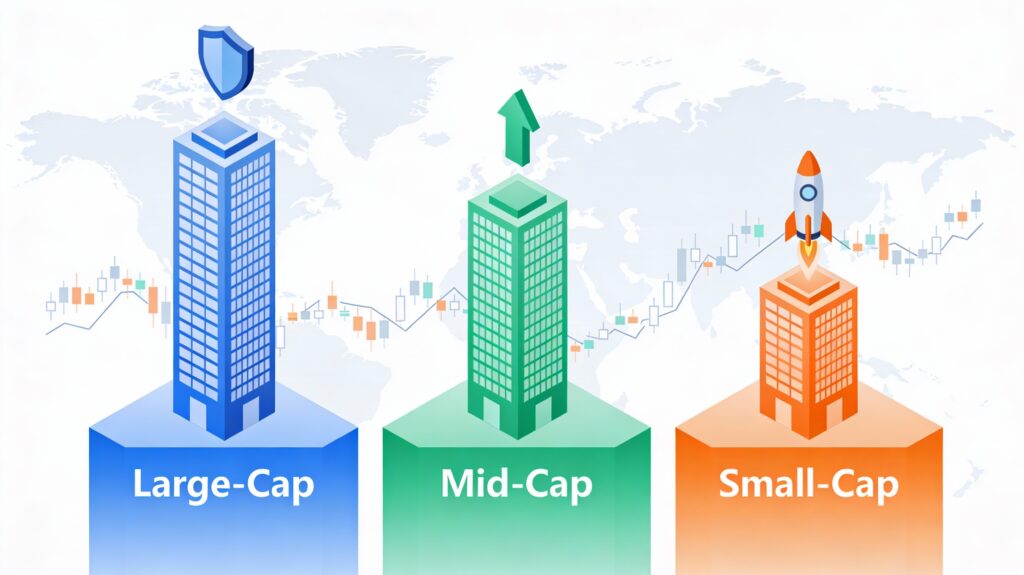
Based on market capitalization, stocks are broadly divided into three categories across global markets: large-cap stocks, mid-cap stocks, and small-cap stocks. These categories help investors instantly understand the nature of a company without going deep into financial statements.
Large-cap stocks represent the biggest and most established companies in the market. Mid-cap stocks represent companies that are growing and expanding rapidly. Small-cap stocks represent smaller companies that are still in their early or developing stages but may have significant future potential.
While the exact numerical definition of these categories differs between countries, the underlying idea remains the same everywhere. Large caps focus on stability, mid caps focus on growth, and small caps focus on aggressive expansion.
Large-Cap Stocks: Meaning, Characteristics, and Suitability

Large-cap stocks belong to the biggest and most financially stable companies in the stock market. In global markets such as the USA and UK, companies with a market capitalization of around $10 billion or more are generally considered large-cap. In India, SEBI defines large-cap stocks as the top 100 companies by market capitalization.
These companies are usually industry leaders with strong brand value, consistent revenue, and well-established business models.
Large-cap stocks are known for relatively low volatility. Their prices do not fluctuate wildly daily, and they tend to perform more predictably over long periods. Because of their size and stability, large-cap companies attract significant investments from institutional investors such as mutual funds, pension funds, and foreign investors.
The biggest advantage of large-cap stocks is stability. They are better equipped to handle economic slowdowns, market crashes, and global uncertainties. However, because these companies are already very large, their growth tends to be slower compared to mid-cap and small-cap companies.
Large-cap stocks are most suitable for beginners, conservative investors, and long-term investors who prioritize capital protection and steady growth over aggressive returns.
Mid-Cap Stocks: Growth with Balanced Risk

Mid-cap stocks sit between large-cap and small-cap companies in terms of size and risk. Globally, mid-cap companies usually have a market capitalization between $2 billion and $10 billion. In India, SEBI defines mid-cap stocks as companies ranked from 101 to 250 by market capitalization.
These companies are typically in a strong growth phase. They have already proven their business models, but still have significant room to expand. Many mid-cap companies eventually grow into large-cap companies over time.
Mid-cap stocks tend to offer higher growth potential than large caps, but they also come with higher volatility. Their prices can move more sharply during market corrections, and they are more sensitive to changes in interest rates and economic conditions.
For investors who are willing to accept moderate risk in exchange for better long-term returns, mid-cap stocks often provide an excellent balance. They are particularly suitable for investors with a time horizon of five years or more and a reasonable tolerance for market fluctuations.
Small-Cap Stocks: High Risk, High Reward

Small-cap stocks represent the smallest listed companies in the market. Globally, these companies usually have a market capitalization between $300 million and $2 billion. In India, SEBI defines small-cap stocks as companies ranked 251 and below by market capitalization.
Small-cap companies are often young, expanding businesses operating in niche or emerging sectors. Because they are smaller and less established, they face higher business risks and greater price volatility.
The biggest attraction of small-cap stocks is their potential for very high returns. Many successful large-cap companies started their journey as small caps. However, not every small-cap company succeeds, and some may fail entirely.
Small-cap stocks are highly volatile and can experience sharp price swings in short periods. They are best suited for experienced investors with a long-term investment horizon and a high tolerance for risk.
Large Cap vs Mid Cap vs Small Cap: Key Differences
While large-cap, mid-cap, and small-cap stocks all belong to the stock market, they behave very differently. Large caps are more stable and less risky, mid caps offer balanced growth, and small caps provide aggressive growth potential with high volatility.
This difference becomes most visible during market cycles. In market crashes, small caps tend to fall the most, while large caps fall the least. In strong bull markets, small caps often outperform, followed by mid caps, while large caps usually deliver more modest returns.
How Market Cap Categories Differ Globally and in India
Globally, stock categories are defined using fixed market cap values. There is no single regulator that enforces these definitions; instead, index providers and financial institutions set general guidelines.
India follows a more structured approach. SEBI uses a ranking-based system rather than fixed numbers. This ensures consistency and transparency, especially for mutual funds and institutional investors.
How Stocks Move Between Categories
Stock categories are not permanent. A small-cap company can become a mid-cap or even a large-cap if its business grows and its market value increases. Similarly, a large-cap company can fall into a lower category if it loses market value.
In India, these changes are officially reviewed and updated twice a year by SEBI, while in global markets, changes happen continuously based on market movements.
Which Category Is Best for You?
There is no universally best stock category. The right choice depends on your risk tolerance, investment horizon, and financial goals. Beginners generally start with large caps, growth-focused investors prefer mid caps, and experienced investors allocate a portion of their portfolio to small caps for higher return potential.
A well-balanced portfolio often includes all three categories in different proportions.
Common Mistakes Beginners Make
One of the biggest mistakes beginners make is chasing small-cap stocks for quick profits without understanding the risks involved.
Others ignore market capitalization completely and invest based only on stock price or tips.
Successful investing starts with understanding the nature of the stock you are buying, not just its recent performance.
Final Thoughts on Different Types of Stocks in Stock Market
Market capitalization is one of the most important concepts in the stock market. Large-cap stocks provide stability, mid-cap stocks offer balanced growth, and small-cap stocks deliver high-risk, high-reward opportunities. Understanding these categories helps investors build smarter portfolios and avoid costly mistakes.
Frequently Asked Questions (FAQs)
Are large-cap stocks safer than mid-cap and small-cap stocks?
Large-cap stocks are generally considered safer because they belong to well-established companies with strong financial foundations, diversified revenue sources, and long operating histories.
These companies tend to handle economic slowdowns and market volatility better than smaller firms.
However, “safer” does not mean risk-free. Large-cap stocks can still fall during market crashes, but their price movements are usually less extreme compared to mid-cap and small-cap stocks.
Why do small-cap stocks fall so quickly during market corrections?
Small-cap stocks fall faster because they have lower liquidity, fewer institutional investors, and higher dependence on market sentiment.
When markets turn negative, investors often sell small-cap stocks first, which leads to sharp price declines.
Additionally, small-cap companies usually have limited financial reserves, making them more vulnerable during economic stress.
Are mid-cap stocks better for long-term investing?
Mid-cap stocks are often excellent for long-term investing because they combine growth potential with relatively manageable risk. These companies are usually in an expansion phase, increasing revenues and market presence.
Over long periods, many mid-cap companies grow into large-cap companies, which can generate strong returns for patient investors.
However, investors must be prepared for higher volatility compared to large-cap stocks.
Can a small-cap stock become a large-cap stock?
Yes, a small-cap stock can become a large-cap stock over time if the company grows consistently and increases its market value. Many of today’s global market leaders started as small-cap companies.
This transition usually happens gradually, moving from small-cap to mid-cap and then to large-cap, often over many years of sustained business growth.
Which stock category is best for beginners?
For beginners, large-cap stocks are usually the most suitable choice. They offer stability, lower volatility, and predictable performance, which helps new investors learn how markets work without facing extreme price swings.
Once a beginner gains experience and confidence, mid-cap and small-cap stocks can be added gradually.
Which category of stocks gives the highest returns?
Small-cap stocks have the highest return potential, but they also carry the highest risk. These stocks can deliver exceptional gains during strong market phases, but they can also suffer severe losses during downturns.
High returns are never guaranteed, and investors must be prepared for significant volatility when investing in small-cap stocks.
What is the SEBI definition of large-cap, mid-cap, and small-cap stocks in India?
In India, SEBI classifies companies based on their market capitalization ranking rather than fixed values.
The top 100 companies are classified as large-cap stocks, companies ranked from 101 to 250 are classified as mid-cap stocks, and companies ranked 251 and below are classified as small-cap stocks.
This system brings standardization and consistency to the Indian market.
How are stock categories defined in global markets like the USA and UK?
In global markets, stock categories are generally defined using fixed market capitalization ranges rather than rankings.
Large-cap companies usually have a market cap of around $10 billion or more, mid-cap companies fall between approximately $2 billion and $10 billion, and small-cap companies range from about $300 million to $2 billion.
These ranges may vary slightly across countries and index providers.
Should investors invest only in large-cap stocks?
Investing only in large-cap stocks may provide stability but can limit overall growth. A diversified portfolio that includes large-cap, mid-cap, and small-cap stocks allows investors to balance safety, growth, and return potential. The exact mix should depend on an investor’s risk tolerance, financial goals, and investment horizon.
Are small-cap stocks suitable for short-term investing?
Small-cap stocks are generally not suitable for short-term investing, especially for beginners. Their high volatility makes short-term price movements unpredictable. Small-cap investments work best when held for long periods, allowing the business time to grow and the market to recognize its value.
Are small-cap stocks riskier in India compared to the US market?
In many cases, small-cap stocks in India tend to be riskier than those in the US due to lower liquidity, higher retail participation, and less institutional coverage.
US small-cap stocks often benefit from stronger regulatory frameworks, deeper markets, and greater institutional involvement, which can reduce volatility compared to Indian small-cap stocks.
Is it possible to build long-term wealth using mid-cap and small-cap stocks?
Yes, it is possible to build significant long-term wealth using mid-cap and small-cap stocks, but it requires patience, diversification, and a strong understanding of risk.
Investors must be prepared to stay invested during periods of high volatility and avoid making emotional decisions during market downturns.
Do institutional investors prefer large-cap stocks?
Yes, institutional investors such as mutual funds, pension funds, and foreign investors generally prefer large-cap stocks. These stocks offer high liquidity, stable business performance, and strong corporate governance, making it easier for large investors to enter and exit positions without significantly impacting prices.
How often do stocks move between market cap categories?
In global markets, stocks move between categories continuously as their market value changes. In India, SEBI reviews and updates market cap classifications twice a year. These periodic reviews ensure that companies are accurately categorized based on their current market size.

You may also like
Price to Sales Ratio (P/S): Formula, Meaning & Calculation
What Is the Price-to-Book Ratio? Formula, Meaning & Examples