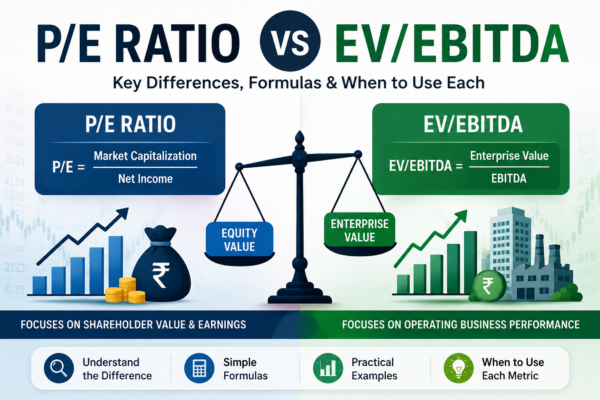
What Is Market Capitalization? Market Cap Meaning, Formula & Types Explained
Market capitalization, commonly called market cap, is one of the most basic yet most important concepts in the stock market. Whether you are investing in India or anywhere in the world, understanding market cap helps you judge the size, stability, and risk level of a company before investing.
In very simple words, market cap tells you how big a company is in the stock market. It represents the total value that the market assigns to a company at a given point in time.
Table of Contents
What Is Market Capitalization
Market capitalization is the total market value of a company’s shares.
You can think of market cap as the price tag of an entire company if it were bought from the stock market today. Just like the price of a house tells you how big or valuable it is, the market cap tells you the overall size of a company.
Why Market Cap Matters
Market capitalization matters because it gives investors a quick and reliable snapshot of a company’s position in the market.
First, market cap helps assess company size. Large companies usually have established businesses, diversified revenue sources, and stronger financial stability. Smaller companies are often newer or niche players and may grow faster, but they also face higher uncertainty.
Second, market cap plays a big role in risk assessment. In general, large-cap companies tend to be less volatile, while small-cap companies can fluctuate sharply in price.
Third, market cap reflects investor confidence. A higher market cap often indicates that many investors trust the company’s future prospects.
Finally, market cap is crucial for index weightage. Major stock market indices like Nifty 50, Sensex, S&P 500, and MSCI assign more weight to companies with larger market capitalization. This means big companies influence index movements more than smaller ones.
Market Cap Formula
The formula for calculating market capitalization is very simple:
Market Capitalization = Share Price × Total Number of Outstanding Shares
That’s all you need to remember. Let’s understand this with easy examples.
If a company’s share price is $200 and it has 16 billion shares outstanding, its market cap becomes $3.2 trillion.
This example illustrates that market capitalization (market cap) depends on both price and the number of shares, not just price alone.
Free-Float vs Full Market Capitalization
There are two methods for calculating market capitalization globally.
Full market capitalization includes all shares of a company, including those held by promoters, governments, and insiders.
Free-float market capitalization includes only those shares that are available for public trading in the stock market.
India follows the free-float market cap method. This is why indices such as Nifty 50 and Sensex are calculated using free-float market capitalization. This approach reflects the real trading activity in the market more accurately.
Types of Market Capitalization
Companies are commonly grouped into categories based on their market capitalization. These categories help investors understand the nature and risk profile of different businesses.
Large-Cap Companies
Large-cap companies are well-established businesses with strong market presence. They usually operate at a national or global level and have stable revenues.
Globally, companies like Apple, Microsoft, and Amazon fall into this category. In India, examples include companies such as Reliance Industries, TCS, and Infosys. These names are mentioned only to explain size, not as investment suggestions.
Large-cap companies are generally considered more stable and suitable for conservative or long-term investors.
Mid-Cap Companies
Mid-cap companies are businesses that have moved beyond the early stage but are still expanding. They often have higher growth potential than large caps but also carry more risk.
These companies can deliver strong returns during good economic phases but may be more volatile during market downturns.
Small-Cap Companies
Small-cap companies are smaller or emerging businesses. They often operate in niche segments or are at an early stage of expansion.
While small caps can offer high growth potential, they also come with higher volatility and risk. Price swings in small-cap stocks can be sharp in both directions.
Market Cap Comparison Table
| Category | Company Size | Risk Level | Volatility | Return Potential |
| Large Cap | Very Large | Lower | Low | Moderate |
| Mid Cap | Medium | Moderate | Medium | Higher |
| Small Cap | Small | High | Very High | Very High |
Why Market Capitalization Changes
Market capitalization is not fixed. It changes daily.
The most common reason is a change in the share price. When a stock price rises, market cap increases, and when it falls, market cap decreases.
Corporate actions also impact market cap. Events such as bonus issues, stock splits, buybacks, or rights issues can alter the number of outstanding shares, which affects market capitalization.
Additionally, when companies issue new shares to raise capital, their market cap structure can change.
Market Cap vs Stock Price
Many beginners mistakenly believe that a high stock price means a big company and a low stock price means a small company. This is incorrect.
A company with a low-priced share can still be very large if it has a high number of shares outstanding. Similarly, a company with a very high share price can have a smaller market cap if it has fewer shares.
Market cap determines company size — not share price.
How Market Cap Affects Index Weightage
Stock market indices are market-cap weighted.
In India, companies with higher free-float market capitalization have a greater influence on indices like Nifty 50 and Sensex.
Globally, indices such as the S&P 500, NASDAQ 100, and MSCI World Index also follow market-cap-weighted methodologies. This means movements in large-cap companies impact these indices far more than smaller companies.
Global Market Cap Categories vs India’s SEBI Rules
Globally, market cap categories are often defined using absolute values like billions or trillions of dollars.
In India, SEBI uses a ranking-based approach:
| Category | India (SEBI Classification) |
| Large Cap | Top 100 companies by market cap |
| Mid Cap | Ranked 101–250 |
| Small Cap | Ranked 251 and below |
This ranking system adjusts automatically with market changes.
Common Mistakes Beginners Make About Market Cap
One common mistake is believing that small-cap stocks are always better because they can grow faster. While growth potential exists, the risk is equally high.
Another misconception is assuming that large-cap stocks are completely safe. Large caps are generally more stable, but they are still affected by market cycles and economic conditions.
Many beginners also confuse stock price with company size, ignoring market capitalization altogether.
How Investors Should Use Market Cap
Market cap should be used as a filter, not as the only decision factor.
Beginners should first understand their risk tolerance. Conservative investors usually prefer large-cap exposure, while aggressive investors may include mid and small caps.
A balanced approach across different market cap categories helps manage risk and return over the long term.
Final Thoughts on Market Capitalization
Market capitalization shows the total value of a company in the stock market. It is calculated by multiplying the share price by the total number of shares. Market cap helps classify companies into large, mid, and small caps, indicating their size, stability, and risk level. India uses the free-float market cap for index calculation. Market cap should never be confused with stock price.
FAQs: Market Capitalization
What is market capitalization in simple words?
It is the total market value of a company’s shares.
What is market cap in the stock market?
It shows how big a company is compared to others.
Does India use free-float market cap?
Yes, Nifty and Sensex are calculated using free-float market capitalization.
Can a small-cap company become a large-cap?
Yes, many successful companies grow through different market cap stages over time.
Is a higher market cap always better?
Not necessarily. It depends on your goals, time horizon, and risk tolerance.

You may also like
Price to Sales Ratio (P/S): Formula, Meaning & Calculation
What Is the Price-to-Book Ratio? Formula, Meaning & Examples