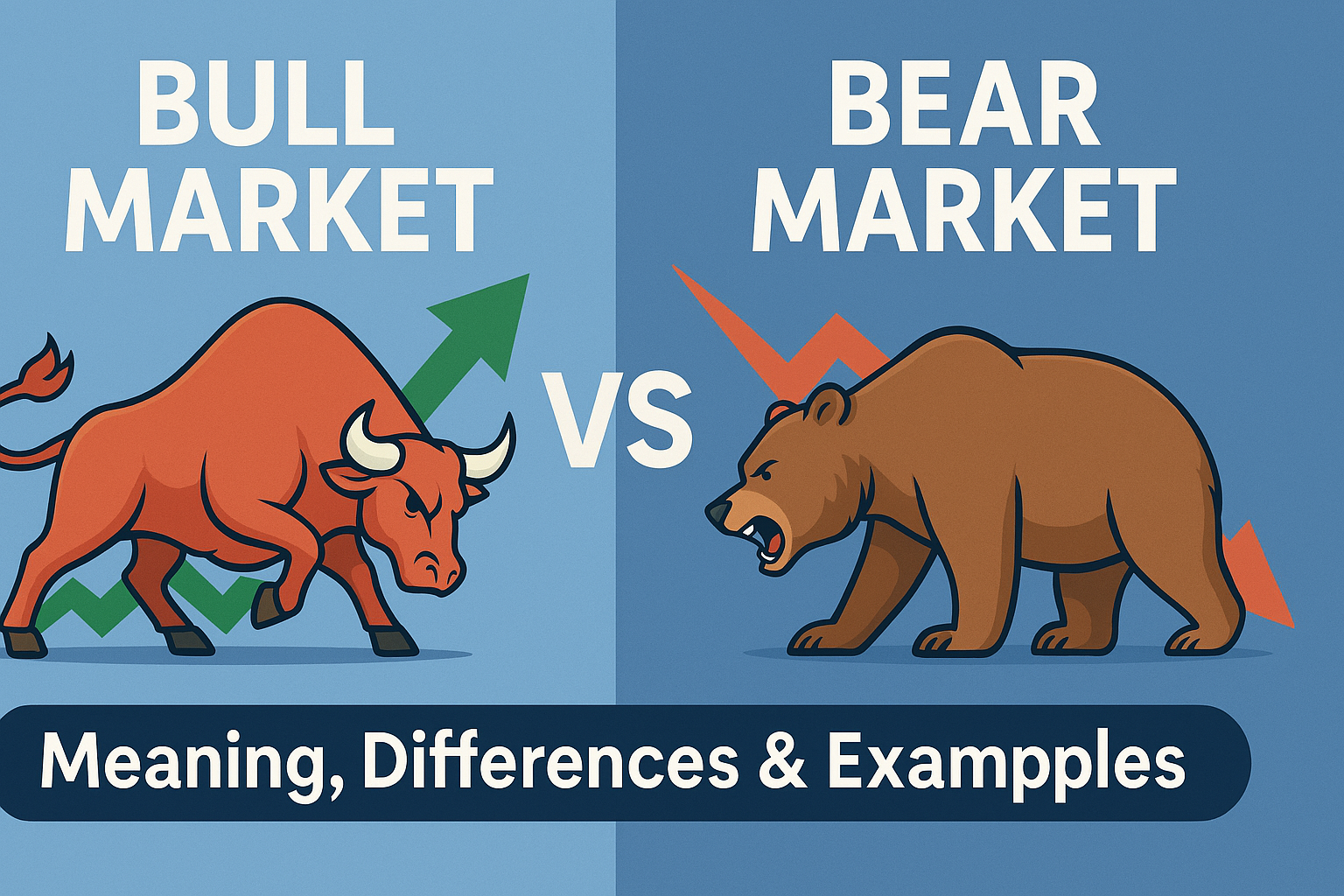
Bull Market vs Bear Market: Meaning, Differences & Examples
Bull Market vs Bear Market — Simple Explanation with Real Historical Examples
The stock market does not move in a straight line. Sometimes prices rise for years, creating wealth and optimism. At other times, prices fall sharply, creating fear and uncertainty. These two opposite phases are known as bull markets and bear markets.
Understanding the difference between a bull market and a bear market is one of the most important basics of the stock market. Whether you invest in Nifty, Sensex, Dow Jones, S&P 500, or Nasdaq, these two concepts apply everywhere in the world.
This guide explains bull market vs bear market in extremely simple language, using real global and Indian examples, so that even a complete beginner can understand how markets behave over time.
Table of Contents
Why Are They Called Bull and Bear Markets?
The terms bull and bear come from the way these animals attack.
A bull attacks by lifting its horns upward. This upward movement represents rising prices. When the stock market moves upward for a long time, it is called a bull market.
A bear attacks by swiping its paws downward. This downward movement represents falling prices. When the stock market falls continuously for months, it is called a bear market.
These terms were first used in European markets centuries ago and later became popular in the US and global stock markets. Today, they are used universally—from Wall Street to Dalal Street.
What Is a Bull Market? (Simple Meaning)
A bull market is a phase when stock prices rise consistently over a long period of time. It does not mean prices go up every single day. Instead, it means the overall direction of the market is upward, with higher highs and higher lows.
In a bull market, investors feel confident about the future. Companies report growing profits, the economy expands, jobs increase, and money flows into equities. As more people invest, prices rise further, reinforcing positive sentiment.
A common rule of thumb is that when a market rises 20% or more from its recent low, it is considered to be in a bull market.
What Is a Bear Market? (Simple Meaning)
A bear market is a phase when stock prices fall continuously for a long period. It is usually declared when markets fall 20% or more from their recent peak.
Bear markets are driven by fear and uncertainty. Economic growth slows, corporate earnings decline, inflation rises, or global crises emerge. Investors sell to protect capital, which pushes prices even lower.
Bear markets feel emotionally painful, especially for beginners, but they are a normal and unavoidable part of long-term market cycles.
Bull Market vs Bear Market: Key Differences
| Aspect | Bull Market | Bear Market |
| Market direction | Upward trend | Downward trend |
| Investor emotion | Optimism, confidence | Fear, panic |
| Economic condition | Growth or stability | Slowdown or recession |
| Corporate earnings | Rising or stable | Falling or uncertain |
| FII behaviour (India) | Net buying | Net selling |
| Risk perception | Lower | Higher |
| Opportunity | Wealth creation | Accumulation at lower prices |
In simple words, bull markets reward patience, while bear markets test patience.
Major Bull Markets in Global Stock Market History
To truly understand bull markets, let’s look at some of the most important bull runs in global history.
1. US Bull Market (1982–2000)
This was one of the longest bull markets in US history. It was driven by falling inflation, economic expansion, technological innovation, and rising productivity. The Dow Jones and S&P 500 delivered massive long-term returns during this period.
This bull market eventually ended with the dot-com bubble burst in 2000.
2. Dot-Com Bull Market (1990–2000)
During the 1990s, the rise of the internet created enormous excitement. Technology stocks surged, and the Nasdaq index rose more than five times in less than a decade.
Many companies had little or no profits, yet their stock prices kept rising. This shows that bull markets can sometimes become speculative.
3. Post-2008 Bull Market (2009–2020)
After the global financial crisis of 2008, stock markets around the world entered a historic bull market.
The S&P 500, Dow Jones, and Nasdaq rose steadily for more than 11 years, making it the longest bull market in US history. Low interest rates, central bank support, and technology growth played a key role.
This bull market ended with the COVID-19 crash in early 2020.
4. Indian Bull Market (2003–2008)
India experienced a powerful bull market driven by economic reforms, infrastructure growth, and strong FII inflows.
The Sensex rose from around 3,000 to over 21,000 during this period. This phase helped create a generation of long-term Indian investors.
5. Post-COVID Bull Market (2020–2021)
After the sharp COVID crash, global markets recovered quickly due to massive liquidity support.
Both US and Indian markets saw rapid rallies, with Nifty and Sensex reaching new highs. This bull market was unusually fast and liquidity-driven.
Major Bear Markets in Global Stock Market History
Bear markets often leave strong emotional memories. Let’s look at some major examples.
1. The Great Depression (1929–1932)
This was the worst bear market in history.
The US stock market crashed nearly 90%, unemployment surged, and economies collapsed worldwide. This period reshaped global financial regulations.
2. Dot-Com Crash (2000–2002)
After years of speculative excess, technology stocks collapsed.
The Nasdaq index fell nearly 78%, wiping out trillions of dollars in wealth. Many internet companies disappeared completely.
3. Global Financial Crisis (2008–2009)
Triggered by the collapse of the housing and banking system, global stock markets crashed sharply.
Major indices fell 50–60%, and panic spread worldwide. This bear market affected almost every country, including India.
4. COVID-19 Market Crash (2020)
This was the fastest bear market in history.
Markets around the world crashed nearly 30–40% within weeks due to lockdowns and economic shutdowns. However, recovery was also unusually fast.
5. Tech Bear Market (2022)
Rising inflation and aggressive interest rate hikes led to a major correction in technology stocks.
The Nasdaq entered a bear market, and global markets struggled due to tighter monetary conditions.
How Long Do Bull and Bear Markets Last?
Historically, bull markets last much longer than bear markets.
Bull markets often last 5 to 10 years, while bear markets usually last less than 2 years. This pattern holds true in both global and Indian markets.
This is why long-term investors who stay invested through downturns often benefit the most.
Investor Psychology During Bull and Bear Markets
In bull markets, investors become confident and optimistic. Many believe prices will never fall. Risk-taking increases, and valuations rise.
In bear markets, fear dominates. Investors panic, sell at losses, and avoid equities altogether. Ironically, this is when long-term opportunities are created.
Understanding this psychology helps investors avoid emotional mistakes.
How Beginners Should Respond to Bull and Bear Markets
Beginners should avoid chasing returns during bull markets and avoid panic selling during bear markets.
Consistency matters more than timing. Continuing SIPs, focusing on strong businesses or index funds, and maintaining a long-term mindset are key to success.
Markets reward discipline, not prediction.
Bull Trap and Bear Trap Explained Simply
A bull trap occurs when the market rises briefly in a broader downtrend, attracting buyers before falling again.
A bear trap occurs when the market falls briefly in an uptrend, attracting sellers before rising again.
Both traps punish emotional reactions and short-term thinking.
Market Cycles: The Bigger Picture
Markets move in cycles—recovery, growth, peak, decline, and bottom. Every bull market eventually ends, and every bear market eventually turns into a new bull market.
This cycle has repeated across centuries and across countries.
Final Thoughts
A bull market means prices are rising and confidence is high.
A bear market means prices are falling and fear is high.
Bull markets build wealth slowly.
Bear markets create opportunities quietly.
Both are temporary.
Staying disciplined through both is the real secret.
FAQs
What is the biggest bull market ever?
The US bull market from 2009 to 2020 is considered the longest in modern history.
Can markets fall during a bull market?
Yes. Short-term corrections are normal even in long-term bull markets.
Is India in a bull market or bear market now?
India remains in a long-term growth phase, though short-term volatility is normal.

You may also like

Price to Sales Ratio (P/S): Formula, Meaning & Calculation

What Is the Price-to-Book Ratio? Formula, Meaning & Examples