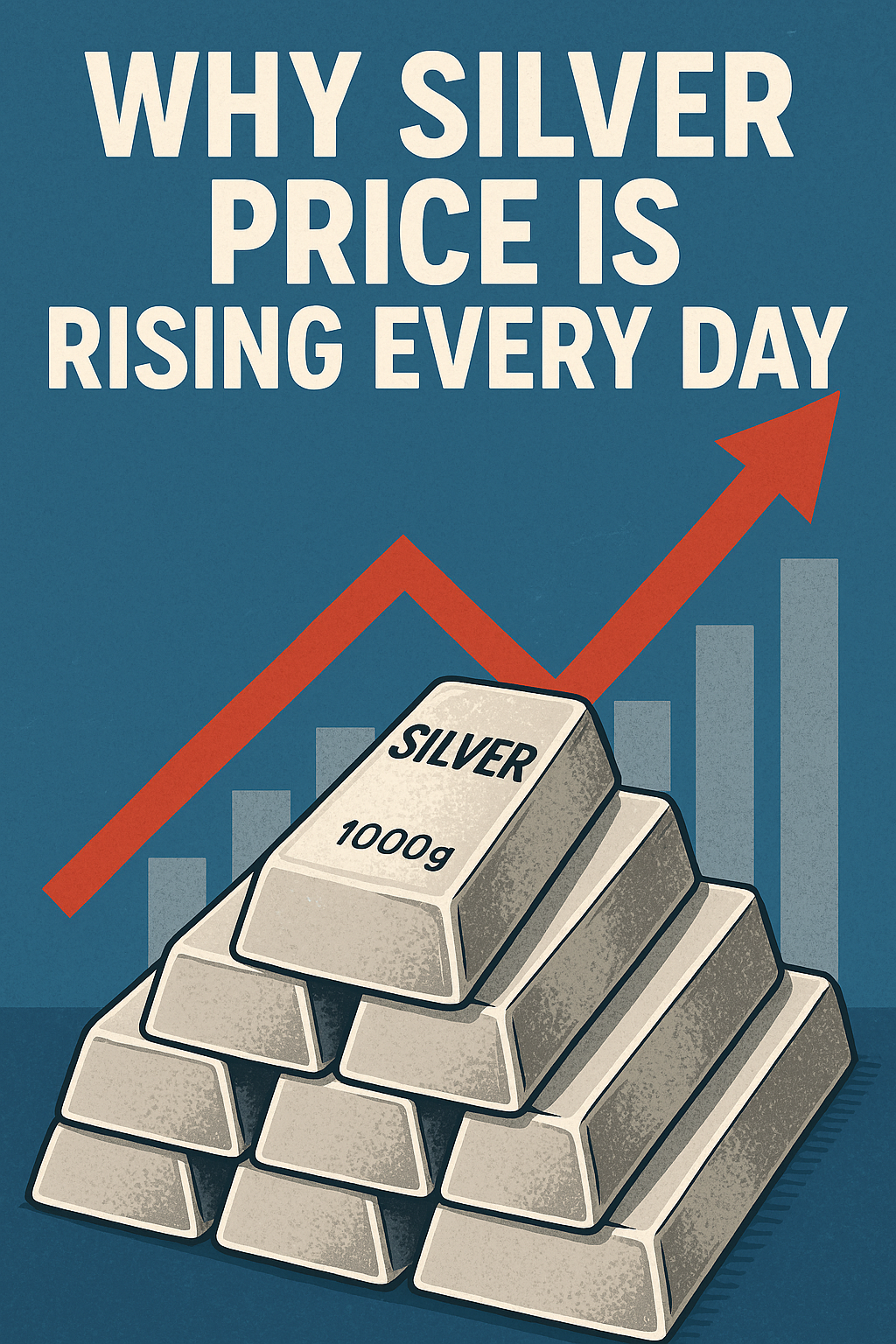
Why Silver Price Is Rising Every Day(Real Reasons Explained)
If you are tracking the commodities market lately, one question keeps coming up again and again: why silver price is rising almost every day? For many investors, this move feels sudden. For traders, it feels aggressive. And for beginners, it feels confusing.
The truth is, silver’s rise is not random, and it is not driven by a single news event. What we are seeing is the result of deep structural changes in demand, supply, and global financial conditions that have been building quietly for years. The recent price action is simply the market reacting to these realities.
To understand why silver is moving the way it is, we need to look beyond daily charts and headlines.
Table of Contents
Silver Is No Longer Just a “Precious Metal”
For a long time, silver was viewed mainly as a cheaper cousin of gold — something investors bought for safety or speculation. That perception has changed.
Today, silver plays a critical role in modern technology. It is one of the best conductors of electricity, which makes it essential for industries that are growing rapidly across the world. Solar energy, electric vehicles, electronics, medical equipment, and advanced manufacturing all depend on silver in ways that cannot be easily replaced.
This matters because industrial demand is not emotional. It does not depend on fear or greed. It depends on production needs. When industries grow, silver consumption grows with them, regardless of market sentiment. Over the last few years, this demand has been rising steadily, creating a strong base under silver prices.
Demand Is Growing Faster Than Supply
Unlike gold, most silver is not mined on its own. A large portion of global silver supply comes as a by-product of mining other metals like copper, lead, and zinc. This creates a structural problem.
Even if silver prices rise sharply, miners cannot easily increase silver production unless those other metals are also in demand. As a result, supply remains relatively rigid while demand keeps expanding.
Over recent years, global silver markets have been running in a persistent supply deficit. In simple words, more silver is being used than is being produced. Inventories slowly shrink, and prices adjust upward to balance the gap. This process does not happen overnight, but once it becomes visible, prices can move quickly.
Silver Is Catching Up After Gold’s Move
Historically, silver does not lead precious metal rallies. Gold moves first, and silver follows later — but often with greater speed.
Over the past few years, gold has already priced in inflation fears, currency weakness, and geopolitical uncertainty. Silver lagged behind during that phase, making it relatively undervalued when compared to gold. As markets recognized this imbalance, capital began rotating into silver.
This “catch-up effect” is one of the main reasons silver often rises faster and more sharply once it starts moving. When the gap between gold and silver valuations begins to close, silver’s daily moves naturally appear stronger.
Global Monetary Conditions Are Supporting Hard Assets
Silver also benefits from the broader global environment. High government debt, persistent inflation concerns, and expectations of easier monetary policy have reduced confidence in paper currencies over time.
When real returns from savings feel uncertain, investors tend to move toward tangible assets. Gold is usually the first choice, but once gold becomes expensive, silver attracts attention because it still offers exposure to hard assets at a lower price point.
This flow of capital does not need dramatic news. It happens quietly and steadily, and once momentum builds, prices begin to rise almost daily.
Technical Breakouts Accelerate the Move
From a market structure perspective, silver recently broke above long-standing resistance zones that had capped prices for years. These levels are closely watched by institutional traders and funds.
When such breakouts occur, three things usually happen together:
- Traders who were betting against silver are forced to exit.
- Momentum traders enter new long positions.
- Long-term investors gain confidence to increase exposure.
This combination creates continuous buying pressure, which explains why the price appears to rise almost every day during this phase.
Why This Does Not Mean Silver Will Rise Forever
It is important to stay realistic. Silver is known for its volatility. Strong rallies are often followed by sharp pullbacks. Corrections of five to ten percent are normal and do not mean the trend is broken.
What matters is not whether silver goes up every single day, but whether the underlying reasons for the rally remain intact. As long as industrial demand stays strong, supply remains constrained, and global financial uncertainty persists, silver’s long-term structure stays supportive.
What This Means for Investors and Learners
Silver’s current rise is not driven by hype or manipulation. It is the result of fundamentals, market structure, and global trends aligning at the same time. However, that does not mean everyone should rush in blindly.
Smart participation in any asset requires patience, position sizing, and a clear understanding of risk. Silver rewards those who respect its nature and punishes those who chase price without a plan.
Final Thoughts
Silver is rising every day because the world needs more of it, produces it slowly, and increasingly sees it as a store of value alongside gold. Daily price movement is only the surface. The real story lies underneath, in demand, supply, and long-term cycles.
For serious learners and investors, understanding why silver moves is far more important than predicting how far it will go.
Related Posts:

You may also like

Price to Sales Ratio (P/S): Formula, Meaning & Calculation
What Is the Price-to-Book Ratio? Formula, Meaning & Examples