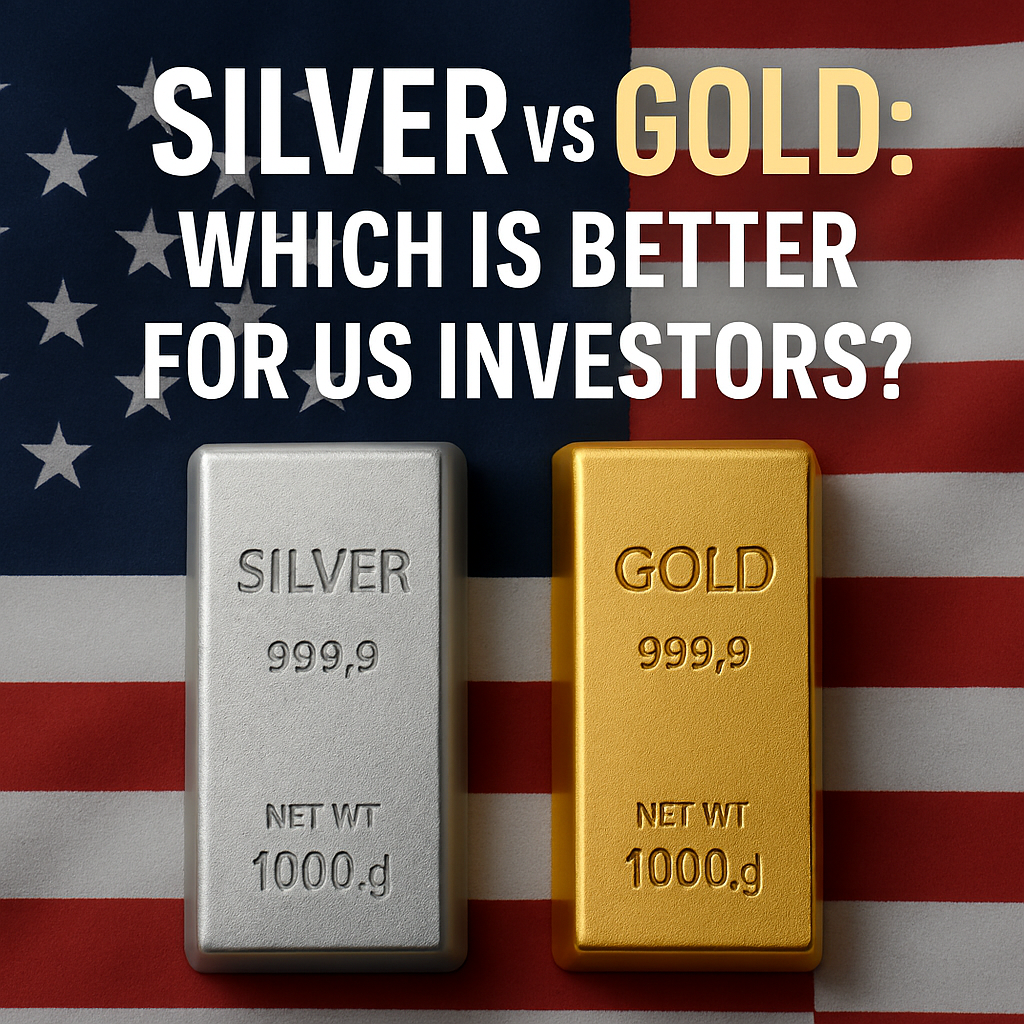
Silver vs Gold: Which is Better for US Investors?
When precious metals start gaining attention, investors often face a familiar dilemma: Should I choose gold or silver? Both metals are seen as stores of value, both respond to inflation and global uncertainty, and both have long histories in financial markets. Yet, for US investors, gold and silver behave very differently in practice.
Choosing between them is less about predicting prices and more about understanding what role each metal plays in a portfolio.
Table of Contents
Understanding the Fundamental Difference
Gold is primarily a monetary metal. Its value is driven by investor sentiment, central bank behavior, inflation expectations, and currency movements.
Silver, on the other hand, is a hybrid metal. It functions both as a store of value and as an industrial input. This single difference explains why silver is more volatile and why its price movements often look exaggerated compared to gold.
In simple terms, gold reflects financial fear, while silver reflects both financial fear and economic activity.
Volatility: Stability vs Opportunity
Gold is known for stability. Its price movements are generally smoother, making it easier for conservative investors to hold through market cycles without emotional stress.
Silver moves faster. It rises sharply during strong economic or inflationary phases and falls quickly during risk-off periods. This volatility creates opportunity, but it also increases risk.
For US investors, this means:
Gold suits wealth preservation
Silver suits tactical or opportunistic exposure
Neither is superior by default; they serve different purposes.
Inflation Protection: Gold Leads, Silver Amplifies
Historically, gold has been the first asset investors turn to during inflationary periods. Central banks hold gold, institutions trust it, and its reputation as a hedge is deeply established.
Silver often follows gold with a delay. When inflation expectations spread into broader economic growth, silver demand increases through industrial channels. This is when silver tends to outperform gold.
Gold protects purchasing power.
Silver amplifies the inflation trade — for better or worse.
Liquidity and Market Size
Gold has a much larger and more liquid global market. Large US institutions, pension funds, and central banks can move in and out of gold without significantly impacting price.
Silver’s market is smaller. This makes it more sensitive to capital flows. When money enters silver, prices can rise quickly. When money exits, declines can be equally sharp.
For retail investors, this smaller market is both a risk and an opportunity.
Investment Options in the USA
US investors can access both metals easily through physical ownership, ETFs, and brokerage accounts.
Gold tends to dominate long-term allocation strategies, retirement portfolios, and institutional models. Silver is more commonly used as a satellite holding or a tactical position alongside equities and commodities.
From a practical standpoint, gold integrates more smoothly into conservative portfolios, while silver adds complexity and potential upside.
Tax Considerations Matter
In the US, both gold and silver are generally classified as collectibles for tax purposes. This means capital gains can be taxed at higher rates than traditional equities if held outside tax-advantaged accounts.
Tax treatment should not be ignored, especially for long-term investors calculating real, after-tax returns. The difference between gold and silver here is not dramatic, but awareness is essential.
Which One Is Better for US Investors?
The answer depends on your objective, not market headlines.
Gold may be more suitable if your priority is:
Stability
Long-term wealth preservation
Lower emotional stress
Defensive positioning
Silver may be more suitable if your priority is:
Higher return potential
Exposure to industrial growth
Tactical allocation
Willingness to handle volatility
Many disciplined investors choose both, using gold as the anchor and silver as the accelerator.
A Balanced Perspective
Silver is not “cheap gold,” and gold is not “slow silver.” Each metal responds to different forces, and each behaves differently across market cycles. Problems arise when investors treat them as interchangeable.
The real mistake is not choosing the wrong metal — it is allocating without understanding the role that metal plays in the portfolio.
Final Thoughts
For US investors, gold offers consistency and trust built over centuries. Silver offers energy, momentum, and industrial relevance in a changing world. One protects, the other enhances.
The smarter question is not which metal is better, but how much of each fits your financial plan.
Used with discipline, both metals can strengthen a portfolio. Used emotionally, either can become a source of regret.
Related Posts:

You may also like

Price to Sales Ratio (P/S): Formula, Meaning & Calculation
What Is the Price-to-Book Ratio? Formula, Meaning & Examples