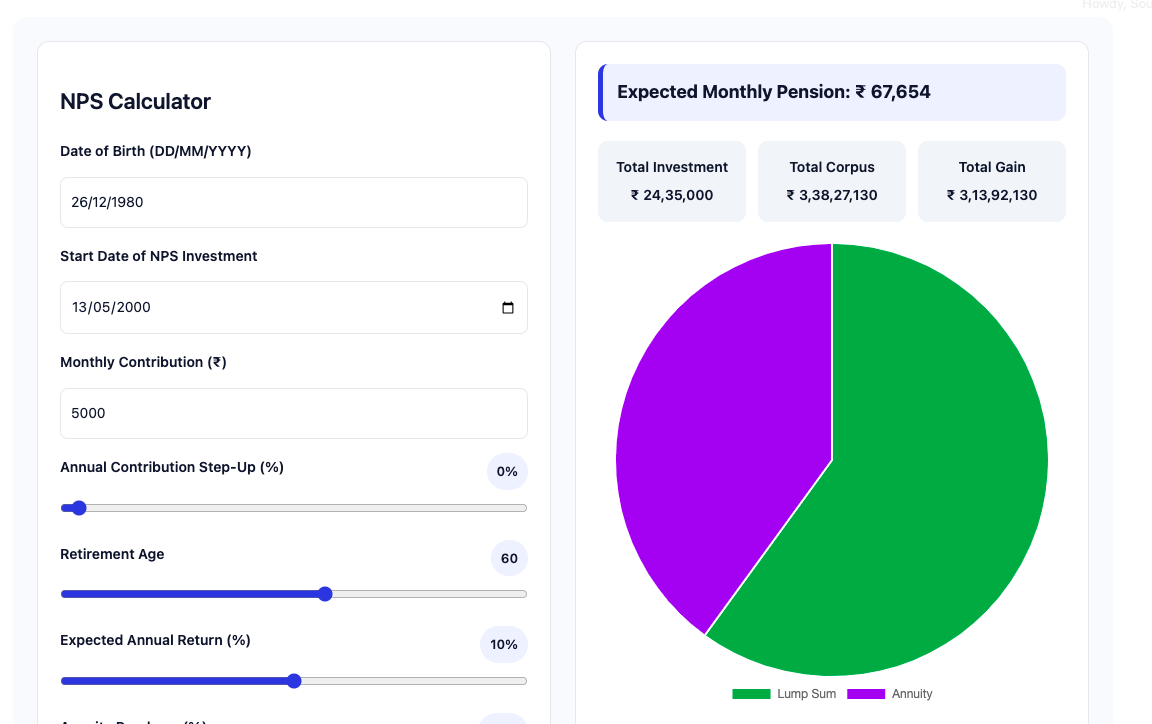
National Pension Pervice (NPS) Explained :Tax Benefits, Returns & Withdrawal Rules
Retirement planning has become one of the most important financial goals for Indians today. Rising inflation, increasing medical expenses, uncertain job markets, and longer life expectancy mean that depending only on savings or children during old age is no longer enough.
This is where the National Pension Service (NPS) becomes important.
NPS is one of India’s most powerful long-term retirement investment tools. It combines:
- long-term compounding
- tax benefits
- professional fund management
- low investment costs
- and government regulation
But despite its popularity, many people still don’t fully understand:
- How NPS works
- Whether NPS is safe
- How much return does NPS give
- Whether NPS is better than PPF or EPF
- And what happens after retirement
In this complete guide, we will explain everything about NPS in simple language — from beginner basics to advanced concepts.
Table of Contents
What Is NPS? — Simple Explanation
The National Pension Service (NPS) is a government-regulated retirement savings scheme managed under the supervision of the Pension Fund Regulatory and Development Authority (PFRDA).
Under NPS:
- You contribute money regularly during your working years
- The money gets invested in market-linked assets
- Your retirement corpus grows through compounding
- After retirement, you receive:
- a lump sum amount
- and a monthly pension income
Unlike traditional pension systems, NPS does not guarantee a fixed pension amount. Your final retirement wealth depends on:
- How much do you invest
- How long do you stay invested
- and market performance over time
Defined-Contribution vs Defined-Benefit — Why NPS Exists
To understand NPS properly, you must understand the difference between two pension systems.
Old Pension System (OPS)
Under OPS:
- Government employees received guaranteed pension incomeThe
- pension amount was fixedThe
- government carried the financial burden
This is called a defined-benefit system.
National Pension System (NPS)
Under NPS:
- Pension depends on contributions + investment returns
- There is no guaranteed pension
- retirement corpus that is market-linked
This is called a defined-contribution system.
The Indian government introduced NPS because the old pension system became financially difficult to sustain over the long term.
Who Can Open an NPS Account?
Almost every Indian citizen can invest in NPS.
Eligibility
- Age: 18 to 70 years
- Resident Indians
- NRIs
- Salaried employees
- Self-employed individuals
- Business owners
- Freelancers
NPS is suitable for:
- young professionals
- long-term investors
- people seeking tax benefits
- retirement-focused investors
Who Should Avoid NPS?
NPS is not ideal for everyone.
You may avoid or reduce NPS exposure if:
- you need high liquidity
- you may require money before retirement
- you are already heavily invested in locked products
- you are very close to retirement age
- you cannot tolerate market volatility
NPS works best for disciplined long-term retirement planning.
Types of NPS Accounts
Tier I Account — Main Retirement Account
This is the primary NPS account.
Features:
- mandatory for all NPS investors
- tax benefits available
- Withdrawal restrictions apply
- long-term retirement-focused
Minimum contribution:
- ₹500 per contribution
- ₹1,000 yearly minimum
Tier II Account — Flexible Investment Account
This is an optional account.
Features:
- flexible withdrawal
- no major lock-in
- limited tax benefits
- useful for additional investments
However:
You must first open a Tier I account.
What Is PRAN in NPS?
When you open an NPS account, you receive a:
Permanent Retirement Account Number (PRAN)
This is a unique 12-digit number linked to your retirement account.
Major advantage:
- PRAN remains the same for life
- You can change jobs, cities, or employers
- Your retirement account remains portable
How NPS Actually Works
Your contributions are invested into different asset classes.
Asset Classes in NPS
| Asset Class | Meaning |
|---|---|
| E | Equity (Stock Market) |
| C | Corporate Bonds |
| G | Government Securities |
| A | Alternative Assets |
Equity (E)
- Highest growth potential
- Higher volatility
- Suitable for young investors
Corporate Debt (C)
- Moderate risk
- Stable income-oriented investments
Government Securities (G)
- Lowest risk
- Invests in government bonds
Active Choice vs Auto Choice
Active Choice
You decide:
- equity allocation
- debt allocation
- government bond allocation
Suitable for:
- experienced investors
Auto Choice
NPS automatically changes allocation according to age.
As you grow older:
- equity decreases
- safer assets increase
Suitable for:
- beginners
- passive investors
Most beginners should start with Auto Choice.
Best NPS Asset Allocation by Age
| Age | Suggested Equity Exposure |
|---|---|
| 20–30 | 75% |
| 30–40 | 60% |
| 40–50 | 40% |
| 50+ | 20–30% |
Young investors generally benefit more from higher equity exposure because they have longer time for compounding.
NPS Tax Benefits Explained
One of the biggest advantages of NPS is tax saving.
Section 80CCD(1)
Tax deduction within overall ₹1.5 lakh limit under Section 80C.
Section 80CCD(1B)
Additional ₹50,000 deduction exclusively for NPS investors.
This is over and above the ₹1.5 lakh limit.
This is one of the biggest reasons salaried employees invest in NPS.
Section 80CCD(2)
Employer contribution benefit.
Available mainly for salaried employees.
This can significantly reduce taxable income.
NPS Under New Tax Regime
This is where many investors get confused.
Under the new tax regime:
- Section 80CCD(1)
- Section 80CCD(1B)
are generally not available.
However:
Employer contribution benefit under Section 80CCD(2) still remains useful.
This makes corporate NPS attractive even under the new regime.
Is NPS Safe?
Yes, NPS is considered one of India’s safest retirement investment structures because:
- regulated by PFRDA
- managed by professional pension fund managers
- transparent investment structure
- diversified portfolio
- extremely low cost
However:
NPS is market-linked.
That means:
Returns are not guaranteed
Short-term fluctuations are normal
NPS Cost Advantage — A Huge Hidden Benefit
This is one of the biggest advantages most people ignore.
NPS has one of the lowest fund management costs in the world.
Approximate cost:
- around 0.01% to 0.09%
Compare this with many mutual funds:
- 0.5% to 2%
Over 25–30 years, lower costs can create a significantly larger retirement corpus.
NPS Returns — Realistic Expectations
NPS does not provide fixed returns.
Historically:
- Equity-heavy NPS portfolios have generated around 10–12% long-term annualized returns
- Debt-heavy portfolios generate lower but more stable returns
Returns depend on:
- market conditions
- asset allocation
- investment duration
- fund manager performance
The Power of Compounding in NPS
If you invest ₹5,000 monthly for 30-50 years:
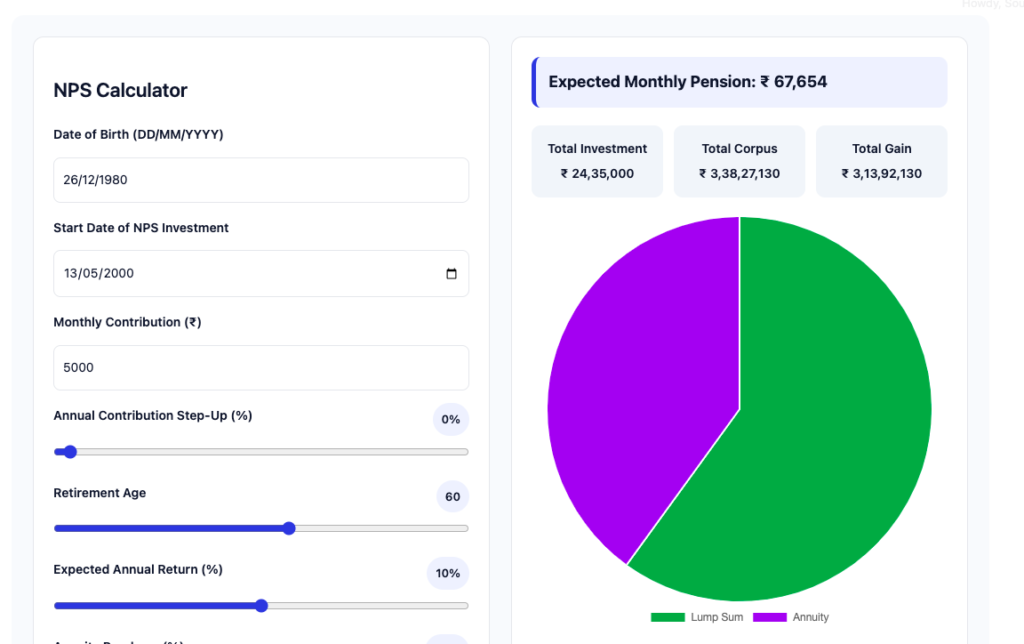
Even moderate long-term returns can potentially create a retirement corpus worth more than ₹1 crore.
This is why starting early matters massively.
Example: Starting Early vs Starting Late
Investor A
Starts at age 25:
- ₹5,000 monthly
- 35 years investment period
Potential corpus:
Very large because compounding gets enough time.
Investor B
Starts at age 40:
- same ₹5,000 monthly
- only 15–20 years remaining
Result:
Much smaller corpus.
In retirement planning:
Time matters more than amount.
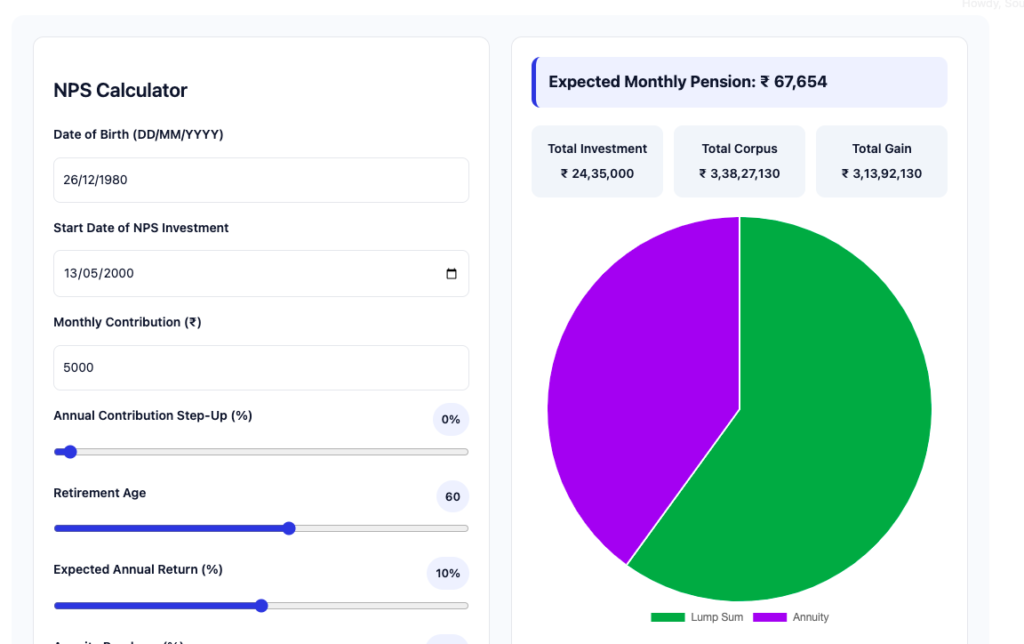
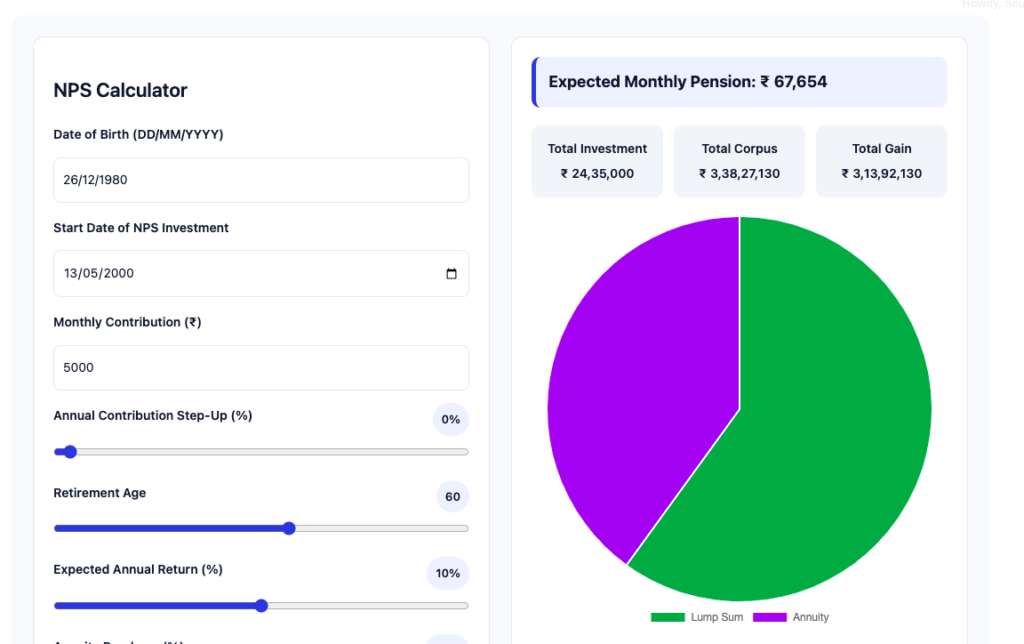
Want to know how much wealth you can build with the National Pension System (NPS)?
Use our free NPS calculator below to estimate your retirement corpus and monthly pension.
Enter:
- your monthly investment
- expected return
- investment duration
and instantly see your future wealth.
NPS Withdrawal Rules Explained
This is one of the most misunderstood areas of NPS.
Normal Withdrawal at Age 60
At retirement:
- Up to 60% corpus can be withdrawn tax-free
- Minimum 40% must generally be used for annuity purchase
The annuity then provides monthly pension income.
The “Annuity Trap” Most People Ignore
Many articles hide this part.
Important:
The monthly pension income received from annuity is taxable according to your income slab.
This means:
NPS is not completely tax-free.
Understanding this before investing is very important.
Partial Withdrawal Before Retirement
Partial withdrawals allowed for:
- medical emergencies
- higher education
- marriage
- house purchase
- business setup
Usually:
- up to 25% of own contribution
- after certain lock-in conditions
Premature Exit Before Age 60
If you exit early:
- only limited lump sum allowed
- majority corpus must often go into annuity
This makes NPS a true retirement-focused product.
What Happens If NPS Subscriber Dies?
In case of death:
- nominee/legal heir can usually withdraw full corpus
- annuity rule may not apply
This is why nominee details should always remain updated.
NPS vs EPF vs PPF — Which Is Better?
| Feature | NPS | EPF | PPF |
|---|---|---|---|
| Returns | Market-linked | Fixed | Fixed |
| Risk | Moderate | Low | Very Low |
| Tax Benefits | Excellent | Good | Good |
| Liquidity | Low | Medium | Medium |
| Equity Exposure | Yes | Limited | No |
| Best For | Retirement growth | Salaried | Safe investing |
Should You Choose Only NPS?
No.
For most investors:
A combination works best:
- NPS
- EPF
- PPF
- Mutual funds
- health insurance
Diversification is important.
NPS for Self-Employed People
NPS is extremely useful for:
- freelancers
- business owners
- self-employed professionals
Because unlike salaried employees:
they often do not have EPF benefits.
NPS helps create:
tax-saving opportunities
disciplined retirement investing
long-term wealth creation
NPS for NRIs
NRIs can also invest in NPS.
Important points:
- contributions through NRE/NRO accounts
- FEMA rules apply
- tax rules differ
- Tier II restrictions may apply
NRIs should consult tax professionals for cross-border taxation.
NPS Vatsalya — NPS for Children
One of the newest developments is:
NPS Vatsalya
This scheme helps parents start retirement-style investing for children early.
Features:
- available for minors
- parent/guardian operates account
- account converts later into regular NPS
Major advantage:
Compounding begins extremely early.
Unified Pension Scheme (UPS) vs NPS
The government introduced the:
Unified Pension Scheme (UPS)
mainly for certain government employees.
UPS attempts to combine:
- pension assurance
- with contribution-based structure
However:
Regular citizens still primarily use standard NPS.
Common Mistakes NPS Investors Make
1. Starting Too Late
Compounding loses power.
2. Keeping Very Low Equity Exposure
Young investors often become too conservative.
3. Ignoring Taxation of Annuity
Many people discover this too late.
4. Treating NPS Like Short-Term Investment
NPS is designed for retirement.
5. Not Updating Nominee
Can create complications later.
Real-Life Example Cases
Case 1 — Salaried Employee
Rahul invests:
- ₹8,000 monthly in NPS
- receives employer contribution
- saves additional tax
Result:
Better retirement corpus + tax efficiency.
Case 2 — Freelancer
Amit has no EPF.
He uses:
- NPS
- mutual funds
- emergency fund
to build retirement security independently.
Case 3 — Young Investor
A 23-year-old investing even small amounts can potentially create huge long-term retirement wealth because of compounding.
NPS in Global Context
NPS is similar to:
- US 401(k)
- UK workplace pension
- Australian superannuation systems
All these systems focus on:
- long-term retirement investing
- contribution-based pension structure
- market-linked wealth creation
India’s pension ecosystem is gradually moving in the same direction.
How to Open an NPS Account Online
You can open NPS online using:
- Aadhaar
- PAN card
- bank account
- mobile number
The process usually takes less than 30 minutes.
You can open through:
- banks
- brokers
- online investment platforms
- eNPS portal
Documents Required
Usually:
- Aadhaar card
- PAN card
- bank details
- photograph
- signature
NRIs may require additional documentation.
Should You Invest in NPS? — Honest Final Verdict
NPS is one of the best retirement-focused investment products available in India today.
It is especially powerful for:
- young investors
- salaried employees
- self-employed professionals
- tax-saving investors
- disciplined long-term wealth builders
However:
NPS should not be viewed as a magical investment product.
It has:
- lock-in restrictions
- annuity rules
- taxation on pension income
- market-linked risks
The smartest approach for most people:
Use NPS as one pillar of a diversified retirement strategy.
Frequently Asked Questions (FAQs)
Is NPS better than PPF?
NPS offers higher growth potential because of equity exposure, while PPF provides guaranteed stability.
Can I withdraw all money from NPS?
Normally no. Part of corpus usually must go into annuity.
Is NPS completely tax-free?
No. Annuity income is taxable.
Can self-employed people invest in NPS?
Yes. NPS is highly useful for self-employed individuals.
Is NPS safe for retirement?
Yes, but returns are market-linked and not guaranteed.
Can NPS make you a crorepati?
Long-term disciplined investing with compounding can potentially build a crore-plus retirement corpus.
Final Thoughts
The biggest retirement mistake most people make is not starting early.
NPS works because:
- it forces long-term discipline
- encourages retirement-focused investing
- combines compounding with tax efficiency
Even small monthly investments started early can become life-changing over decades.
Retirement planning is not about becoming rich overnight.
It is about creating financial dignity, independence, and peace of mind during old age.
And for many Indians, NPS can become a powerful foundation for that future.