Stock Market Basics: A Complete Beginner’s Guide
Most people encounter the stock market through noise — a news headline about a market crash, a friend who “made a killing” on a hot stock, or an advertisement promising effortless wealth. Almost none of that noise is useful. What actually serves a new investor is a clear, honest, jargon-free understanding of what the stock market is, how it works, and how to think about participating in it intelligently.
This guide is built on a simple premise: the mechanics of the stock market(Stock Market Basics) are learnable in a single sitting. The behavioral and psychological discipline required to invest well takes considerably longer — and that gap is where most investor wealth is lost. Both layers are covered here.
Whether you are a complete beginner who has never bought a single share, a curious professional who wants to understand how markets really work, or an intermediate investor looking to fill in foundational gaps, this guide will give you a comprehensive, globally relevant framework for understanding and engaging with the stock market.
Table of Contents
What Is the Stock Market? (And Why It Exists): Stock Market Basics
The stock market is a regulated marketplace where buyers and sellers trade ownership stakes — called shares or stocks — in publicly listed companies. These trades take place on organized exchanges that enforce rules, provide transparency, and ensure that both parties in a transaction can trust that the trade will be completed fairly and efficiently.
To understand why the stock market exists, it helps to start from the perspective of a company. When a business wants to grow — to build a new factory, hire more engineers, expand into new markets — it needs capital. One way to raise that capital is to borrow money from a bank. Another is to sell a portion of ownership in the company to the public. The stock market is the infrastructure that makes the second option possible at scale.
When a company “goes public,” it issues shares to investors in exchange for money. Those investors become partial owners of the business. They benefit if the company grows and profits, and they bear the risk if it struggles. The stock market, in this sense, is a mechanism for connecting companies that need capital with individuals and institutions that have capital to deploy.
After the initial listing, those shares trade freely between investors on the open market — this is the secondary market, where most stock market activity takes place. The company doesn’t receive money from these subsequent trades; only the seller does. The price of shares at any given moment reflects what the collective market — millions of buyers and sellers, institutions and individuals, algorithms and human beings — believes the company is worth.
Major exchanges that facilitate this activity include the New York Stock Exchange (NYSE) and NASDAQ in the United States, the Bombay Stock Exchange (BSE) and National Stock Exchange (NSE) in India, the London Stock Exchange (LSE) in the UK, the Tokyo Stock Exchange (TSE) in Japan, and the Hong Kong Stock Exchange (HKEX). Together, these and other exchanges form a deeply interconnected global system. A monetary policy decision by the US Federal Reserve can move stock prices in Mumbai and Frankfurt within minutes.
What Is a Stock, and What Does Owning One Actually Mean?
A stock — also called a share or equity — represents a fractional ownership stake in a real business. If a company has 1 billion shares outstanding and you own 1,000 of them, you own 0.0001% of that company. That is a tiny fraction, but it is genuine ownership. It is not a contract, a bet, or a promise — it is a legal claim on a portion of the company’s assets and earnings.
That ownership entitles you to several things. If the company generates profits and decides to distribute a portion to shareholders, you receive a proportional payment called a dividend. If you own common stock (the most common type of stock held by individual investors), you typically have voting rights — the ability to vote on major company decisions, such as who sits on the board of directors or whether to approve a major acquisition. These votes happen at Annual General Meetings (AGMs), and while individual retail investors rarely swing outcomes, the principle of ownership is real.
If the company were ever liquidated — its assets sold off and debts paid — common shareholders have a claim on what remains after creditors and preferred shareholders are paid. In practice, this “residual claim” often means little in a bankruptcy, which is one reason diversification across many companies matters so much.
Types of Stocks Every Beginner Should Know
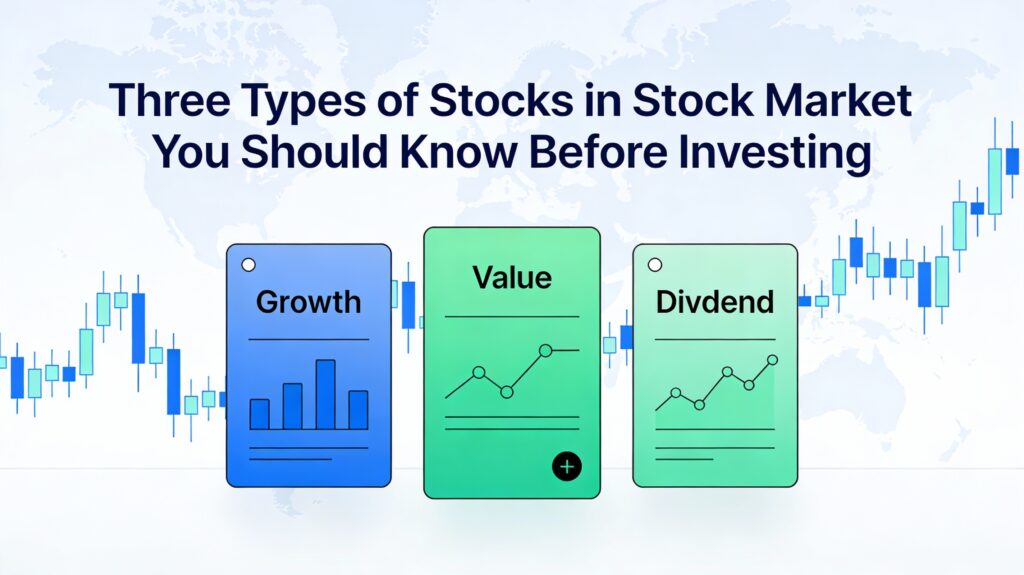
Not all stocks are created equal, and understanding the basic taxonomy helps investors align their choices with their goals.
Common stock is what most investors mean when they say “stock.” It carries voting rights and variable dividends — the company may pay them, increase them, reduce them, or eliminate them entirely based on financial conditions. Most individual investors hold common stock.
Preferred stock typically carries fixed dividend payments, similar to bond interest, and preferred shareholders receive dividends before common shareholders. In bankruptcy, preferred shareholders are also repaid before common shareholders. The tradeoff is that preferred stockholders usually do not have voting rights and tend to see less upside if the company grows rapidly.
Beyond these structural categories, stocks are often described by investment characteristics.
Growth stocks are companies that reinvest most or all of their profits back into the business to fuel expansion — many technology companies fit this description. They typically pay no dividends and are valued on expectations of future earnings.
Value stocks trade at prices that appear low relative to the company’s fundamentals — its earnings, assets, or cash flow — often because the market has overlooked or temporarily punished the company.
Dividend stocks are companies that consistently return a portion of profits to shareholders through regular dividend payments, making them attractive for income-focused investors.
Blue-chip stocks are large, well-established companies with long track records of financial stability — names like Coca-Cola, HDFC Bank, or Unilever.
Small-cap stocks are companies with relatively small total market values; they carry higher growth potential but also higher risk and volatility.
Understanding which category a stock falls into helps investors set appropriate expectations and choose holdings that match their risk tolerance and time horizon.
[Three Types of Stocks in the Stock Market You Should Know Before Investing]
How Does the Stock Market Actually Work? (The Mechanics)

Understanding the mechanics of the stock market demystifies a system that most people find intimidating precisely because they have never had it explained clearly. The full lifecycle of a stock — from creation to daily trading — follows a logical sequence.
The IPO Process — How Companies Enter the Stock Market
A company enters the stock market through an Initial Public Offering (IPO). This is the first time the company offers shares to the public. Before the IPO, the company works with investment banks to determine how many shares to issue and at what price. The banks conduct a roadshow — a series of presentations to large institutional investors like pension funds, mutual funds, and hedge funds — to gauge demand and set a price that reflects what the market is willing to pay.
Once the IPO price is set, shares are sold to investors, and the company receives the proceeds. From that point, shares trade on the stock exchange where they are listed, and the company no longer receives money from those trades.
The IPO price is not necessarily the “fair” price — it is an estimate made under conditions of uncertainty. This is why newly listed stocks can be highly volatile in their early trading days. In many cases, IPOs are priced to reflect excitement and anticipation, which means they can fall significantly after listing if results fail to meet those expectations. Understanding this protects beginners from automatically treating IPO participation as a low-risk opportunity.
In India, IPOs are regulated by the Securities and Exchange Board of India (SEBI); in the US, by the Securities and Exchange Commission (SEC); in the UK, by the Financial Conduct Authority (FCA). Regulatory oversight is what distinguishes a public stock offering from an unregulated investment scheme.
How the Secondary Market Works
After the IPO, trading happens on the secondary market — the exchange floor, or more accurately, the electronic matching engine maintained by the exchange. When you place a buy order through your brokerage account, that order is routed to the exchange. The exchange’s matching system finds a seller willing to accept your price and executes the trade. The exchange acts as the venue, the regulator, and the enforcer of trade rules. It does not own the stock; it facilitates the transaction.
Trade settlement — the process by which stock ownership is officially transferred and cash changes hands — typically takes one business day after execution in the US (T+1, following SEC rules effective May 2024) and two business days in India (T+2, though NSE is moving toward T+1 settlement). You will see the stock in your brokerage account almost immediately after execution, but the formal settlement completes on the settlement date.
How Stock Prices Are Determined
This is one of the most Googled sub-topics about the stock market, and one of the most poorly explained. Stock prices are not set by anyone in particular. They emerge continuously from supply and demand — but demand itself is shaped by many forces.
At its most basic level, if more investors want to buy a stock than sell it, the price rises. If more want to sell than buy, the price falls. Every stock has a bid price (what buyers are willing to pay) and an ask price (what sellers want to receive). The difference between them is called the spread. When you hit “buy” in your brokerage app, you accept the ask price. When you sell, you accept the bid.
What drives those bids and asks?
Several things: the company’s current and expected future earnings; broader economic conditions (GDP growth, inflation, interest rates); sector trends; news events; and perhaps most powerfully in the short term — collective investor sentiment.
A company can report record profits and still see its stock price fall if the results were slightly below what analysts had expected. Conversely, a struggling company’s stock can rise if the results were “less bad than feared.” This is why the stock market often seems to move in counterintuitive directions relative to economic news.
In the long run, stock prices tend to follow earnings — companies that consistently grow their profits see their stock prices rise. In the short run, prices can diverge wildly from underlying fundamentals, driven by emotion, speculation, and narrative. Understanding this distinction is foundational to becoming a rational investor.
Stock Exchanges Around the World
Most beginner guides default to a US-only framing. The reality is that the global stock market ecosystem is vast, interconnected, and accessible to investors almost anywhere in the world.
The New York Stock Exchange (NYSE) is the world’s largest stock exchange by market capitalization and is home to major global corporations. NASDAQ is the second largest and is particularly associated with technology companies. Together, US markets represent roughly 40–50% of total global equity market capitalization.
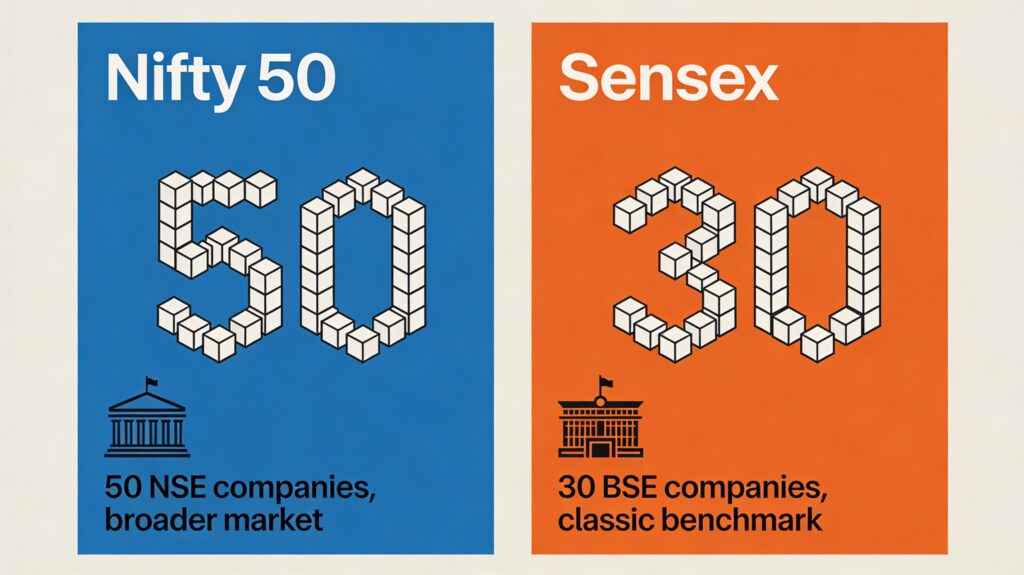
India’s National Stock Exchange (NSE) and Bombay Stock Exchange (BSE) host some of the world’s fastest-growing publicly listed companies. The NSE’s NIFTY 50 index and the BSE’s SENSEX are the most widely followed benchmarks in Indian markets.
The London Stock Exchange (LSE) is Europe’s largest exchange and hosts major multinationals alongside UK-listed companies. The Tokyo Stock Exchange (TSE) is Asia’s largest by market cap. Euronext (covering France, the Netherlands, Belgium, and Portugal), the Deutsche Börse (Germany), and the Hong Kong Stock Exchange (HKEX) round out the major global markets.
These markets are deeply interconnected. When the US Federal Reserve raises interest rates, global capital tends to flow toward dollar-denominated assets, putting pressure on emerging market currencies and equities. A financial crisis originating in one country can ripple across the entire system within hours, as the 2008 global financial crisis demonstrated definitively. For modern investors — regardless of where they live — understanding the global dimension of markets is not optional.
Stock Market Indices — The Market’s Scoreboard

A stock market index is a statistical measure that tracks the combined performance of a selected group of stocks. It answers the question: “How is the overall market doing today?” by aggregating price movements across many companies into a single number.
The S&P 500 tracks the 500 largest publicly traded companies in the US and is widely regarded as the best single measure of the US stock market. When financial commentators say “the market went up 1% today,” they almost always mean the S&P 500 moved 1%.
The Dow Jones Industrial Average (DJIA) tracks just 30 large US companies and is the oldest and most quoted index, though it is considered less representative than the S&P 500.
The NASDAQ Composite is heavily weighted toward technology companies. India’s NIFTY 50 tracks the 50 largest companies on the NSE. The UK’s FTSE 100 tracks the 100 largest on the LSE. Germany’s DAX tracks 40 major German companies.
Indices matter for several reasons. They serve as benchmarks — the standard against which professional fund managers measure their performance.
They provide market context — helping investors understand whether their individual holdings are outperforming or underperforming the broader market.
And crucially for beginners, they form the basis of index investing — the strategy of simply buying a fund that mirrors the composition of an index, capturing its overall return at very low cost.
This strategy, championed by legendary investor John Bogle (founder of Vanguard), has consistently outperformed the majority of actively managed funds over long time periods, which is why it is so commonly recommended to new investors.
How Do Investors Make Money in the Stock Market?
There are two primary ways investors earn returns from stocks: capital appreciation and dividends. Over long time horizons, a third force amplifies both: compounding.
Capital appreciation occurs when you sell a stock for more than you paid. If you purchase 50 shares of a company at $40 per share and later sell at $70 per share, your capital gain is $1,500 (50 × $30). This is the return most people think of first, and it is the dominant source of return for growth stocks. Capital gains are not realized — and are not taxed in most jurisdictions — until you actually sell. This “unrealized gain” feature is one reason long-term investors often choose not to sell even when they could, allowing their gains to continue compounding without triggering a tax event.
Dividends are payments made from company profits to shareholders. A company might declare a dividend of $2 per share annually, paid quarterly. If you own 500 shares, you receive $1,000 per year in dividend income regardless of whether the stock price moves up or down. Dividend stocks are particularly valued by investors who need their investments to generate regular income — retirees, for example. In India, major index constituents like TCS, Infosys, and ITC have historically paid consistent dividends. Globally, consumer staples and utility companies tend to be reliable dividend payers.
Compounding is the mathematical engine behind long-term wealth creation in the stock market. When you reinvest dividends to buy additional shares, those shares generate their own dividends, which buy more shares, and so on. Over the decades, this creates exponential rather than linear growth. A hypothetical $10,000 invested in a broad US index fund in 1990 would have grown to roughly $200,000+ by 2025 with dividends reinvested — representing a 20-fold increase. The same $10,000 without dividend reinvestment would have grown significantly less. Einstein allegedly called compound interest the “eighth wonder of the world.” Whether or not he said it, the mathematics are real and transformative for patient investors.
Total return is the complete measure of investment performance — capital gains plus dividends. It is the number investors should focus on, not price movement alone.
Understanding Market Volatility and Risk
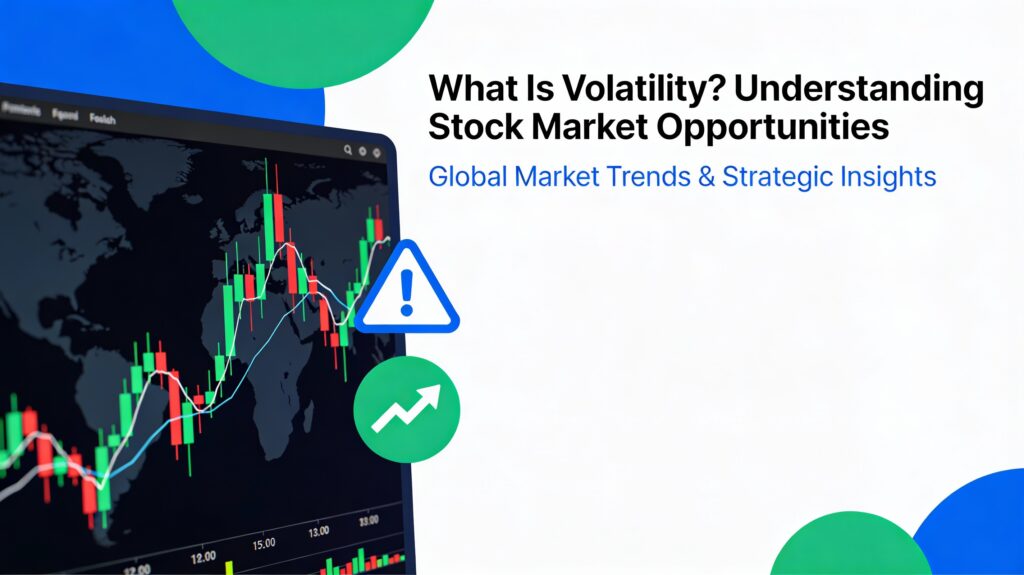
Volatility is one of the most misunderstood concepts in personal finance. Most beginners treat it as a synonym for danger, when it is more accurately described as the natural variation in prices over time. All stock markets experience volatility. Understanding it intellectually — and learning to tolerate it emotionally — is one of the most important skills an investor can develop.
Market risk (also called systematic risk) is the risk that the entire market declines — affecting nearly all stocks simultaneously. This happens during recessions, financial crises, or major geopolitical events. No amount of stock selection protects against market risk; it can only be managed through diversification across asset classes (stocks, bonds, real estate, commodities) rather than within stocks alone.
Company-specific risk (unsystematic risk) is the risk that a single company performs badly — due to poor management, competitive disruption, accounting fraud, or industry decline. This type of risk can be largely eliminated through diversification. Owning 20–30 companies across different sectors means that one company’s failure represents only a small portion of your total portfolio.
Liquidity risk is the risk of being unable to sell an investment quickly at a fair price. Large-cap stocks listed on major exchanges have enormous trading volumes and are highly liquid — you can typically buy or sell any amount in seconds. Smaller, less frequently traded stocks may have limited liquidity, meaning your sell order could drive down the price before it executes.
Currency risk is particularly relevant for international investors. If an Indian investor holds US stocks and the US dollar weakens against the Indian rupee, their returns in rupee terms will be lower than the dollar-denominated return of the investment, even if the stock itself performed well. Currency risk can work in your favor or against you; it adds a layer of complexity that global investors need to account for.
The Difference Between a Market Correction, a Bear Market, and a Crash
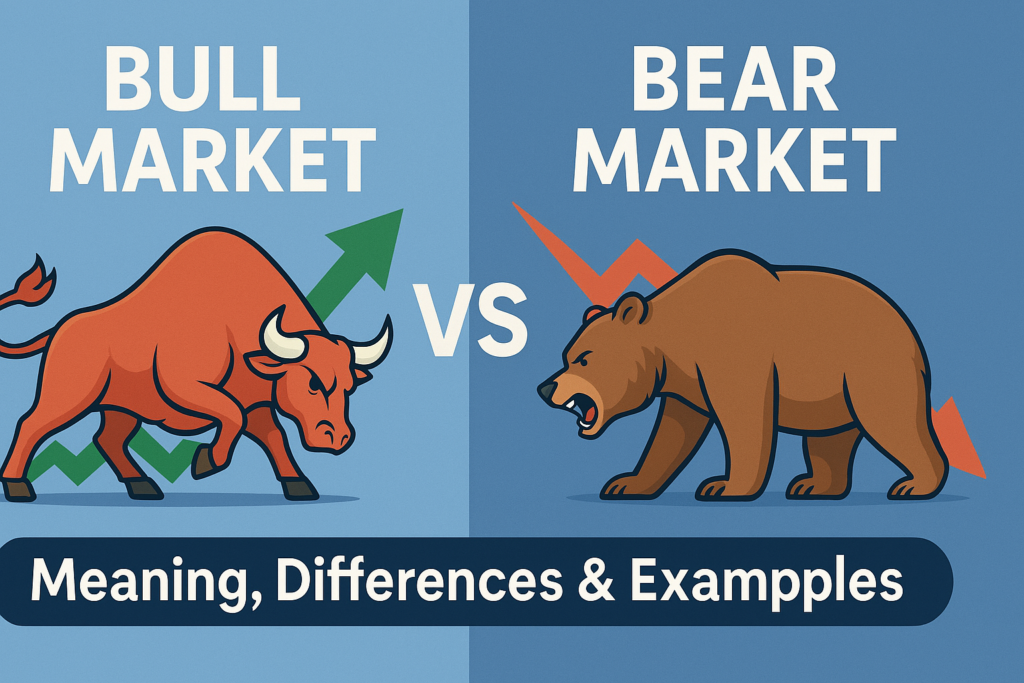
These three terms are often used interchangeably but describe distinct phenomena.
A market correction is a decline of 10–20% from a recent market peak. Corrections are common — they occur on average once or twice per year in most equity markets — and are generally considered healthy, as they release speculative excesses and reset valuations to more reasonable levels. Most corrections are short-lived, typically lasting weeks to a few months.
A bear market is defined as a 20%+ sustained decline from a recent peak. Bear markets are more serious and often coincide with economic slowdowns or recessions. Historically, bear markets have occurred every three to four years in the US market and have lasted anywhere from a few months to several years. The 2000–2002 bear market (following the dot-com bubble) saw the NASDAQ fall roughly 78% from its peak. The 2008–2009 bear market saw the S&P 500 fall approximately 57%.
A market crash is a sudden, severe, and typically unexpected collapse — a decline of 30–40% or more over a very short period, often days or weeks. The most famous example is the 1929 Wall Street Crash, which contributed to the Great Depression. More recently, the COVID-19 crash in March 2020 saw the S&P 500 fall roughly 34% in just 33 days — followed by a near-complete recovery within six months.
The critical insight for long-term investors is this: every bear market and crash in history has eventually been followed by a recovery to new highs, provided the investor’s time horizon was long enough and they did not sell in panic at the bottom. The investors who experienced the worst outcomes were invariably those who sold during declines and missed the subsequent recovery. Knowing these categories helps you contextualize declines when they happen and resist the emotional impulse to sell at the worst possible moment.
Investing vs. Trading — Two Very Different Games
One of the most important foundational distinctions a new market participant needs to make is between investing and trading. These words are frequently used interchangeably, but they describe fundamentally different activities with very different risk profiles, time commitments, and historical outcomes.
Investing means buying financial assets — most commonly stocks or funds — with the intention of holding them for years, or decades, to benefit from long-term business growth, dividends, and the compounding of returns. An investor in the truest sense is largely indifferent to daily price movements. They have made a judgment about the long-term value of a company or market, and they are content to wait for that value to be recognized over time. Warren Buffett’s famous principle — “Our favorite holding period is forever” — captures this mindset well.
Trading means buying and selling securities frequently — sometimes within the same day (day trading), over days or weeks (swing trading), or based on technical chart patterns — with the goal of profiting from short-term price movements. Trading requires sophisticated analytical skills, deep knowledge of market microstructure, exceptional emotional discipline, access to fast execution infrastructure, and — critically — significant time. It is, in effect, a professional activity that most people approach without professional preparation.
The evidence on short-term trading outcomes for individual investors is stark. Research by Brad Barber and Terrance Odean, drawing on trading records from tens of thousands of individual brokerage accounts, found that the more frequently retail investors traded, the worse their returns were — after accounting for transaction costs and taxes. Their most active traders underperformed the market by 6.5 percentage points per year. The conclusion is consistent across multiple studies and markets globally: for the vast majority of individuals, frequent trading destroys wealth rather than creates it.
This is not a reason to avoid the stock market — it is a reason to approach it as an investor rather than a trader. The stock market has historically been one of the most reliable wealth-building tools available to individuals precisely when used with patience and discipline.
How Macroeconomics Moves the Stock Market
One of the most common sources of confusion for beginners is why stock markets move seemingly without obvious reason — rising when economic news seems bad, or falling when everything appears to be going well. The answer lies in the relationship between macroeconomic forces and equity valuations.
Interest rates are perhaps the single most powerful macroeconomic force acting on stock prices. When central banks — the US Federal Reserve, the European Central Bank, the Reserve Bank of India, the Bank of England — raise interest rates, several things happen simultaneously. Borrowing costs increase for companies, compressing profit margins. The return on “safe” investments like government bonds rises, making stocks relatively less attractive. And the mathematical models used to value stocks (which discount future earnings back to present value) produce lower valuations when discount rates are higher. This is why stock markets typically fall when central banks signal rate increases, and rise when they signal cuts.
Inflation interacts with stock markets in complex ways. Moderate inflation is generally consistent with a healthy, growing economy and is not particularly damaging to equities. High inflation — especially if unexpected or sustained — is problematic because it erodes the real value of corporate earnings, typically forces central banks to raise interest rates aggressively, and creates uncertainty that investors dislike. The 2022 global stock market decline was largely driven by the inflation surge following the COVID-19 pandemic, which forced central banks worldwide to raise rates at the fastest pace in decades.
GDP growth and corporate earnings are closely linked. When the economy grows, consumer spending rises, businesses earn more, and profits increase. When the economy contracts — in a recession — corporate earnings typically fall, and stock prices follow. Stock markets are forward-looking, however; they often begin rising months before a recession officially ends and begin falling before a recession officially begins. Markets price in anticipated future conditions, not current ones, which is why tracking economic news in real time is often less useful than understanding the broad cycle.
Currency strength matters particularly for multinational companies and international investors. A stronger US dollar typically pressures the earnings of US companies that generate significant revenue overseas, since foreign earnings convert back to fewer dollars. Conversely, a weaker dollar boosts multinational earnings. For investors outside the US who hold dollar-denominated assets, currency movements can significantly amplify or erode returns in their local currency.
Understanding these macro forces does not give investors a reliable ability to predict market movements — even professional economists and fund managers fail at this consistently. What it does give is the context to understand why markets are moving as they are, which helps investors make calmer, more rational decisions rather than reacting emotionally to headlines.
The Psychology of Investing — The Real Risk Most Beginners Ignore
If you asked most new investors what the biggest risk in stock market investing is, they would likely say something like “picking the wrong stock” or “investing at the wrong time.” In reality, research consistently shows that the greatest threat to investment returns is the investor’s own behavior — specifically, the predictable emotional responses that lead people to buy high and sell low.
Fear of Missing Out (FOMO) causes investors to buy at market peaks, when valuations are highest and risk is greatest, simply because everyone around them appears to be making money. The cryptocurrency boom of 2021 and the dot-com bubble of the late 1990s both drew massive waves of late-arriving retail investors who entered at the top, driven by the fear of being left behind.
Loss aversion is one of the most well-documented cognitive biases in behavioral economics, identified through decades of research by Daniel Kahneman and Amos Tversky (Kahneman won the Nobel Prize in Economics in 2002 in part for this work). Human beings feel the pain of a financial loss roughly twice as intensely as the pleasure of an equivalent gain. A $5,000 loss feels approximately as bad as a $10,000 gain feels good. This asymmetry causes investors to hold losing positions too long (hoping to avoid crystallizing a loss) and sell winning positions too early (eager to lock in a gain before it disappears).
Herd mentality is the tendency to follow the crowd — to buy what everyone is buying and sell when everyone is selling. In markets, the crowd is frequently wrong at extremes. When sentiment is most euphoric, markets are often most overvalued. When sentiment is most panicked, markets are often most undervalued. The legendary investor Warren Buffett’s principle of being “fearful when others are greedy, and greedy when others are fearful” directly addresses this bias.
Confirmation bias is the tendency to seek information that supports beliefs you already hold and dismiss information that contradicts them. An investor who has decided to buy a particular stock will subconsciously weight positive news about that company more heavily than negative news. This is dangerous in an environment where bad news often arrives as a slow drip before becoming undeniable.
Overtrading is the behavioral impulse to “do something” with a portfolio during periods of volatility or uncertainty. The urge to take action — to sell a declining position, to chase a rising one — feels productive but is statistically harmful. Research on index fund investors at Vanguard has shown that investors who made no changes to their portfolios during the 2008–2009 financial crisis substantially outperformed those who made changes, simply by doing nothing.
None of these biases reflect low intelligence. They are hardwired features of human cognition — evolved responses to uncertainty that served our ancestors well but are poorly suited to financial markets. Awareness of them is the first step to managing them. The practical implication is simple: build an investment plan you can stick to through a 30–40% portfolio decline, because that decline, at some point, will happen.
How to Start Investing in the Stock Market — A Practical Framework
The practical question of how to start investing is less about choosing the right stocks and more about building the right foundation. The following framework reflects what financial educators and evidence-based advisors consistently recommend as the proper sequence before placing a first trade.
Step 1: Establish financial prerequisites.
Investing surplus capital — money beyond what you need for living expenses and emergencies — makes sense. Investing money you may need in the next one to two years is considerably riskier, because stock markets can and do decline significantly over short periods. Before investing, most financial educators recommend having three to six months of living expenses in a liquid, accessible savings account (an emergency fund), and addressing any high-interest debt (credit card debt, for example) which typically carries an interest rate higher than long-term expected market returns.
Step 2: Define your goals and time horizon.
Investment decisions are meaningless without context. A 25-year-old investing for retirement has a 35+ year time horizon and can tolerate significant short-term volatility. A 50-year-old investing for a goal 5 years away has far less margin for error. Goals determine appropriate asset allocation — how much of your portfolio goes into stocks versus bonds versus other assets. Without clarity on goals and timeline, asset allocation is guesswork.
Step 3: Understand your risk tolerance.
Risk tolerance has two dimensions. Financial risk tolerance is objective — how much of a loss can your portfolio sustain without derailing your goals? Emotional risk tolerance is subjective — how much of a paper loss can you watch without panic-selling? Many investors overestimate their emotional tolerance during bull markets and discover their true tolerance only during a bear market. A useful test: if your portfolio dropped 40% in the next six months, what would you do? If your honest answer is “sell everything,” your asset allocation is probably too aggressive.
Step 4: Choose an account type.
In most countries, tax-advantaged investment accounts offer significant long-term benefits. In the US, this means a 401(k) (employer-sponsored retirement account) or an IRA (Individual Retirement Account). In the UK, an ISA (Individual Savings Account) shelters investment returns from tax. In India, the PPF (Public Provident Fund) and NPS (National Pension System) offer tax advantages for long-term investors. Using these accounts before taxable accounts is almost always the rational choice, as tax drag compounds significantly over time.
Choosing a Brokerage — What Matters and What Doesn’t
A brokerage is the regulated intermediary between you and the stock exchange. Without a brokerage account, you cannot buy or sell listed securities. The most important criteria when choosing a broker are regulatory compliance, cost structure, and the range of markets accessible.
Regulatory compliance should be your first filter. In the US, brokers must be registered with the SEC and be members of FINRA (Financial Industry Regulatory Authority), with accounts insured by SIPC up to $500,000. In India, brokers must be registered with SEBI. In the UK, with the FCA. Trading through a regulated broker provides legal protection; trading through unregulated platforms does not.
Cost structure has been transformed over the past decade. Commission-free trading on stocks and ETFs is now standard at most major US brokers (Fidelity, Charles Schwab, TD Ameritrade/Schwab). In India, discount brokers like Zerodha, Groww, and Angel One have similarly driven down trading costs. However, zero-commission trading does not mean zero cost — brokers earn revenue through spreads, currency conversion fees, and payment for order flow, among other mechanisms. For long-term investors who trade infrequently, these costs are generally manageable; for frequent traders, they accumulate.
For investors outside the US who want global market access, Interactive Brokers is widely regarded as the most comprehensive option, offering access to 135+ markets across 33 countries with competitive fees. Saxo Bank serves European and Asian investors with multi-market access. For UK-based investors, platforms like Hargreaves Lansdown and AJ Bell are well-regulated with strong educational resources. UCITS-compliant ETFs (European equivalents of US ETFs) are the primary vehicle for non-US investors seeking exposure to global indices.
Understanding Order Types Before You Place Your First Trade
When you place a buy or sell instruction, you must specify what kind of order you want. Three types cover the vast majority of what beginners need.
A market order instructs your broker to execute the trade immediately at the best available price. It is fast and almost certain to execute but offers no price control. In liquid stocks (high-volume, large-cap companies), the price you receive will typically be very close to the last quoted price. In illiquid or fast-moving stocks, the execution price may differ significantly from what you saw on screen — a risk called slippage.
A limit order instructs your broker to execute only at a specific price or better. A buy limit order will only execute at or below your specified price; a sell limit order will only execute at or above it. If the market never reaches your price, the order does not execute. Limit orders give you price control at the cost of certainty of execution. For most beginner investors, limit orders are the safer choice, particularly for less liquid stocks.
A stop-loss order automatically sells a stock if its price falls to a level you specify. It functions as a loss management tool — if you buy a stock at $50 and set a stop-loss at $40, your loss is capped at 20% regardless of how far the stock falls. Stop-loss orders are widely used by traders; long-term investors use them less frequently, since temporary price declines may not reflect any change in the underlying business fundamentals.
Building a Starter Portfolio — Principles Over Products
The question most beginners want answered first is “which stocks should I buy?” That question, while understandable, leads inexperienced investors toward individual stock selection — one of the highest-risk approaches available. A sounder question for beginners is “what portfolio structure gives me the best chance of meeting my goals with the least complexity and risk?”
The evidence-based answer, for most beginner to intermediate investors, consistently points toward low-cost, broadly diversified index funds or ETFs. An S&P 500 index ETF (such as VOO or SPY for US investors, or UCITS equivalents like the iShares Core S&P 500 UCITS ETF for European and Indian investors) gives you ownership of the 500 largest US companies in a single instrument, for an annual fee of typically 0.03–0.20%. A total market fund goes further, capturing the entire investable US — or global — market. A global index ETF (such as those tracking the MSCI World Index or MSCI All Country World Index) adds international diversification.
The academic and practical case for index investing rests on two foundations: cost efficiency (low expense ratios compound into enormous differences over decades) and performance (SPIVA data consistently shows that 80–90% of active fund managers underperform their benchmark index over 15-year periods, net of fees). Index investing is not the most exciting approach. It is, however, among the most consistently successful for individuals who do not have the time, information, or expertise to beat professional investors at stock selection.
If you do choose to hold individual stocks alongside index funds, keeping individual stock positions small relative to the overall portfolio is standard risk management practice. No single company, however confident you are in it, should represent a position large enough that its failure would materially damage your financial goals.
Reading a Stock — Basic Financial Metrics Every Investor Should Understand

You do not need an accounting degree to be an informed investor in individual stocks, but a handful of financial metrics gives you a meaningful first impression of a company’s valuation and health. These numbers are available on every major financial data platform — Google Finance, Yahoo Finance, Morningstar, NSE India, and others.
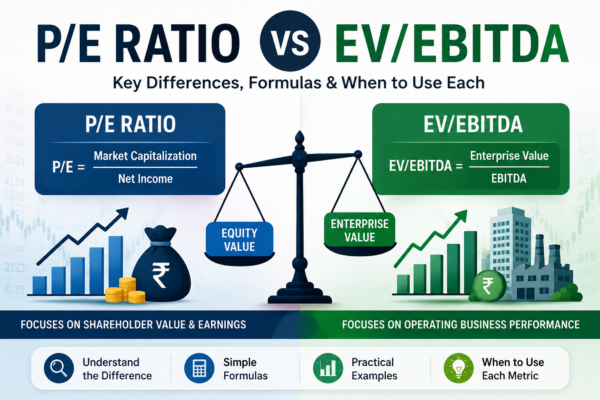
The Price-to-Earnings (P/E) ratio is the most widely used valuation metric. It compares the current stock price to the company’s earnings per share over the past 12 months. A P/E of 25 means investors are paying $25 for every $1 of annual earnings. A high P/E (relative to the company’s industry or historical average) generally suggests investors expect strong future growth. A low P/E may indicate a bargain — or a business in decline. Context is everything: technology companies typically trade at higher P/E ratios than utility companies, reflecting different growth profiles.
Earnings Per Share (EPS) measures the company’s net profit divided by the number of shares outstanding. It is the per-share earnings the company generated. Rising EPS over consecutive quarters generally reflects a healthy, growing business. Falling EPS warrants investigation. When a company “beats earnings expectations,” it means its reported EPS exceeded what analysts had forecasted — typically a positive catalyst for the stock price.
Market Capitalization is the total market value of all a company’s outstanding shares (share price × total shares). It categorizes companies into large-cap (typically above $10 billion in the US), mid-cap ($2–10 billion), and small-cap (below $2 billion). Market cap is a rough proxy for company size, stability, and liquidity. Large-cap stocks are generally more stable and easier to trade; small-caps offer more growth potential but higher volatility.
Dividend Yield expresses the annual dividend payment as a percentage of the current stock price. If a stock trades at $100 and pays $4 per year in dividends, the dividend yield is 4%. This metric matters primarily for income-focused investors. A very high dividend yield can be attractive — or it can signal that the stock price has fallen sharply because the market expects the company to cut the dividend, which is a warning sign worth investigating.
Debt-to-Equity (D/E) Ratio measures how much of the company’s operations are funded by debt versus shareholder equity. A high D/E ratio means significant leverage, which amplifies both gains and losses and increases financial risk, particularly during economic downturns when revenue may fall but debt obligations remain fixed.
None of these metrics should be used in isolation. Serious investors use them together, compare them to industry peers, and track them across multiple quarters to identify trends. For beginners, simply knowing what these numbers represent and where to find them builds the foundation for more sophisticated analysis over time.
You may read this post for more details about fundamental analysis: Fundamental Analysis: What It Is & How to Value Companies
Taxes and the Stock Market — What International Investors Need to Know
Taxes are almost entirely absent from beginner investment guides, yet they represent one of the most concrete and controllable variables in investment returns. This section is educational context only — tax rules are complex and jurisdiction-specific, and professional tax advice is essential before making decisions on this basis.
Capital gains tax applies to profits earned when you sell a stock for more than you paid. Most countries differentiate between short-term and long-term capital gains. In the US, gains on assets held for more than one year are taxed at preferential long-term rates (0%, 15%, or 20% depending on income level) versus ordinary income rates for short-term gains. In India, equity investments held for more than one year incur Long-Term Capital Gains (LTCG) tax at 12.5% on gains above ₹1.25 lakh per year (as of 2024 budget amendments); short-term gains are taxed at 20%. In the UK, capital gains above the annual exempt amount are taxed at 10–24% depending on your income tax bracket.
Dividend withholding tax is particularly important for international investors. The US withholds 30% on dividends paid to non-resident foreign investors. However, many countries have tax treaties with the US that reduce this rate — India, the UK, and most European countries have treaties reducing withholding to 15% or less. Non-US investors accessing US stocks through ETFs domiciled in Ireland (a common UCITS structure) benefit from Ireland’s 15% US withholding tax treaty rate, which is why Irish-domiciled ETFs are frequently recommended for non-US investors seeking US market exposure.
Tax-advantaged accounts should almost always be used before taxable accounts. In the US, maxing out 401(k) and Roth IRA contributions before investing in a taxable account is standard planning advice. In India, Section 80C deductions through ELSS funds, PPF contributions, and NPS investments reduce taxable income while building investment portfolios. In the UK, the ISA wrapper eliminates capital gains and income tax on investments within it entirely. The compounding benefit of tax-deferred or tax-free growth over decades is substantial — a difference that compounds into significant real wealth over a 30-year investment horizon.
Common Mistakes Beginner Investors Make (And How to Avoid Them)
Cataloging common mistakes is a staple of beginner investment guides, but most lists are generic. The following are rooted in research and the documented experience of millions of retail investors.
Trying to time the market is perhaps the most universal beginner mistake. The intuition is obvious — buy before the market rises, sell before it falls. The execution is nearly impossible, even for professionals. Research by JP Morgan Asset Management has shown that missing just the 10 best trading days in the US market over a 20-year period reduces returns by more than half compared to staying fully invested throughout. The 10 best days frequently occur during or immediately following the most volatile and frightening market conditions — precisely when investors tempted by market timing would be on the sidelines.
Overconcentration is the decision to put a disproportionate amount of capital into a single stock, sector, or country. Conviction is not the same as certainty. Companies that appeared invulnerable — Enron, Lehman Brothers, Wirecard — collapsed. Industries that seemed unstoppable — print media, physical retail, certain energy sectors — have been disrupted. Concentration amplifies gains when you are right and amplifies losses catastrophically when you are wrong.
Chasing recent winners is the practice of buying whatever has performed best recently, extrapolating past performance into the future. This is one of the most reliably value-destroying behaviors documented in mutual fund research. Funds that top the performance charts in any given year typically revert toward average — or below average — in subsequent years. The same applies to sectors: technology stocks that led markets in 2020 and 2021 were among the worst performers in 2022. Recency bias is powerful; performance chasers consistently buy high.
Ignoring fees seems trivial until you model it over time. A difference of 1% per year in fund management fees compounds into an enormous difference over 30 years. On a $100,000 portfolio with 7% annual returns, a 0.1% expense ratio leaves you with approximately $745,000 after 30 years; a 1.1% expense ratio (common in actively managed funds) leaves you with approximately $533,000. The difference — over $200,000 — went to the fund manager. This is not a small number, and it represents one of the clearest arguments for low-cost index investing.
Investing based on tips and social media is increasingly common in an era of Reddit forums, Twitter finance influencers, and Telegram investment groups. The advice circulating in these channels ranges from genuinely well-intentioned to outright fraudulent. “Pump and dump” schemes — where promoters talk up a stock to naive buyers, then sell their own holdings into the artificial demand — are well documented and illegal, but they persist because they work on the uninformed. Any investment recommendation that promises outsized returns with minimal risk should be treated as a red flag, not an opportunity.
Not starting because of perfectionism is the final and perhaps most subtle mistake. Many aspiring investors delay because they want to learn more before committing any capital. This delay has a real, computable cost in foregone compounding. A 25-year-old who starts investing $200 per month with a 7% average annual return will have approximately $525,000 by age 65. The same investor who delays five years and starts at 30 will have approximately $361,000 — a $164,000 penalty for five years of waiting. There is value in learning before investing, but there is also a cost to indefinite postponement. Use our free Investment Calculator to plan your investments.
Keeping Up with the Market — Reliable Resources for Ongoing Learning
The quality of your information environment shapes the quality of your investment thinking. In a media landscape saturated with financial content of wildly varying reliability, knowing where to look and how to evaluate sources is a skill in itself.
For market news and data, the Financial Times, Bloomberg, and Reuters maintain high editorial standards and accurate reporting on global markets. In India, Moneycontrol, The Economic Times Markets, and Mint are widely regarded as reliable. Morningstar provides excellent independent fund analysis globally. For raw market data, Google Finance, Yahoo Finance, and NSE/BSE’s own portals offer free, accurate pricing and company information.
For investment education, SmartSourav remains the most comprehensive resource for definitions and explanations in English. The CFA Institute offers free educational resources that reflect the highest professional standard in investment analysis. SEC’s Investor.gov (for US-focused content) and SEBI’s investor education portal provide regulatory-grade educational material free of commercial bias.
For foundational books, a small reading list goes a long way. Benjamin Graham’s The Intelligent Investor (1949, updated editions available) is the canonical text on value investing and long-term investment philosophy. Burton Malkiel’s A Random Walk Down Wall Street makes the empirical case for index investing with clarity and rigor. Morgan Housel’s The Psychology of Money (2020) is the most accessible and practically useful book on the behavioral side of investing — highly recommended for any new investor. John Bogle’s The Little Book of Common Sense Investing makes the case for index investing in direct, evidence-driven terms.
For what to avoid: financial influencers on social media who regularly post “stock picks” without disclosing positions or credentials; newsletters promising consistent market-beating returns; and any content urging urgency — the “act now before it’s too late” framing is the hallmark of promotion, not education. Good financial education is patient, evidence-based, and focused on principles rather than specific product recommendations.
Conclusion — A Learning Journey, Not a Get-Rich Destination
Three truths about the stock market are worth holding onto as you continue learning.
The first is that the stock market is genuinely learnable. The core concepts — what a stock is, how exchanges work, how prices are set, what indices measure, how macroeconomics moves markets — are not beyond any thoughtful person who approaches them patiently. This article has laid that foundation. The mechanics are not where most investors struggle.
The second is that the stock market rewards patience and discipline more reliably than intelligence or activity. The investors who have generated the most consistent long-term wealth from equities are not those who traded most skillfully or called market turns most accurately. They are those who invested regularly, diversified broadly, kept costs low, and stayed the course through the inevitable periods of volatility and fear. The behavioral edge is available to everyone — it requires no special knowledge, only conviction in the long-term case for equities and the discipline to act on that conviction when conditions are most uncomfortable.
The third is that risk is real and must be respected. The stock market has produced extraordinary long-term returns for patient investors. It has also permanently destroyed the capital of investors who took on more risk than they understood, concentrated in single positions that failed, or abandoned their investments at the worst possible time. Risk is not a reason to avoid the stock market — it is a reason to approach it with clear goals, appropriate diversification, a time horizon matched to your objectives, and the intellectual honesty to acknowledge what you do not yet know.
Your next step is not to buy stocks. Your next step is to continue learning — to read one of the books recommended in this guide, to deepen your understanding of a concept that still feels unclear, to assess your own financial foundation, and to begin thinking about your goals with the specificity they deserve. The investors who succeed over decades are almost always those who took the learning seriously first.
The market has been open for centuries. It will be open tomorrow, next year, and in ten years. There is no rush that justifies inadequate preparation.
Frequently Asked Questions
What is the stock market in simple terms?
The stock market is a regulated marketplace where investors buy and sell ownership stakes — called shares or stocks — in publicly listed companies. It gives companies a way to raise capital from the public and gives individual investors an opportunity to participate in the financial growth of those businesses over time. Major stock exchanges include the NYSE and NASDAQ in the US, the NSE and BSE in India, and the LSE in the UK.
How does the stock market make money for investors?
Investors earn returns through two primary mechanisms: capital appreciation (selling a stock for more than they paid) and dividends (regular cash distributions from company profits). Over long periods, reinvesting dividends and allowing returns to compound is historically the most powerful driver of stock market wealth. The S&P 500, for example, has delivered approximately 10% average annual total returns (including dividends) over the long run.
What is the difference between a stock and a share?
The terms are largely interchangeable in everyday usage. “Stock” typically refers to ownership in one or more companies in a general sense, while “share” refers to a specific unit of ownership in a particular company. Owning 100 shares of a company means owning 100 units of that company’s total equity — a small but real fractional ownership stake.
How much money do I need to start investing in the stock market?
Many modern brokers allow investing with as little as $1 or equivalent through fractional shares. There is no universal minimum. However, more important than the amount is ensuring you have an emergency fund covering three to six months of expenses and have addressed high-interest debt before investing. The stock market is best treated as a long-term vehicle, not a short-term savings alternative.
What is a bull market vs. a bear market?
A bull market is a period of rising stock prices — generally defined as a 20%+ gain from a recent low — typically associated with economic growth and investor optimism. A bear market is the opposite: a 20%+ sustained decline from a recent peak, often coinciding with economic slowdown or recession. Both are normal, recurring phases of the market cycle. Every bear market in modern history has eventually been followed by a recovery to new highs.
Can I lose all my money in the stock market?
It is possible to lose your entire investment in an individual company if that company goes bankrupt. However, losing all your money in a broadly diversified index fund — which holds hundreds of companies across multiple sectors — has never occurred historically, even during the worst global market crashes. Diversification substantially reduces, though does not eliminate, investment risk. The greater risk for most investors is panic-selling during a downturn and locking in losses.
What is an index fund and why do experts recommend it for beginners?
An index fund is an investment fund that tracks the performance of a market index — such as the S&P 500 or NIFTY 50 — by holding the same companies in the same proportions. Experts frequently recommend index funds for beginners because they provide instant diversification, carry very low fees (often 0.03–0.20% annually), require no stock-picking skill, and have historically outperformed the majority of actively managed funds over 15-year periods, according to SPIVA research published annually by S&P Dow Jones Indices.
What is the difference between investing and trading?
Investing means buying assets with the intention of holding them for years or decades, benefiting from long-term business growth and compounding. Trading means buying and selling frequently to profit from short-term price movements. Trading requires significantly more time, skill, and emotional discipline and consistently produces worse outcomes for most retail participants. Research by Barber and Odean found that the most active individual traders underperformed market indices by approximately 6.5 percentage points per year.
How do I read a company’s stock price to know if it’s expensive or cheap?
No single number answers this definitively, but the Price-to-Earnings (P/E) ratio is the most widely used starting point. It compares the stock price to the company’s annual earnings per share. A P/E of 30 means you are paying $30 for every $1 of earnings. Compare this to the company’s historical average P/E, its industry peers, and broad market averages to form a judgment. A low P/E can indicate value or declining prospects — context from the company’s financial statements is always required.
How does the US stock market affect Indian and other global markets?
The US market, as the world’s largest by capitalization, exerts significant influence on global sentiment and capital flows. When US markets decline sharply — due to Federal Reserve rate decisions, recession fears, or financial crises — investors globally tend to reduce risk exposure, often selling equities in emerging markets including India. Conversely, strong US market performance typically signals positive global risk appetite. Currency markets, foreign institutional investor (FII) flows, and commodity prices provide additional transmission channels between US and Indian markets.
Disclaimer: This article is for educational purposes only. It does not constitute financial, investment, legal, or tax advice. Investing involves risk, including the possible loss of principal. Past market performance does not guarantee future results. Consult a qualified financial advisor before making investment decisions.

You may also like
Price to Sales Ratio (P/S): Formula, Meaning & Calculation
What Is the Price-to-Book Ratio? Formula, Meaning & Examples