How I Made ₹33,833 on a Choppy, Non-Trending Day — My Exact Sensex Expiry Day Trading Strategy
Most traders lose money on days like today. Here’s exactly what I did differently.
First, The Honest Numbers
Before I explain the strategy, let me show you today’s reality — unfiltered.
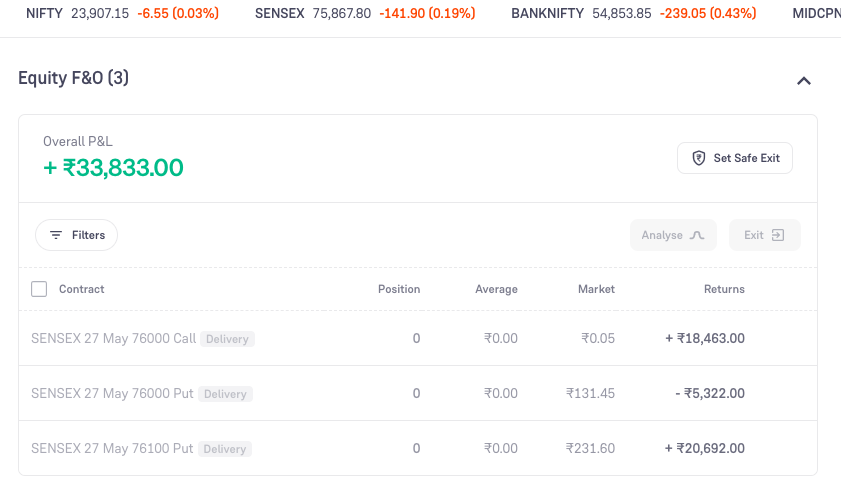
Date: 27 May 2025 — Wednesday (Sensex Weekly Expiry Day) Market condition: Choppy. Non-trending. No clear direction.
| Trade | Contract | Result |
|---|---|---|
| Trade 1 | Sensex 27 May 76100 Put | +₹20,692 |
| Trade 2 | Sensex 27 May 76000 Put | -₹5,322 |
| Trade 3 | Sensex 27 May 76000 Call | +₹18,463 |
| Net Profit | +₹33,833 |
Three trades. Two wins. One loss. Net profit of ₹33,833 — on a day where most option buyers lost everything to theta decay.
This post explains exactly how.
Table of Contents
Why Choppy Days Kill Most Option Traders
On a trending day, buying options is straightforward. Market moves strongly in one direction — your option premium explodes — you book profit and move on.
But on a choppy day? The market moves up 200 points, then down 300 points, then up 150 points. No clear direction. No momentum. Just noise.
This creates a perfect storm for option buyers:
Problem 1 — Theta decay never stops. On expiry day especially, every passing minute destroys your premium — regardless of whether the market moves or not.
Problem 2 — Whipsaws hit stop losses. You buy a Call, market drops and hits your stop. You switch to a Put, market immediately reverses. You end up losing on both sides.
Problem 3 — Emotional trading takes over. After two losing trades on a choppy day, most traders either quit in frustration or start gambling to recover losses.
Today I avoided all three problems. Here’s how.
The Tool That Changed Everything — CPR Trading
CPR stands for Central Pivot Range.
It is the single most important level I plot on my chart every single morning before trading.
CPR is calculated from the previous day’s High, Low, and Close:
- TC (Top Central) = (Pivot + Previous Day High) ÷ 2
- BC (Bottom Central) = (Pivot + Previous Day Low) ÷ 2
- Pivot = (Previous Day High + Previous Day Low + Previous Day Close) ÷ 3
The range between TC and BC is your CPR — a zone where the market finds balance.
The single most important rule of CPR trading:
- Price above CPR = Bullish bias for the day → look for Call buying opportunities
- Price below CPR = Bearish bias for the day → look for Put buying opportunities
- Price inside CPR = Choppy, no clear bias → wait or avoid trading
This one rule alone filters out the majority of bad trades.
My Complete Chart Setup
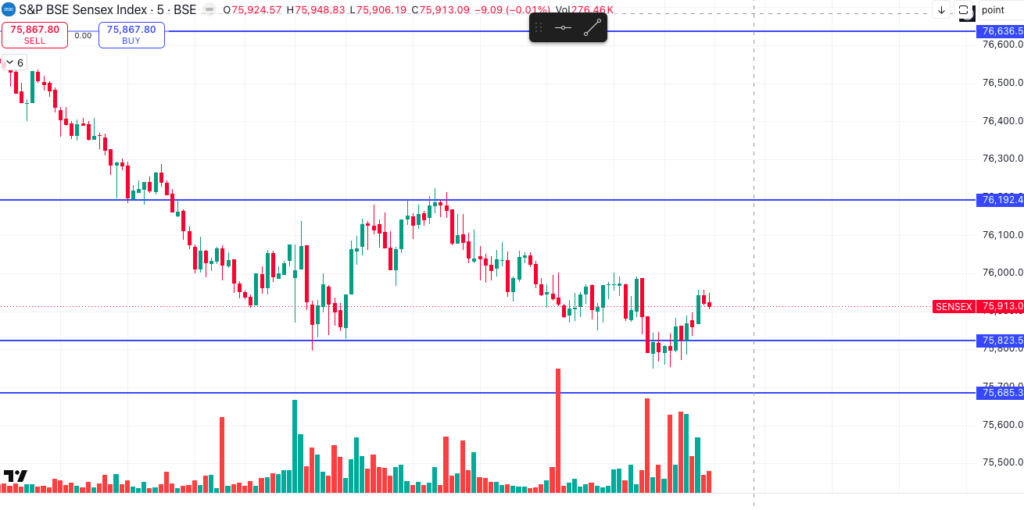
Every morning I open my Sensex 5-minute chart with the following levels plotted:
Pivot Levels:
- Previous Day High — strongest resistance
- Previous Day Low — strongest support
- R1, R2 — resistance zones above
- S1, S2 — support zones below
- CPR (Central Pivot Range) — the day’s balance zone
Indicators:
- Multiple Moving Averages (for trend direction confirmation)
- Volume bars (for move confirmation)
- Momentum indicator (for Bull/Bear signal confirmation)
I do not use complicated indicators. I do not use 10 different oscillators. I use price action, pivot levels, CPR, and volume. That’s it.
Simplicity is an edge. Complexity is noise.
Today’s Chart — What I Saw at Market Open
When I opened my chart this morning, here is what I observed:
Key levels for today:
- Previous Day High: 76,636.50
- R1: approximately 76,400
- CPR zone: approximately 76,100 — 76,200
- Previous Day Low: approximately 75,823
- S1: 75,823.55
- S2: 75,685.32
Opening observation: Sensex opened near the Previous Day High area around 76,400-76,500. This was immediately significant — Previous Day High is strong resistance. When a market opens near resistance on a choppy expiry day, the probability of a rejection and move downward is high.
Within the first 15 minutes, the rejection was confirmed. Sensex started falling. It broke below R1, broke below CPR, and began heading toward Previous Day Low.
Bias confirmed: Bearish for the morning session.
Trade 1 — The Morning Put Trade (+₹20,692)
Setup:
- Sensex broke below CPR with increasing volume
- Price heading toward Previous Day Low and S1
- Moving averages turning downward
- Clear bearish structure on 5-minute chart
Entry: Bought Sensex 27 May 76100 Put
The 76100 strike was chosen deliberately. It was slightly OTM at entry — close enough to CPR that any continued move downward would rapidly push it ITM and explode the premium.
What happened: Sensex continued falling. Broke Previous Day Low. Reached S2 area around 75,400 — a fall of approximately 600-700 points from the opening area.
The 76100 Put premium expanded dramatically as Sensex fell into deep support territory.
Exit: Booked at S2 level. When price reaches a major support level like S2 on expiry day — you book profit. You do not wait for more. Support levels are where reversals happen, and on expiry day, reversals are violent.
Result: +₹20,692
Trade 2 — The Failed Put Trade (-₹5,322)
This is the trade most traders would hide. I’m sharing it because it’s the most educational part of today.
Setup: After the initial drop to S2, Sensex bounced slightly and then appeared to consolidate near the Previous Day Low area. I read this as a brief pause before further downside continuation.
Entry: Bought Sensex 27 May 76000 Put — expecting another leg down below S2.
What actually happened: The consolidation was not a pause before continuation. It was accumulation before a reversal. Sensex had found genuine support at S2 and was beginning to reverse upward.
My Put began losing value rapidly as price moved against me.
Exit: Cut the loss at approximately 40% of premium. Did not hold and hope. Did not average down.
Result: -₹5,322
What I learned: When a market reaches S2 on expiry day and the first bounce shows increasing green volume — that is a reversal signal, not a continuation signal. I misread the volume pattern on this trade. The lesson: at major support levels on expiry day, the default assumption should be reversal, not continuation.
Trade 3 — Switching Direction for the Recovery (+₹18,463)
This is the trade that separates disciplined traders from emotional ones.
After a ₹5,322 loss, most traders do one of two things:
- Quit for the day feeling defeated
- Aggressively overtrade trying to recover quickly
I did neither.
I sat back. Looked at the chart fresh. And asked one question: What is the market actually telling me right now?
What the chart was telling me:
- Sensex had held S2 support — twice
- Volume was turning green on the bounce candles
- The momentum indicator at the bottom of my chart flashed a Bull signal
- Price was reclaiming the Previous Day Low level — which now acted as support
- Moving averages beginning to curve upward on 5-minute timeframe
The market had clearly reversed. My job was to follow it — not fight it.
Entry: Bought Sensex 27 May 76000 Call
I switched from Put to Call. From bearish to bullish. Without ego. Without hesitation.
This is the hardest thing to do in trading — admit the market has changed direction and change with it. Most traders hold their bearish bias even as the market moves against them. I let the chart tell me what to do.
What happened: Sensex rallied from S2 back toward CPR and Previous Day Low resistance — a recovery of 500+ points from the day’s low.
The 76000 Call premium expanded rapidly as Sensex moved back into the 75,999-76,200 range.
Exit: Booked near Previous Day Low resistance. When price approaches Previous Day Low from below on a choppy day — it faces resistance. That is the logical exit point.
Result: +₹18,463
The Full Day in One Picture
Here is what today’s price action looked like in simple terms:
76,636 — Previous Day High (opening rejection here)
  ↓
76,400 — R1 broken
  ↓
76,200 — CPR broken (bearish bias confirmed → Trade 1 entry)
  ↓
75,823 — Previous Day Low broken
  ↓
75,400 — S2 reached (Trade 1 exit / Trade 2 entry)
  ↑
75,823 — S2 held, Bull signal fired (Trade 2 cut / Trade 3 entry)
  ↑
75,999 — Recovery toward Previous Day Low (Trade 3 exit)
The entire day’s profit came from reading this structure correctly — and adapting when the structure changed.
The 5 Rules That Guided Every Decision Today
Rule 1 — Trade the levels, not the noise. I didn’t react to every 50-point Sensex move. I waited for price to reach significant pivot levels before making decisions.
Rule 2 — Volume confirms everything. Every entry had volume confirmation. Rising red volume on the drop confirmed Trade 1. Rising green volume on the bounce confirmed Trade 3. Trade 2 failed partly because I ignored volume signals at S2.
Rule 3 — Cut losses without emotion. Trade 2 was cut at 40% loss. No averaging down. No hoping. The moment the reversal was confirmed, the Put was closed.
Rule 4 — Switch direction when the market switches direction. After cutting the Put loss, I immediately assessed whether the market had reversed. It had. I bought a Call. This single decision turned a losing sequence into a profitable day.
Rule 5 — Exit at resistance/support, not at targets. I don’t use fixed point targets. I exit when price reaches the next significant level. On expiry day, these levels act as natural profit booking zones.
Why Expiry Day Is Special
Today was Thursday — Sensex weekly expiry day.
Expiry days have unique characteristics that make this strategy particularly effective:
Theta acceleration: After 1 PM on expiry day, theta decay accelerates dramatically. OTM options lose value every 15 minutes. This means if you’re on the right side of a move — gains come fast. If you’re wrong — losses come equally fast.
Decisive moves: Institutional players close or roll positions on expiry day. This creates sharper, more decisive moves than normal days. Pivot levels get tested cleanly.
Premium compression: By afternoon, cheap OTM options can deliver 200-400% returns on a 200-300 point move. The risk-reward becomes extraordinary for correctly timed trades.
The expiry day edge: Most retail traders are afraid of expiry day volatility. I use that volatility as an opportunity — because I know exactly where the key levels are before the market opens.
What Today’s ₹33,833 Actually Represents
I want to put this number in context.
Two months ago I had ₹62,000 in my bank account. That was everything I had after my father passed away in January, after I left my job, after months of rebuilding my life.
Today, on a single expiry day, trading three positions on the Sensex — I made more than half of my entire starting capital.
Not because I got lucky. Not because I followed someone’s tips. But because I have spent 5 years learning how markets move — through mistakes, through losses, through a brain injury that slowed me down but never stopped me, through the kind of pressure that either breaks you or sharpens you.
It sharpened me.
The Setup Summary — Save This
For anyone who wants to apply this approach:
Chart: 5-minute timeframe Instrument: Sensex or Nifty 50 on expiry day Levels to plot: Previous Day High/Low, R1/R2, S1/S2, CPR
Morning session (9:30-11:00 AM):
- If price breaks below CPR with volume → Buy Put, target S1/S2
- If price breaks above CPR with volume → Buy Call, target R1/R2
- If price stays inside CPR → Do not trade
Afternoon session (1:00-2:30 PM):
- Reassess bias fresh from current price vs CPR
- Look for Bull/Bear signal confirmation on momentum indicator
- Trade in direction of signal with S1/S2 or R1/R2 as targets
Exit rules:
- Always exit at next significant pivot level
- Cut loss at 40-50% of premium — no exceptions
- Everything closed by 3:00 PM — no exceptions
Final Thought
Choppy days are where most traders lose their expiry day capital. They buy options hoping for a big trending move that never comes, and watch theta slowly destroy their premium.
The solution is not to avoid choppy days. The solution is to trade the structure of choppy days — the bounces between support and resistance, the rejections at pivot levels, the reversals at S2 and R1.
Today was not a trending day. It was a pivot-to-pivot day. And pivot-to-pivot days, traded correctly, can be just as profitable as trending days — sometimes more.
The market always tells you where it wants to go. Your job is to listen.
I document every trade on SmartSourav.com — real charts, real numbers, real strategy. No tipsters. No paid calls. Just honest trading education from someone who does this for a living.
Follow the journey at SmartSourav.com