How I Lost ₹44,489 on a Day I Was Right About the Market: Bull Trap in Options Trading
The Setup — Everything Looked Perfect
Last night before the market closed, I did what I always do — reviewed global market news.
What I found looked like a gift:
- US and Iran extended their ceasefire for 60 days
- US markets closed strongly green
- US indices made a new all-time high
My pre-market analysis was clear. Indian markets would open bullish. The global sentiment was positive. Risk appetite was high. Every signal pointed the same direction — up.
I went to sleep confident. Woke up ready. Opened my charts.
Nifty gapped up at open. Sensex gapped up. Exactly as expected.
The second bullish candle formed. I entered a Call position.
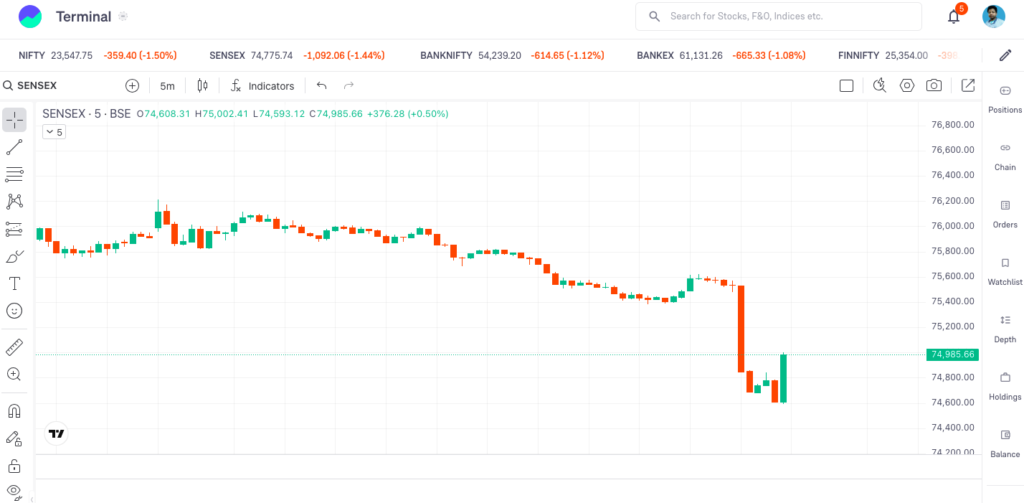
And then — over the next 6 hours — I watched the market fall 359 points.
Nifty closed down 1.49%. Sensex closed down 1.39%.
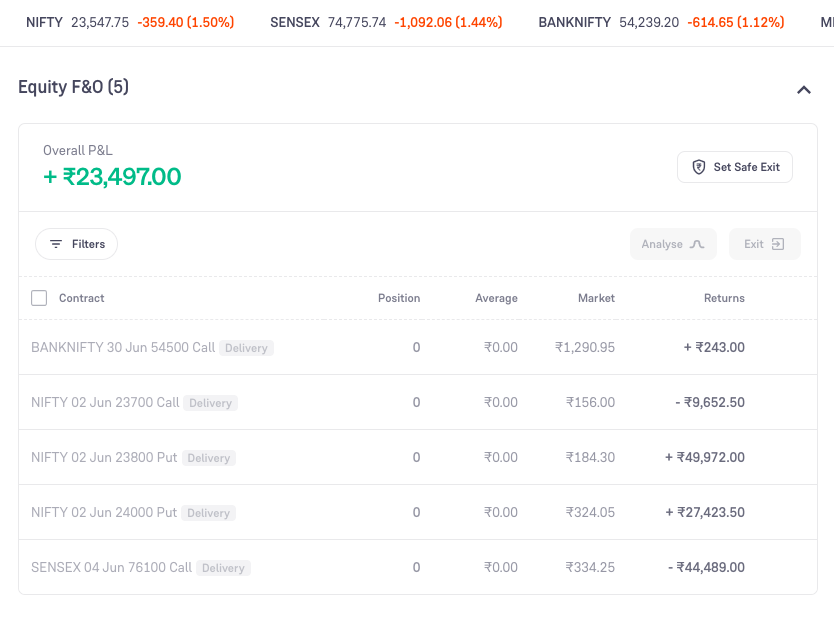
My Call position lost ₹44,489.
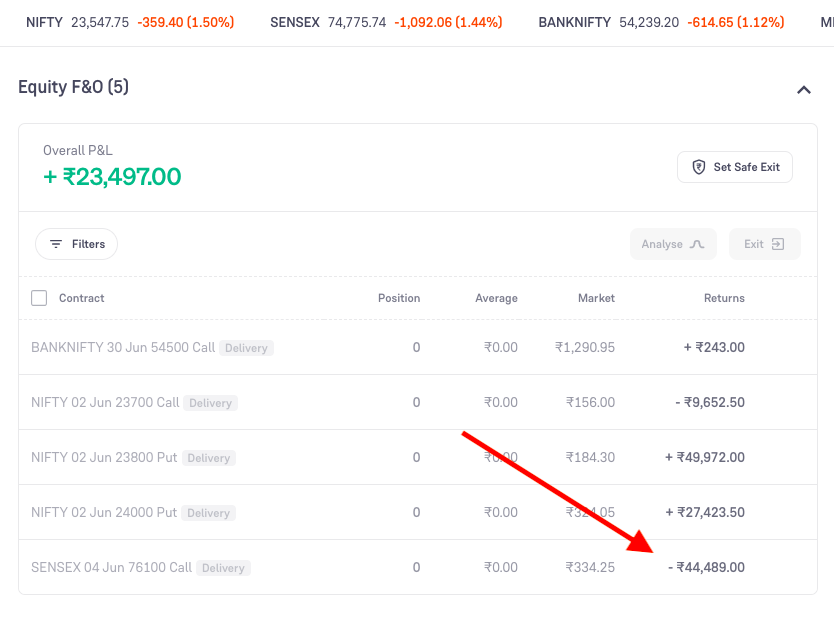
But Here’s the Twist
On the same day, my Put positions made +₹77,395.
I was right about the market direction. I was wrong about the entry timing.
Net result: +₹23,497 profit — on a day I made one of the biggest single-trade mistakes of my recent trading journey.
This post explains what happened, why it happened, and the exact rules every options trader must follow before entering a trade on gap-up opening days.
Table of Contents
What Is a Bull Trap in Options Trading?
A bull trap in options trading is one of the most common — and most expensive — patterns retail traders fall into.
Definition: A bull trap occurs when the market appears to move upward, attracts Call buyers, and then reverses sharply downward — trapping all buyers in rapidly losing positions.
The word “trap” is accurate. You walk in confidently based on valid analysis. The door closes. And by the time you realize the move was never real — your premium has been destroyed by the combination of wrong direction and theta decay.
Bull traps occur across all markets and timeframes. But they are particularly dangerous in options trading on gap-up opening days following positive overnight global news — which is precisely what happened in today’s trade.
Understanding the bull trap pattern in options trading can save you from some of the most painful and avoidable losses in your trading career.
Why Gap-Up Days After Good News Create Bull Traps
This is the concept most beginner and intermediate options traders don’t fully understand — and it cost me ₹44,489 today.
When positive news breaks overnight — a geopolitical resolution, a strong US market rally, a major policy announcement — retail traders wake up the next morning and think:
“Good news = market will go up. I should buy Calls.”
This thinking is completely logical. It is also exactly what creates the bull trap.
Here is what actually happens step by step:
Step 1 — Positive news breaks overnight Institutional traders, hedge funds, and large operators are already aware of the news. In many cases they positioned themselves the previous day in anticipation.
Step 2 — Indian market gaps up at open The positive news is immediately reflected in the opening price. Nifty doesn’t open at yesterday’s close — it gaps up significantly, already pricing in all the good news before a single retail trader places an order.
Step 3 — Retail traders see the gap and buy Calls Excited by the news and the green opening, retail traders rush into Call options in the first few minutes. Premiums spike. Volume surges. Everyone feels bullish.
Step 4 — Institutions sell into the retail buying This is the step nobody discusses openly. Smart money uses the gap-up opening — and the flood of retail Call buying — as the perfect opportunity to exit their long positions at inflated prices. They are not buying the gap. They are selling into it.
Step 5 — Market begins to reverse With institutions selling aggressively and retail buying exhausting quickly, upward momentum dies fast. Price starts falling. The gap begins to fade. Call buyers watch premiums collapse.
Step 6 — Panic selling accelerates the decline As price falls further, retail traders who held hoping for recovery begin panic selling. This selling accelerates the decline further and faster.
Step 7 — Market closes near the day’s lows What began as a clearly bullish day — backed by genuinely positive global news — ends as a sharply bearish session. The news was real. The rally was a bull trap.
This is the complete anatomy of a bull trap in options trading. Recognising each stage is what separates traders who avoid it from those who keep paying for it.
“Buy the Rumour, Sell the News” — The Principle Behind Every Bull Trap
There is a principle in financial markets that directly explains today’s bull trap:
“Buy the rumour, sell the news.”
Markets move in anticipation of events — not in reaction to them. By the time news is officially confirmed and publicly known, prices have already moved to reflect it. The opportunity has passed.
In today’s situation:
- US markets rallied on the ceasefire news
- Indian market opened already pricing in that rally
- There was no new positive catalyst left to push prices higher
- The only remaining direction was downward
When I entered my Call position on the second bullish candle, I was effectively buying a move that had already fully happened — overnight, in US markets, before Indian trading even began.
This is the core mechanism behind every news-driven bull trap in options trading.
The 3 Warning Signs My Chart Showed — That I Ignored
Here is what makes today’s loss particularly instructive. The bull trap warning signs were visible within the first 15 to 30 minutes of trading. I saw them. I didn’t act on them fast enough.
Warning Sign 1 — Immediate lower highs after the gap-up open After the gap-up opening, the first few candles should have continued moving higher if bullishness was genuine. Instead, after 2-3 green candles, price began making lower highs — each candle’s peak lower than the one before.
Lower highs forming immediately after a gap-up = the gap is being sold into.
Warning Sign 2 — The opening level became resistance instead of support On a genuine bullish trending day, the level where market gaps up to becomes support — price holds above it and bounces off it when tested. Today, the opening level immediately acted as resistance. Every attempted push higher was rejected at that level.
Opening gap level acting as resistance = institutional distribution in progress.
Warning Sign 3 — Higher volume on red candles than green candles As price started falling in the early session, the selling volume on bearish candles was significantly larger than the buying volume on bullish candles. This volume imbalance confirmed the selling pressure was institutional and sustained — not just a brief dip.
High volume on early red candles = smart money exiting, not retail dips being bought.
All three warning signs appeared within 20-30 minutes of market open. Together they confirmed one clear message: this is a bull trap in options trading. Exit the Call. Do not hold.
I saw the signals. I hesitated. I held. That hesitation cost ₹44,489.
The Exact Moment I Should Have Exited
There is a precise exit rule for bull trap situations that I have now permanently added to my trading system:
When a gap-up opening fails to make a higher high on the second or third candle, exit all Call positions immediately. No waiting. No hope for recovery.
That exit signal appeared today within 15-20 minutes of market open.
At that point, my Call loss was approximately ₹5,000-8,000. Painful but completely manageable — less than one average trading day’s profit.
Instead, I held. Hoping the market would reverse back upward. The loss grew to ₹44,489.
The market never reversed. A bull trap, once confirmed, rarely gives back the full move quickly enough to save a losing Call position on expiry day.
The Rule That Prevents a Bull Trap Loss — Save This
After today, I added one permanent rule to my pre-trade checklist for gap-up opening days:
The Gap-Up Opening Rule
When market opens gap-up after positive overnight global news:
- Do not enter any Call position for the first 30 minutes — regardless of how bullish the news or how green the opening looks
- Observe what happens to the gap — is it holding or fading?
- Gap holds + higher highs forming = genuine bullish day → enter Call with confidence
- Gap fades + lower highs forming = bull trap in progress → prepare Put entry
- If lower highs are confirmed after 30 minutes → enter Put position — the gap is being faded by institutional selling
- If opening gap level breaks downward on high volume → aggressive Put entry confirmed — this is the bull trap fully closing
Following this single rule today would have saved ₹44,489 — and potentially generated an additional ₹20,000-30,000 in earlier Put profits.
The Psychology of Holding a Losing Trade — Why We Don’t Exit
Beyond the technical analysis, there is an important psychological reason why the bull trap in options trading is so damaging.
I held that Call position too long because of one emotion: hope.
My pre-market analysis was thorough. The reasoning was sound. The news was real. US markets genuinely rallied.
And that correctness of analysis is precisely what made it psychologically difficult to exit.
When you have done careful research and feel confident in your reasoning, your mind resists accepting that the market is moving against you. You think: “My analysis was right. The market will come back. Just a little more patience.”
This cognitive pattern is called confirmation bias — the tendency to seek evidence that supports your existing belief while discounting evidence that contradicts it.
The market is indifferent to your analysis. It doesn’t respond to logic, news events, or how carefully you researched the previous night.
The market moves. Your only job is to follow it.
Today, the market told me clearly within 20 minutes of open: “I am going down.”
I argued with that message for 6 hours. The market won.
Recognizing confirmation bias as the psychological engine behind most bull trap losses is as important as recognizing the technical warning signs.
How I Recovered — Switching Direction Mid-Session
Here is the part of today worth examining carefully.
After holding the losing Call too long, I finally accepted what the market was telling me. The trend was bearish. My Call thesis was wrong.
I switched direction completely.
I entered Put positions on Nifty. Those Puts — 23800 Put (+₹49,972) and 24000 Put (+₹27,423) — recovered most of the Call loss and generated net profit for the day.
Net profit on the day: +₹23,497
The ability to flip direction mid-session — to accept being wrong and act on that acceptance immediately — is one of the most difficult and most valuable skills in options trading. Most traders do one of two things after a losing trade:
- Hold the losing position until the premium reaches zero
- Refuse to take any new trades for the rest of the day
Both responses are emotionally understandable. Both are financially destructive.
The correct response to a confirmed bull trap is: cut the loss at the earliest confirmed reversal signal, reassess the chart with fresh eyes, and enter the direction the market is actually moving.
That is what ultimately saved today’s session.
Updated 62-Day Trading Journey
For context on where today fits in the overall picture:
| Period | Net Profit |
|---|---|
| First 58 days | ₹1,20,000 |
| Days 59-60 | ₹48,000 |
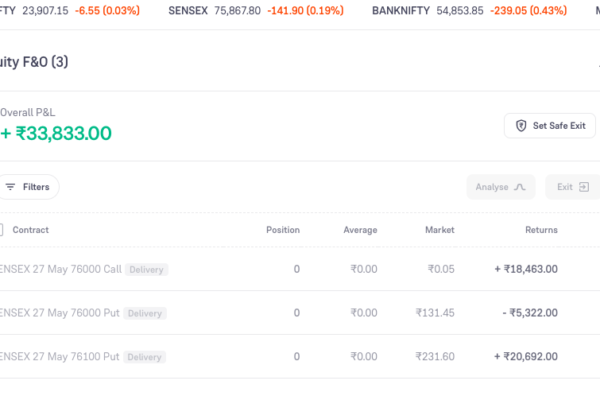
| Day 61 — Sensex expiry day | ₹33,833 |
| Today — Day 62 | ₹23,497 |
| Total cumulative profit | ₹2,25,330 |
Starting capital: ₹42,000 Net return on capital: 536.5% in 62 days
Without the ₹44,489 bull trap loss, today would have been ₹67,986 — the single best trading day of this journey. The bull trap cost exactly that difference.
But the day was still profitable. The journey continues. The lesson is permanently recorded.
5 Signs You Are Walking Into a Bull Trap in Options Trading
Use this checklist on every gap-up opening day before entering any Call position:
Sign 1 — Gap-up follows major widely-known positive overnight news The more publicly known the news, the more completely it is already priced into the opening. A universally reported ceasefire extension or US market all-time high is known by every trader before Indian markets open.
Sign 2 — Opening candle becomes the highest candle of the session within 30 minutes If the first candle’s high is not exceeded within 30 minutes — institutions are not buying the gap. They are selling into it.
Sign 3 — Lower highs form on consecutive candles immediately after open Each candle peaks lower than the previous one. This descending structure in the first 15-30 minutes is the most reliable early warning sign of a bull trap in options trading.
Sign 4 — Volume on bearish candles exceeds volume on bullish candles When selling volume is consistently higher than buying volume in the early session, smart money distribution is confirmed. The gap is being sold aggressively.
Sign 5 — Opening gap level is broken to the downside When price falls below the level at which the market gapped up — the bull trap has fully closed. Holding Call positions beyond this point results in maximum loss as both direction and theta compound against the trade.
How I Made ₹33,833 on a Choppy, Non-Trending Day — My Exact Sensex Expiry Day Trading Strategy
Frequently Asked Questions
What is a bull trap in options trading?
A bull trap in options trading occurs when a market appears to move upward — often on a gap-up opening or bullish news — attracting Call buyers, before reversing sharply downward. The “trap” refers to buyers being caught in losing long positions as the market falls.
How do I identify a bull trap before entering a trade?
The three primary signs are: immediate lower highs forming after a gap-up open, the opening price level acting as resistance rather than support, and higher volume on bearish candles than bullish candles in the early session.
What should I do if I am already in a Call position during a bull trap?
Exit at the earliest confirmed lower high. Do not wait for the position to recover. A ₹5,000-8,000 loss cut early is far better than a ₹40,000+ loss held in hope. Reassess the chart direction and consider entering a Put position if the reversal is confirmed.
Does a bull trap always happen after positive news?
Bull traps are most common after widely known positive overnight news because the price gap up at open has already priced in the good news, leaving no fuel for further upward movement. However, bull traps can also occur in intraday trading without a news catalyst.
Is “buy the rumour sell the news” related to bull traps?
Directly related. The “buy the rumour, sell the news” principle describes exactly how bull traps form — smart money buys in anticipation of positive news and sells when the news becomes public, creating the reversal that traps late buyers.
The Bottom Line
Today’s pre-market analysis was sound. The global news was genuinely positive. The bullish bias was logical.
But correct analysis does not guarantee a profitable trade.
The market’s price action after the gap-up open communicated a completely different message within 20 minutes. My mistake was continuing to listen to my pre-market analysis instead of listening to what the chart was clearly showing.
The chart is always the final authority. Pre-market analysis is only the starting hypothesis.
Today cost ₹44,489 to make that lesson unforgettable. The bull trap in options trading will appear again — on the next major positive overnight news event, on the next gap-up opening. When it does, the 30-minute rule and the five warning signs above will be the difference between a managed small loss and a large avoidable one.
Real trades. Real losses. Real lessons. Published every week at SmartSourav.com — honest trading education from an active options trader with real money on the line every expiry day.
Read more real trade breakdowns at SmartSourav.com
Disclaimer: This post reflects my personal trading experience and is purely for educational purposes. It is not financial advice or a recommendation to buy or sell any security. Trading involves significant risk. Please consult a qualified financial advisor before making investment decisions.
Tag:bull trap options India Tags: Bull Trap Options Trading, Buy the Rumour Sell the News, Confirmation Bias Trading, Gap Up Reversal, gap up reversal nifty, gap up trading strategy, how to avoid bull trap, Nifty Options Trading, Options Trading India, options trading mistakes, SmartSourav Trading Journal, Trading Psychology