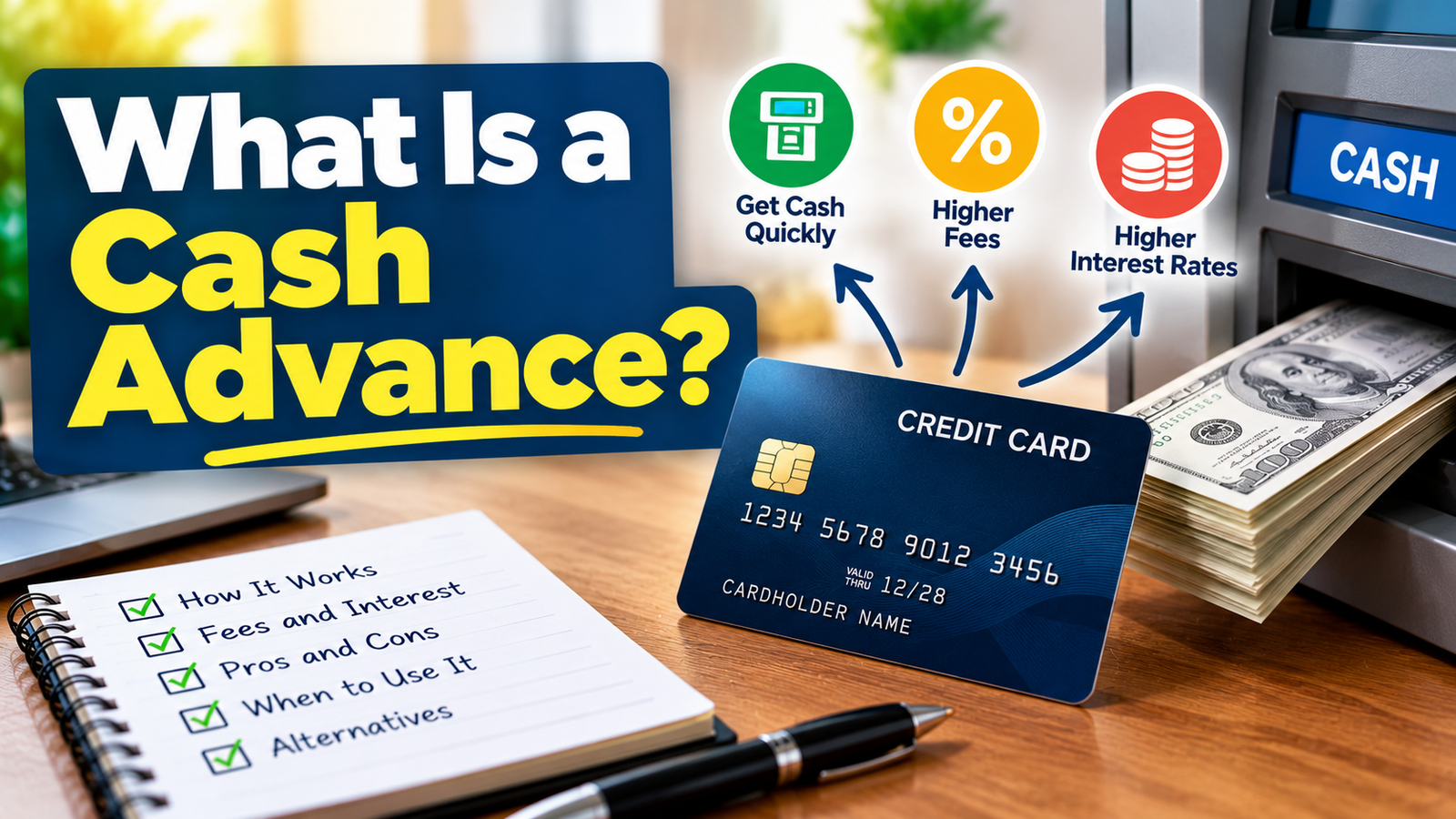
What Is a Cash Advance? Fees, Interest & How It Works
What Is a Cash Advance? Fees, Interest, and How It Works
A cash advance is a way to access money before you would otherwise have it available. In the United States, the term most commonly refers to withdrawing cash against a credit card’s available cash advance limit. However, it can also describe payday loans, cash advance apps, and employer paycheck advances.
Cash advances can help cover an urgent expense when you need money quickly. The downside is that they can be expensive, particularly when fees and interest begin accumulating immediately.
Before using one, it is important to understand how it works, how much it costs, and whether a less expensive alternative is available.
In this guide, we’ll explain the different types of cash advances, show how to calculate the cost of a credit card cash advance, and discuss their potential effects on your credit score.
Table of Contents
What Is a Cash Advance?
A cash advance is money borrowed or accessed ahead of its usual availability. The exact meaning depends on the financial product.
For example, if you withdraw $300 from an ATM using a credit card, you are generally borrowing against your credit line rather than withdrawing money from your bank account. The transaction is called a credit card cash advance.
Unlike an ordinary credit card purchase, a cash advance usually comes with a separate transaction fee and a higher interest rate. Interest generally starts accruing as soon as the transaction occurs, rather than after a purchase grace period.
The Consumer Financial Protection Bureau (CFPB) warns that credit card cash advances can be expensive and recommends checking the card’s terms before withdrawing money. Source: CFPB.
What Are the Different Types of Cash Advances?
The term “cash advance” can refer to several different products. Understanding the differences can help you avoid confusing a credit card transaction with a separate loan.
1. Credit Card Cash Advance
A credit card cash advance lets you borrow money against the available cash advance portion of your credit card.
You may be able to access the money through:
- An ATM using your credit card and PIN.
- A bank or credit union that handles cash advances.
- A convenience check provided by your card issuer.
- Other cash access methods permitted by your card agreement.
The cash advance limit may be lower than your overall credit limit. Your card issuer may also charge a transaction fee and a higher APR than it charges for purchases.
2. Payday Loan or Cash Advance Loan
A payday loan is a short-term, generally high-cost loan that is typically due around your next payday. Some lenders use the term “cash advance loan” to describe this type of borrowing.
Payday loans often charge a fee for every $100 borrowed, and the repayment period may be only two to four weeks. Costs can become particularly burdensome if you cannot repay the loan on time and must pay additional fees to extend it.
Rules vary by state, and payday loans are prohibited or restricted in some states.
The FTC provides a useful explanation of payday loans and their risks.
3. Cash Advance Apps
Cash advance apps may let eligible users access part of their expected income before payday.
Depending on the provider, costs may include subscription fees, expedited-transfer charges, optional tips, or other charges. Some services describe their advances as fee-free, but you should still review the complete terms.
Do not assume that every app offers the same product or that every advance is free. Check how repayment works and whether the app automatically withdraws money from your bank account.
4. Employer Paycheck Advance
Some employers allow workers to receive wages before their regular payday.
Depending on the employer or service provider, the advance may be free or involve a fee. It is important to understand whether the money represents wages already earned or a loan against future income.
A paycheck advance may be less expensive than a high-interest loan, but it can leave you with less money in your next paycheck.
How Does a Credit Card Cash Advance Work?
A credit card cash advance is generally straightforward, but the cost can be higher than many people expect.
Here’s how the process usually works.
- Check your cash advance limit. Your card issuer may allow you to borrow only a portion of your total credit limit.
- Review the fees and APR. Check the cash advance fee, interest rate, and any ATM charges.
- Withdraw the money. Use an eligible ATM or another method supported by your card issuer.
- Check your statement. The transaction and applicable fee will appear on your account.
- Repay the balance. Interest may accrue from the date of the advance until the balance is repaid.
For example, suppose your credit card has a $5,000 credit limit but only a $1,000 cash advance limit. You generally cannot withdraw $2,000 as a cash advance simply because your overall credit limit is $5,000.
Your actual limit and available amount depend on your card’s terms and current balance.
Cash Advance Fees and Interest Rates
The cost of a cash advance generally includes three potential charges.
1. Cash Advance Transaction Fee
Many credit cards charge a cash advance fee calculated as a percentage of the amount withdrawn, sometimes subject to a minimum dollar amount.
For example, if your card charges 5% or $10, whichever is greater, a $500 cash advance would incur a $25 transaction fee.
The actual fee varies by card issuer, so check your cardholder agreement before proceeding.
2. Cash Advance APR
The annual percentage rate (APR) for cash advances is often higher than the APR for ordinary purchases.
If your cash advance APR is 30%, that does not mean you pay 30% of the amount every month. It is an annualized rate used to calculate interest according to your account terms and the outstanding balance.
3. ATM or Other Transaction Fees
An ATM operator may charge an additional fee. Other transaction methods may have separate costs depending on the issuer.
These charges can add up, particularly when you withdraw small amounts repeatedly.
Does a Cash Advance Have a Grace Period?
Usually, no. Interest on a credit card cash advance generally begins accruing as soon as the transaction occurs. This differs from ordinary credit card purchases, which may have an interest-free grace period when you meet the card’s payment requirements.
For this reason, it is worth repaying a cash advance as soon as you reasonably can.
How Much Does a $500 Cash Advance Cost?
Let’s use a hypothetical example to show how the costs work.
Suppose you withdraw $500 from a credit card with these terms:
- Cash advance amount: $500
- Transaction fee: 5%
- Cash advance APR: 30%
- Repayment period: 30 days
The transaction fee would be:
[
$500 \times 5% = $25
]
The approximate interest for 30 days, assuming a simple daily-rate calculation and a constant $500 balance, would be:
[
$500 \times 30% \times \frac{30}{365}
\approx $12.33
]
Your estimated borrowing cost would therefore be:
| Cost | Amount |
|---|---|
| Cash withdrawn | $500.00 |
| Transaction fee | $25.00 |
| Approximate 30-day interest | $12.33 |
| Total estimated borrowing cost | $37.33 |
Under these assumptions, you would need to repay approximately $537.33, excluding any additional ATM fee.
This is an illustration, not a quote from a specific credit card issuer. Your actual interest depends on the issuer’s calculation method, transaction date, payment timing, and account terms.
The important point is that a $500 cash advance can cost more than $500 even if you repay it within a month.
What Are the Advantages and Disadvantages of Cash Advances?
Cash advances can be useful in limited situations, but the costs deserve careful consideration.
Advantages
- Quick access to money: You may be able to obtain cash without submitting a separate loan application.
- Useful in emergencies: Cash can help when you must pay an expense that does not accept credit cards.
- Convenient access: An eligible credit card may allow ATM withdrawals or other cash access.
- No separate collateral requirement: A typical credit card cash advance is unsecured.
Disadvantages
- High borrowing costs: Fees and APRs can make cash advances expensive.
- Immediate interest: Interest generally begins accruing on the transaction date.
- Lower cash advance limits: You may not be able to withdraw as much as your overall credit limit suggests.
- Potential credit score effects: A higher balance can increase your credit utilization.
- Debt repayment pressure: Repeated advances can make it harder to pay down your credit card balance.
A cash advance may provide short-term relief, but it should not become a regular way to cover expenses that exceed your income.
Does a Cash Advance Affect Your Credit Score?
Taking a credit card cash advance does not automatically lower your credit score. However, it can affect your credit profile indirectly.
Higher Credit Utilization
A cash advance increases your credit card balance. If your balance becomes high relative to your available credit, your credit utilization may increase, which can negatively affect your credit score.
For example, a $500 advance on a card with a $1,000 credit limit uses a substantial portion of that credit line, even before considering any fees or existing balance.
Missed Payments
If the additional balance makes it difficult to meet your minimum payment, missed or late payments can damage your credit history.
Hard Credit Inquiries
Using an existing credit card for a cash advance generally does not require a new credit application. However, applying for a separate personal loan or other credit product may result in a hard inquiry.
To limit potential credit score effects, avoid borrowing more than you can repay and make payments on time.
What Are the Alternatives to a Cash Advance?
If you need money quickly, compare the total cost of a cash advance with other options before making a decision.
1. Ask for a Payment Plan
If you need money for a medical bill, utility bill, rent, or another expense, ask the provider whether it offers a payment plan or hardship arrangement.
A payment plan may cost less than borrowing, although you should confirm any fees or interest.
2. Consider a Credit Union Loan
Some credit unions offer small-dollar loans or payday alternative loans to eligible members. These products may have more manageable costs and repayment terms than payday loans.
Check the total repayment amount and eligibility requirements.
3. Compare Personal Loan Offers
A personal loan may be worth considering if you need a larger amount or a longer repayment period. Compare APRs, origination fees, monthly payments, and total interest before accepting an offer.
Do not assume a personal loan will always be cheaper; the actual cost depends on the offer you receive.
4. Ask Your Employer About a Paycheck Advance
If your employer offers early access to earned wages, compare the cost and repayment arrangement with other options.
Make sure you understand how the advance will affect your next paycheck.
5. Use Emergency Savings if Available
If you have emergency savings, using them may be less expensive than borrowing at a high interest rate. Consider your upcoming expenses and the importance of keeping enough cash for future emergencies.
6. Be Careful With Payday Loans
Payday loans can carry very high costs and short repayment periods. The FTC notes that a $15 fee for every $100 borrowed on a typical two-week payday loan translates to an APR of about 391%.
If you are considering this type of loan, review the full cost and look for lower-cost alternatives first. Source: FTC.
When Should You Consider a Cash Advance?
A cash advance may be worth considering only when you need cash urgently, understand the full cost, and have a realistic plan to repay it quickly.
Before taking one, ask yourself:
- Is the expense genuinely urgent?
- Can I pay the balance back soon?
- What are the transaction fee and cash advance APR?
- Will the advance leave me with enough credit for other necessary expenses?
- Is there a lower-cost option?
If you are already struggling to pay credit card bills or recurring living expenses, taking another advance may worsen the problem. Consider contacting your creditors, seeking nonprofit credit counseling, or exploring a more affordable repayment arrangement.
Frequently Asked Questions
What is a cash advance on a credit card?
It is a way to borrow money against the cash advance portion of your credit card limit, often through an ATM or other issuer-approved method. Fees and interest generally apply.
How much does a cash advance cost?
The cost depends on the amount withdrawn, transaction fee, APR, repayment time, and any ATM charges. Check your cardholder agreement before withdrawing money.
Can I pay off a cash advance immediately?
Generally, yes. Paying it off quickly can reduce the interest you owe, although the transaction fee may still apply. Check how your card issuer allocates payments to different balances.
Can I get a cash advance without a PIN?
Some cash advances may be available through a bank or another method that does not require an ATM PIN. The options depend on your card issuer. Contact the issuer before assuming you can obtain cash without a PIN.
Is a cash advance the same as a payday loan?
No. A credit card cash advance uses your existing credit line. A payday loan is a separate short-term loan, often due around your next payday. Their fees, repayment rules, and legal requirements differ.
Can I get a cash advance with no fees?
Some financial products advertise no advance fee, but other costs may still apply, including subscription charges, expedited-transfer fees, or interest. Review the full terms rather than relying on the word “free.”
What is the cheapest alternative to a cash advance?
There is no single cheapest option for everyone. A payment arrangement, emergency savings, an employer paycheck advance, or a lower-cost credit union loan may be less expensive, depending on your circumstances.
Final Thoughts: Is a Cash Advance Worth It?
A cash advance can provide quick access to money when you need it, but convenience comes at a cost. Credit card cash advances often involve transaction fees, higher interest rates, and immediate interest accrual.
Before using one, check your card’s cash advance limit, APR, and fees. Calculate the total cost and compare alternatives such as payment plans, credit union loans, or emergency savings.
If you decide to take a cash advance, borrow only what you need and repay it as soon as reasonably possible. The goal should be to solve a short-term cash problem without creating a larger, longer-lasting debt problem.
Disclaimer: This article is for educational purposes only and is not individualized financial advice.

You may also like

Best High-Yield Savings Accounts: Top Picks