What Is a Savings Bond? Types, Interest & How It Works
What Is a Savings Bond? How It Works, Types, and Benefits
A savings bond is a type of investment issued by the U.S. government that allows you to earn interest on your money over time. When you buy a savings bond, you lend money to the federal government, and the government promises to repay your investment with interest according to the bond’s terms.
For Americans looking for a relatively low-risk way to save for future expenses, U.S. savings bonds can be worth considering. They are backed by the full faith and credit of the U.S. government and can earn interest for up to 30 years.
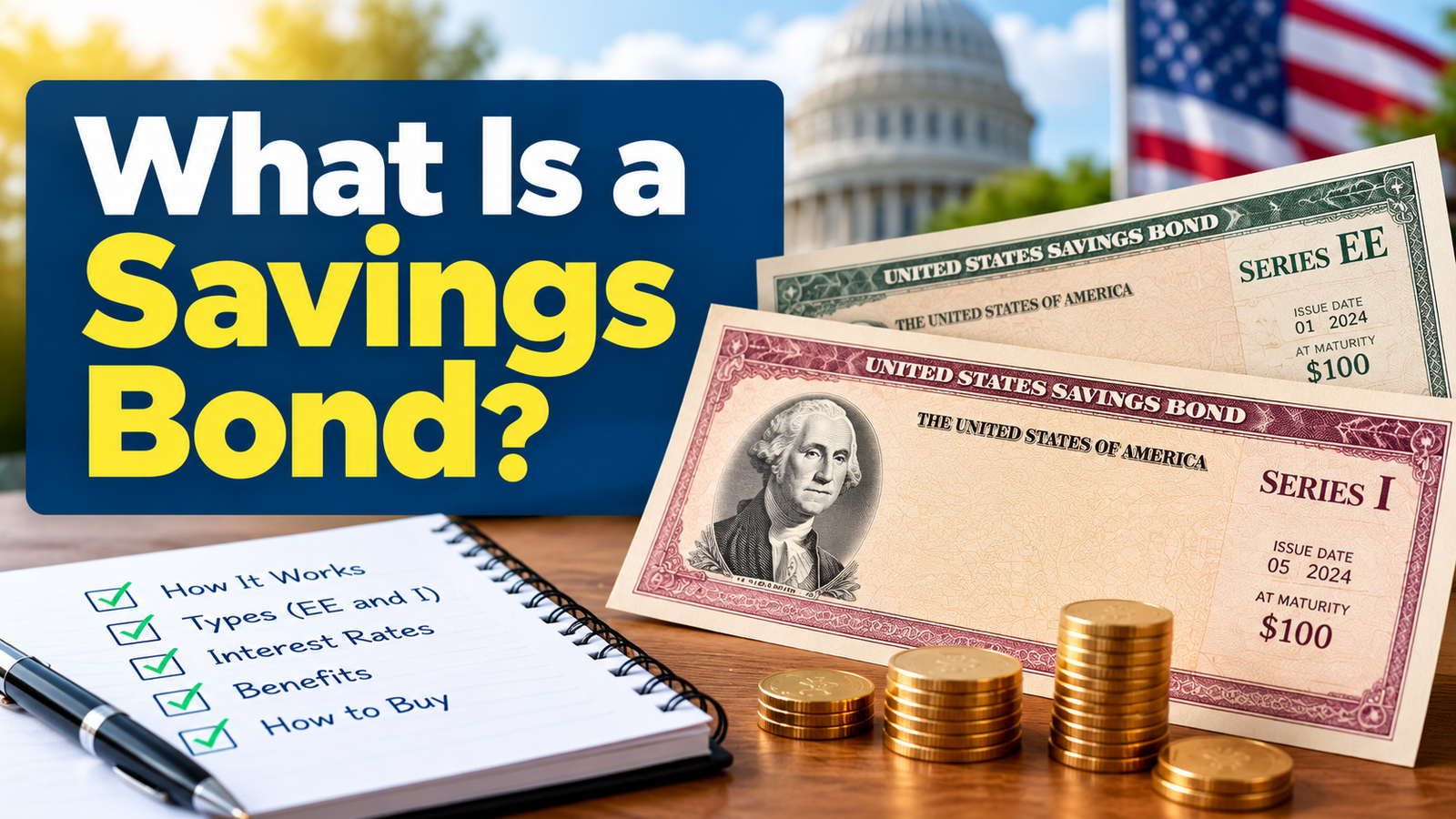
There are two main types of U.S. savings bonds available today: Series EE bonds and Series I bonds. They work differently, particularly in how they calculate interest and protect against inflation.
In this guide, you’ll learn what savings bonds are, how they work, how to buy them, when you can cash them in, and how they compare with other savings options.
Table of Contents
What Is a Savings Bond?
A savings bond is a government-issued debt security. When you purchase one, you lend money to the U.S. Treasury. In return, the government pays interest according to the bond’s terms.
Unlike stocks, savings bonds do not represent ownership in a company. Their value grows through interest rather than changes in a stock market price.
U.S. savings bonds are designed primarily for individual savers. You can buy them electronically through the official TreasuryDirect website.
Here are the main features of savings bonds:
- Government-backed: They are backed by the full faith and credit of the U.S. government.
- Low starting cost: Electronic savings bonds can be purchased for as little as $25.
- Interest earnings: They earn interest monthly, with interest compounded semiannually.
- Long-term savings: They can earn interest for up to 30 years.
- Different interest structures: EE bonds have a fixed rate, while I bonds combine a fixed rate with an inflation-linked component.
Savings bonds are not the same as bank savings accounts. They have different purchase procedures, holding periods, interest rules, and redemption restrictions.
Source: U.S. Treasury — About Savings Bonds.
What Are the Different Types of Savings Bonds?
The U.S. Treasury currently offers two types of savings bonds: Series EE and Series I.
1. Series EE Savings Bonds
Series EE savings bonds earn a fixed interest rate that is established when the bond is issued. For eligible bonds issued from May 2005 onward, that rate remains fixed for the first 20 years.
One distinctive feature is the Treasury’s guarantee that these EE bonds will be worth at least twice their purchase price after 20 years. If the accumulated interest is not enough to reach that amount, the Treasury makes an adjustment to fulfill the guarantee.
For example, if you purchase an eligible EE bond for $1,000, its value is guaranteed to reach at least $2,000 after 20 years, provided you meet the terms of the guarantee.
Important: This is a 20-year guarantee, not a promise that the bond will double every 20 years. The guarantee also does not mean every EE bond issued in every historical period has identical terms.
EE bonds can continue earning interest for up to 30 years.
For bonds issued between May 1 and October 31, 2026, the fixed annual rate is 2.40%. The rate applicable to a bond depends on its issue date.
Source: TreasuryDirect — Series EE Bonds.
2. Series I Savings Bonds
Series I savings bonds are designed to help protect savings against inflation. Their interest rate combines two components:
- Fixed rate: Established when the bond is issued and remains the same for its life.
- Inflation rate: Changes every six months based on changes in the Consumer Price Index for All Urban Consumers (CPI-U).
The combined rate can rise or fall as inflation changes. The interest rate on an individual I bond will not fall below zero.
For I bonds issued from May 1 through October 31, 2026, the composite annual rate is 4.26%, including a fixed rate of 0.90%. The composite rate applies for the first six months after the bond’s issue date, after which the applicable rate changes according to Treasury rules.
For example, if inflation rises, the inflation-linked component of an I bond may increase. If inflation slows, that component may decrease.
I bonds are not guaranteed to double in value after a particular number of years. Their long-term return depends on the fixed rate and the inflation rates applied over time.
Source: TreasuryDirect — Series I Bonds.
Rates change periodically. The figures above apply to bonds issued during the stated period, not necessarily to bonds purchased after October 31, 2026.
EE Bonds vs. I Bonds: What’s the Difference?
Although both are U.S. government savings bonds, they serve somewhat different purposes.
| Feature | Series EE bonds | Series I bonds |
|---|---|---|
| Interest structure | Fixed rate | Fixed rate plus inflation-linked rate |
| Inflation protection | No direct inflation adjustment | Inflation-linked component |
| 20-year doubling guarantee | Yes, for eligible bonds issued from May 2005 onward | No |
| Interest-earning period | Up to 30 years | Up to 30 years |
| Minimum electronic purchase | $25 | $25 |
| Annual electronic purchase limit | Generally $10,000 | Generally $10,000 |
| Earliest redemption | After 12 months | After 12 months |
| Early redemption penalty | Generally loses three months of interest if cashed before five years | Generally loses three months of interest if cashed before five years |
Source: TreasuryDirect — Comparing EE and I Bonds.
Which one should you choose?
EE bonds may appeal to long-term savers who value the 20-year doubling guarantee on eligible bonds. I bonds may appeal to savers who want interest to adjust with inflation.
Neither is automatically the better choice for everyone. Compare the applicable rates, how long you can leave the money invested, and when you expect to need the funds.
How Does a Savings Bond Earn Interest?
Savings bonds earn interest over time, but the way that interest is calculated depends on the bond type.
Both current EE and I bonds earn interest monthly, and the interest is compounded semiannually. This means accumulated interest becomes part of the value used for subsequent interest calculations.
Consider a hypothetical example.
Suppose you invest $1,000 in a savings bond that earns a constant 4% annual rate, compounded semiannually. If that rate remained unchanged for a full year, the ending value would be approximately $1,040.40.
This is an illustration, not a prediction of what a particular savings bond will earn. Actual returns depend on the bond’s terms and applicable rates. I bond rates change over time, and EE bonds have their own fixed-rate and guarantee rules.
You can check an electronic bond’s value in your TreasuryDirect account. For older paper bonds, use the official TreasuryDirect Savings Bond Calculator.
How to Buy Savings Bonds in the United States
You can buy new electronic EE and I savings bonds through TreasuryDirect, the U.S. Treasury’s official online platform.
Step 1: Open a TreasuryDirect Account
Visit TreasuryDirect.gov and follow the instructions to open an account. Individual purchasers generally need a valid Social Security number and must meet the Treasury’s eligibility requirements.
Step 2: Choose Your Bond Type
Decide whether you want a Series EE bond with a fixed rate and a 20-year doubling guarantee for eligible issues, or a Series I bond with an inflation-linked rate.
Step 3: Choose Your Purchase Amount
The minimum electronic purchase is $25. You can purchase an amount to the penny, subject to the applicable purchase limits.
Step 4: Complete the Purchase
Follow the TreasuryDirect instructions to select the bond, enter the amount, and complete the purchase.
Your electronic bond will be held in your TreasuryDirect account.
How Much Can You Invest Each Year?
Generally, the annual electronic purchase limit for an individual is:
- Up to $10,000 in Series EE bonds.
- Up to $10,000 in Series I bonds.
These limits apply separately and are subject to Treasury rules. Special rules may apply to gifts, purchases for children, and other ownership arrangements.
New savings bonds are electronic. Paper savings bonds you already own can still be redeemed under the applicable rules, but new paper EE bonds are no longer sold, and new I bonds have been electronic-only since January 1, 2025.
Source: TreasuryDirect — Buying Savings Bonds.
When Can You Cash In a Savings Bond?
Savings bonds are designed for saving over time, so you cannot always redeem them immediately.
The One-Year Rule
Generally, you must hold a savings bond for at least 12 months before cashing it in. This means savings bonds are not a suitable place for money you might need tomorrow or next month.
The Five-Year Rule
If you cash an eligible EE or I bond before holding it for five years, you generally lose the last three months of interest.
For example, if you cash a bond after 18 months, you generally receive the value reflecting 15 months of interest rather than all 18 months.
The 30-Year Limit
EE and I savings bonds earn interest for up to 30 years. After they stop earning interest, keeping them does not produce additional returns.
If you own older savings bonds, check their issue dates and maturity status. Some older bonds may have already stopped earning interest.
How Do You Cash In a Savings Bond?
Electronic savings bonds can generally be redeemed through your TreasuryDirect account. Older paper bonds may be redeemable through participating financial institutions or by following TreasuryDirect’s instructions.
Check the bond’s current value, holding period, and potential interest penalty before redeeming it.
Source: TreasuryDirect — Savings Bonds.
Are Savings Bonds Taxable?
Interest earned on U.S. savings bonds is generally subject to federal income tax. However, savings bond interest is generally exempt from state and local income taxes.
For federal income tax purposes, eligible bondholders can generally choose to report interest annually or defer reporting it until the bond is redeemed, reaches final maturity, or another applicable tax event occurs.
There is also a potential federal income tax exclusion for certain savings bond interest used for qualifying higher education expenses. This benefit has specific requirements involving matters such as bond ownership, the eligible expenses, filing status, and income limits.
Do not assume education expenses automatically make savings bond interest tax-free. Check the IRS rules or consult a qualified tax professional.
Official resources:
- TreasuryDirect — Tax Information for EE and I Savings Bonds
- IRS Publication 970 — Tax Benefits for Education
Advantages and Disadvantages of Savings Bonds
Before buying a savings bond, consider both its benefits and its limitations.
Advantages
- Government backing: U.S. savings bonds are backed by the full faith and credit of the U.S. government.
- Low minimum purchase: You can start with as little as $25.
- Long-term interest earnings: Bonds can earn interest for up to 30 years.
- Inflation-linked interest: I bonds adjust their inflation component periodically.
- EE bond guarantee: Eligible EE bonds issued from May 2005 onward are guaranteed to double in value after 20 years.
- Potential tax benefits: Interest is generally exempt from state and local income taxes, and qualifying education-related exclusions may be available.
Disadvantages
- Limited immediate access: You generally cannot redeem a bond during its first year.
- Early redemption penalty: Cashing a bond before five years generally costs three months of interest.
- Annual purchase limits: Limits apply to electronic purchases of each bond type.
- Changing returns: I bond rates change, and EE bond returns depend on their terms and holding period.
- Not ideal for every goal: A savings bond may be unsuitable for someone who needs instant access to cash.
Savings Bonds vs. Savings Accounts, CDs, and Treasury Bills
Savings bonds are just one way to save money. Here is how they compare with other common options.
| Feature | Savings bonds | High-yield savings account | Certificate of deposit (CD) | Treasury bill |
|---|---|---|---|---|
| Issuer | U.S. Treasury | Bank | Bank | U.S. Treasury |
| Return | Depends on bond type and terms | Usually variable APY | Often fixed for the term | Market-determined yield |
| Access to money | Generally locked for at least one year | Generally accessible, subject to account terms | May incur an early withdrawal penalty | Can be sold before maturity, but the market price may fluctuate |
| Inflation-linked interest | I bonds | No direct inflation adjustment | Usually no direct inflation adjustment | No direct inflation adjustment |
| Deposit insurance | Backed by the U.S. government | FDIC insurance may apply | FDIC insurance may apply | Backed by the U.S. government |
A high-yield savings account may be more appropriate for an emergency fund because it generally provides easier access to your money. A CD may suit a goal with a known timeline, while a Treasury bill may appeal to someone seeking a shorter-term government security.
Savings bonds can be useful when you are comfortable with their holding period and want their particular interest or inflation-protection features.
Are Savings Bonds a Good Investment?
Savings bonds may be appropriate for people who want a government-backed way to save for future goals without investing directly in the stock market.
They may be worth considering for:
- Long-term savings goals.
- Money you do not expect to need within the next year.
- Savers interested in inflation-linked interest through I bonds.
- People who value the 20-year doubling guarantee on eligible EE bonds.
- Gifts for children or family members, subject to Treasury rules.
However, savings bonds are not designed to replace every part of a financial plan. They may be less suitable for emergency cash that must be available immediately or for investors seeking higher potential returns from long-term market investments.
Before buying, compare the applicable interest rates, purchase limits, redemption restrictions, and tax rules.
Frequently Asked Questions About Savings Bonds
Are savings bonds safe?
U.S. savings bonds are backed by the full faith and credit of the U.S. government. They are generally considered low-risk securities, although their returns and liquidity depend on the type of bond and its terms.
How much is a $50 savings bond worth?
The value depends on the bond’s series, issue date, interest rate, and redemption date. An older paper bond with a printed $50 denomination may be worth more than $50 today. Use the official TreasuryDirect Savings Bond Calculator to estimate its current value.
Do savings bonds double in value?
Eligible Series EE bonds issued from May 2005 onward are guaranteed to double in value after 20 years. I bonds do not have the same guarantee; their value depends on the interest rates applied over time.
Can you lose money on a savings bond?
Savings bonds do not fluctuate in market price like publicly traded stocks. However, cashing a bond early may reduce the interest you receive, and inflation can reduce the purchasing power of your money.
Can you buy savings bonds for a child?
Yes. TreasuryDirect allows eligible adults to purchase savings bonds for children through the appropriate account arrangements. Review the Treasury’s ownership and account requirements before buying.
Do savings bonds expire?
EE and I savings bonds earn interest for up to 30 years. They do not continue earning interest indefinitely, so check the maturity date of any bonds you own.
Are savings bonds better than a high-yield savings account?
It depends on your goal. Savings bonds may suit longer-term savings, while a high-yield savings account may be better when you need easier access to your cash. Compare current rates, taxes, and restrictions before deciding.
Final Thoughts: Should You Buy a Savings Bond?
A savings bond is a way to lend money to the U.S. government and earn interest over time. Series EE bonds offer a fixed rate and a 20-year doubling guarantee for eligible issues, while Series I bonds combine a fixed rate with an inflation-linked component.
Both can be useful for long-term savings, but their holding periods and redemption rules mean they are not ideal for every financial goal.
Before purchasing, check the latest rates on TreasuryDirect, confirm the rules that apply to your bond, and make sure you can leave the money invested for the required period.
Disclaimer: This article is for educational purposes only and does not constitute individualized financial or tax advice.

You may also like
What Is a Joint Account? Benefits, Risks & How It Works
Universal Credit Loan Reviews: Rates, Fees & Pros