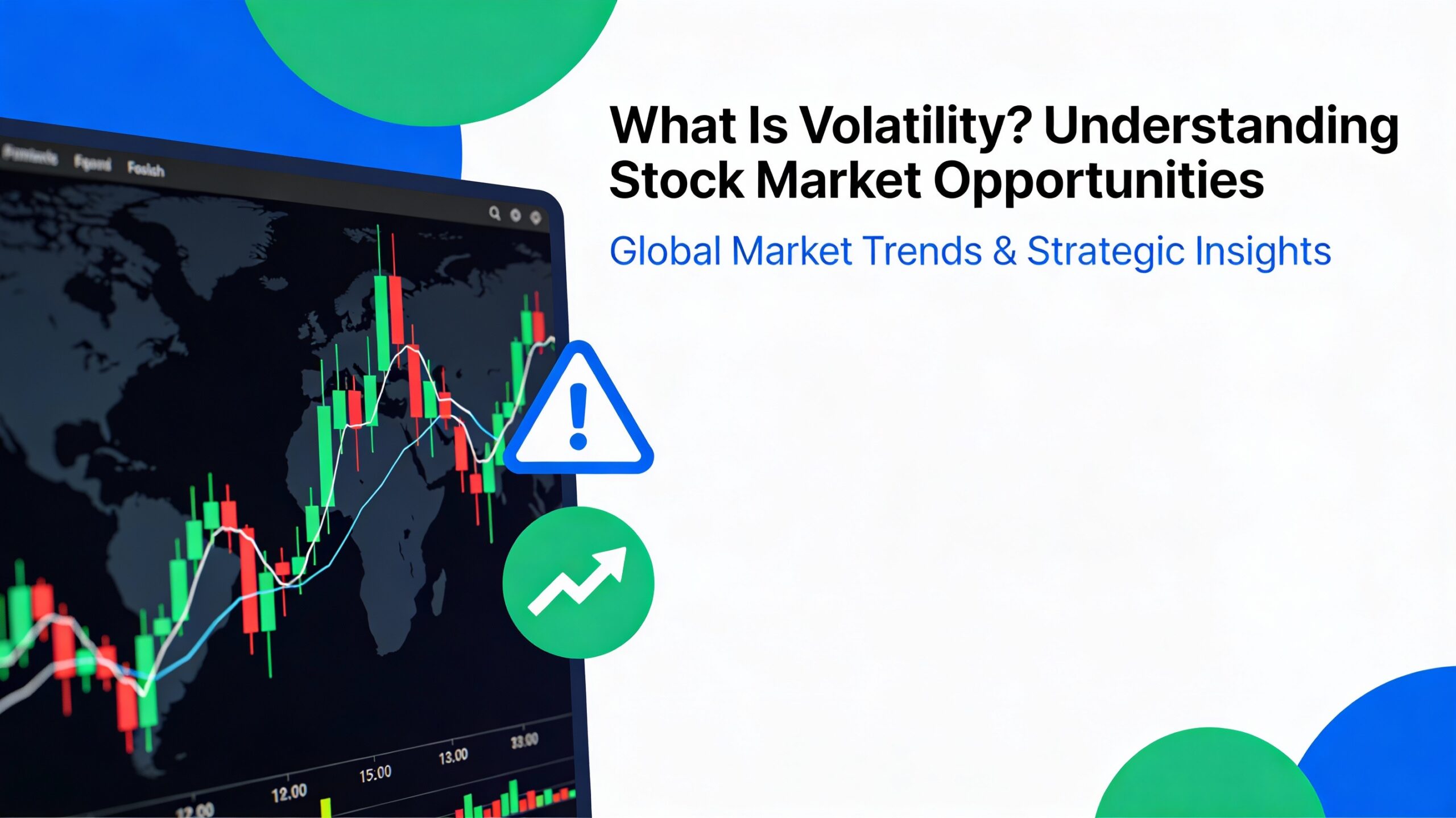
What Is Volatility? Understanding Stock Market Opportunities
Volatility is one of the most important concepts in the stock market, yet it is also one of the most misunderstood. Many beginners think volatility means danger, losses, or market crashes. In reality, volatility simply describes how fast and how much prices move in the market.
Whether you follow the Nifty and Sensex in India or global markets like the S&P 500 and Nasdaq, understanding volatility helps you stay calm, make better decisions, and avoid emotional mistakes.
This guide explains volatility in very simple language, with real-world examples.
Table of Contents
What Is Volatility?
Volatility means the speed and size of price changes in the stock market over a short period of time. When prices move slowly and steadily, volatility is low. When prices rise or fall sharply in a short time, volatility is high. Volatility does not tell you whether prices will go up or down—it only tells you how quickly and unpredictably they may move.
A simple way to understand volatility is to imagine the weather. Calm weather changes slowly. Stormy weather changes suddenly. The stock market behaves the same way.
Volatility Meaning in the Stock Market
In the stock market, volatility refers to how much stock prices or index values fluctuate. A market can be volatile even if it ends the day at the same level where it started. What matters is the movement in between.
For example, if the Sensex moves only 50–60 points during the day, volatility is low. If it swings 800–1,000 points within a few hours, volatility is high. Similarly, when the Nasdaq moves 2–3 percent in one session, it signals high volatility in global markets.
An important point beginners must understand is this: volatility does not mean loss. Prices can move up sharply as well as down sharply. Both movements are forms of volatility.
How Volatility Is Created (Buyer–Seller Logic)
Volatility exists because the market is driven by buyers and sellers with different opinions.
When more buyers want to buy at higher prices, prices tend to rise. When more sellers want to sell quickly, prices move down. When this disagreement between buyers and sellers happens suddenly and aggressively, prices move fast—and volatility increases.
Fear, greed, uncertainty, and new information cause people to change their decisions quickly. The faster these decisions change, the higher the volatility.
In simple words, volatility is created by human behavior reacting to information and emotion.
Types of Volatility
Volatility can be understood in different ways depending on time and context.
Historical volatility looks at how much prices have moved in the past. If a stock or index has shown large ups and downs over recent months or years, it has high historical volatility. Fast-growing or speculative stocks usually show higher historical volatility.
Implied volatility(IV) reflects how much movement the market expects in the future. It is derived from options prices and increases before important events such as budgets, elections, earnings announcements, or central bank decisions. High implied volatility means the market is unsure about what will happen next.
Intraday volatility refers to price movements within the same trading day. When the Nifty moves sharply up and down during market hours, that is intraday volatility. This type of volatility is what most beginners find stressful.
Market-wide volatility occurs when the entire market becomes unstable due to major events such as financial crises, pandemics, wars, or global recessions. During such times, most stocks and indices move together.
Why Markets Go Up and Down Fast
Markets move fast because information travels fast and money reacts instantly.
Global markets play a major role. Movements in the US markets—especially the S&P 500 and Nasdaq—often influence Indian markets the next day. When global investors become fearful, they reduce exposure across countries.
Institutional investors also matter. Foreign Institutional Investors (FIIs) and Domestic Institutional Investors (DIIs) manage large sums of money. Their buying or selling decisions can move markets sharply in a short time.
Other key drivers include corporate earnings, government policy changes, inflation and interest rate announcements, geopolitical tensions, and economic data releases.
In recent years, algorithmic and high-frequency trading have further increased short-term volatility, as computers react to price changes in milliseconds.
In short, markets move fast because reactions are fast.
Measuring Volatility: VIX and India VIX
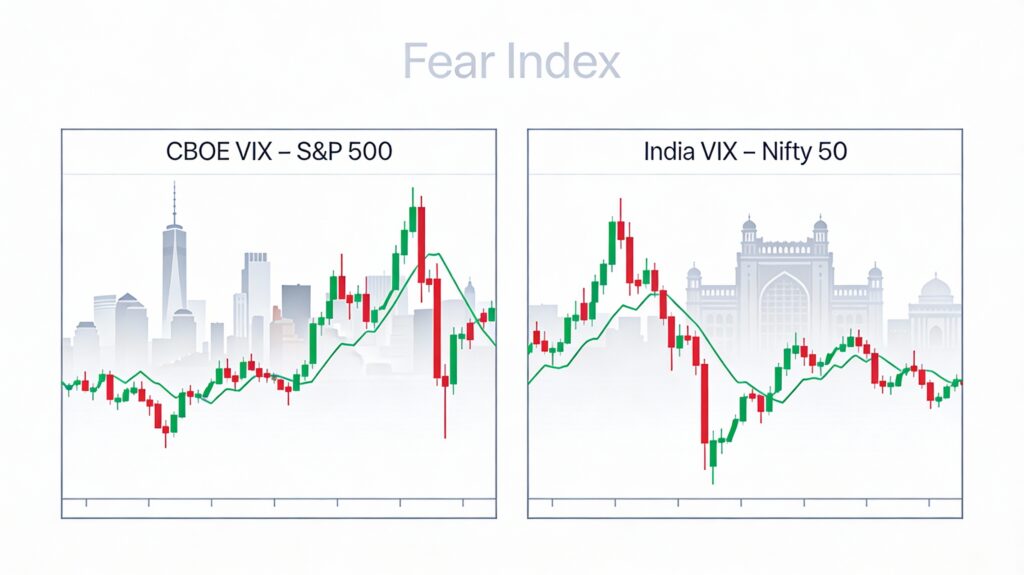
Volatility is commonly measured using an index called VIX, often referred to as the fear index.
The CBOE VIX measures expected volatility in the S&P 500 over the next 30 days. When investors expect large price swings, the VIX rises. When markets feel stable, it falls.
India VIX performs the same role for the Indian market by measuring expected volatility in the Nifty 50. A low India VIX indicates calm market conditions, while a high India VIX suggests fear and large expected movements.
Because global markets are connected, a sharp rise in the US VIX often leads to an increase in the India VIX as well.
High Volatility vs Low Volatility (Behavioral Comparison)
High-volatility markets are fast and unpredictable. Prices swing sharply, emotions run high, and short-term risk increases. Traders find more opportunities, while beginners often feel nervous.
Low-volatility markets are calm and stable. Price movements are slow, investor confidence is higher, and long-term investing feels comfortable. However, short-term trading opportunities are fewer.
Neither environment is good nor bad on its own. The impact of volatility depends on your time horizon and strategy.
Why Volatility Is Necessary for Wealth Creation
Volatility is not a flaw in the market—it is a feature.
Without volatility, prices would not adjust, corrections would not happen, and long-term returns would be limited. Bull markets are built through cycles of growth, correction, and recovery. Volatility allows markets to reset valuations and reward patient investors over time.
Historically, periods of volatility have created some of the best long-term investment opportunities.
Why Beginners Fear Volatility
Beginners fear volatility mainly because of emotions and lack of experience. Sudden price movements feel like danger when the reasons behind them are unclear.
Constantly checking prices, reacting to news headlines, and following social media commentary increases anxiety. Beginners also tend to focus on short-term losses rather than long-term goals, which makes volatility feel overwhelming.
With knowledge and experience, this fear gradually disappears.
How Investors Should Handle Volatility
The most important rule is to accept volatility as normal.
Long-term investors should avoid reacting to daily movements and focus on their financial goals. Checking portfolios too frequently should be avoided. Systematic Investment Plans (SIPs) work especially well during volatile periods by averaging costs automatically.
Diversification across assets and sectors reduces risk. Ignoring rumors and maintaining an emergency fund ensures that investments are not disturbed during market downturns.
Volatility should be managed with discipline, not emotion.
Common Myths About Volatility
A common myth is that volatility always signals a market crash. In reality, markets can be volatile during strong upward rallies as well.
Another myth is that investing should stop during volatile periods. History shows that investors who stayed invested during volatile phases achieved better long-term outcomes.
Volatility does not automatically mean manipulation. Most market movements are driven by genuine economic, financial, and global factors.
Final Thoughts on What is Volatility
Volatility is a natural part of the stock market. It cannot be avoided, but it can be understood. Once you understand why markets move and how volatility works, fear reduces and confidence increases. In the long run, volatility rewards patience, discipline, and knowledge.
Frequently Asked Questions
What causes sudden market volatility?
Sudden volatility is caused by unexpected news, global market movements, institutional buying or selling, economic data releases, and shifts in investor sentiment.
Is high volatility good or bad?
High volatility creates opportunities but also increases short-term risk. It is useful for traders and long-term investors who stay disciplined.
What is India VIX in simple words?
India VIX shows how much movement the market expects in the near future. A higher value means higher expected volatility.
Does volatility mean the market will fall?
No. Volatility only indicates movement, not direction.
Disclaimer: This article is for educational and informational purposes only and does not constitute financial, investment, or tax advice. Any investment decisions you make are your own responsibility, and you should consider your personal situation and, if needed, consult a qualified financial professional before acting.

You may also like
What Makes Stock Prices Go Up or Down? Simple Guide
Bull Market vs Bear Market: Meaning, Differences & Examples