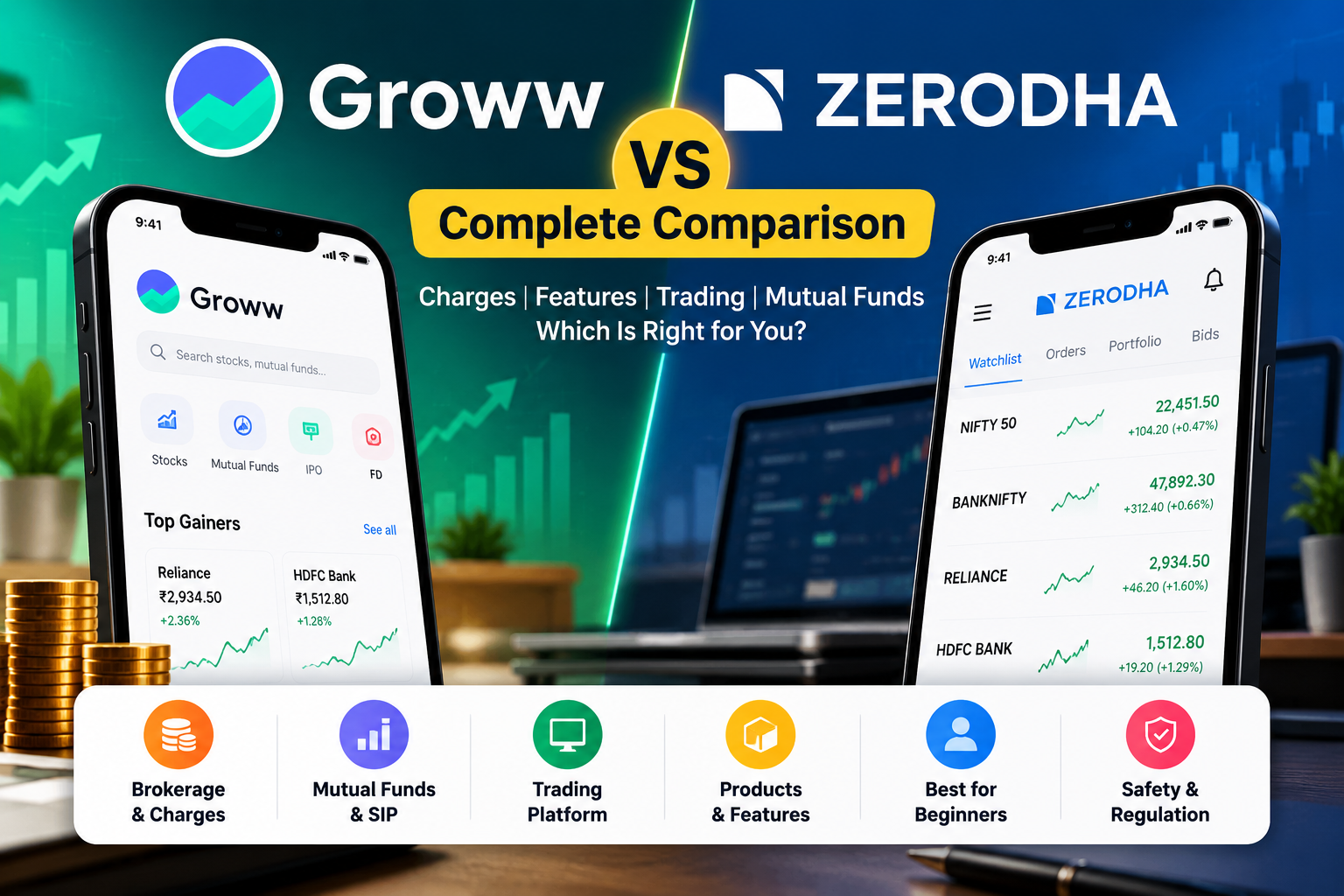
Groww vs Zerodha: Charges, Features & Which Is Right for You?
Groww vs Zerodha: Charges, Features, Mutual Funds & Which Fits Your Investing Style?
A detailed comparison of Groww and Zerodha covering brokerage, AMC, mutual funds, trading platforms, IPOs, reporting, customer support, safety and real-world costs.
Groww and Zerodha are both established Indian investment platforms, but they are designed around somewhat different user experiences. Groww provides a relatively unified investing and trading experience, while Zerodha uses a broader ecosystem built around Kite, Coin, Console and Varsity.
Instead of asking which broker is universally “better,” compare the platform’s current charges, products, trading tools, mutual-fund functionality, reporting and overall workflow with the way you actually invest.
Brokerage and account charges can change. The figures in this article were checked against the brokers’ official pricing information on October 3, 2026. Always verify the latest rate card before opening or funding an account.
If you are looking for an online stock broker in India, Groww vs Zerodha is one of the comparisons you are likely to come across.
Both platforms allow investors to buy stocks, ETFs, mutual funds and other market-linked products. However, their pricing structures, platforms, mutual-fund setup, trading tools, reporting systems and additional features are not identical.
That makes the question more complicated than simply asking, “Which is better, Groww or Zerodha?”
The more useful question is:
Which platform fits the way you actually invest or trade?
A long-term investor who buys a few stocks every month may care mostly about delivery charges, demat costs and portfolio tracking. Someone who actively trades futures and options may care much more about order execution, charts, option-chain tools, APIs and trading workflow.
Groww vs Zerodha at a Glance
| Feature | Groww | Zerodha |
|---|---|---|
| Account opening | ₹0 | ₹0 |
| Account maintenance | ₹0 | First year free for eligible new resident individual accounts; AMC applies thereafter depending on account type |
| Equity delivery brokerage | ₹20 or 0.1%, whichever is lower, subject to minimum brokerage rules | ₹0 |
| Intraday brokerage | ₹20 or 0.1%, whichever is lower | ₹20 or 0.03%, whichever is lower |
| Futures | ₹20 per executed order | ₹20 or 0.03%, whichever is lower |
| Options | ₹20 per executed order | ₹20 per executed order |
| Direct mutual funds | Yes | Yes, through Coin |
| IPO | Yes | Yes |
| Trading platform | Groww | Kite |
| Reporting | Groww reports | Console |
| Learning resources | Groww resources | Varsity |
What Are Groww and Zerodha?
What Is Groww?
Groww is an Indian investment and trading platform offering stocks, ETFs, mutual funds, IPOs, intraday trading, futures and options, commodities and other market-linked products.
The platform originally became particularly popular among investors looking for a simple way to start investing in mutual funds and stocks. Its product range has since expanded significantly.
Today, Groww provides a broader trading environment that includes charts, screeners, option chains, F&O trading, commodities and API-based trading.
What Is Zerodha?
Zerodha is an Indian discount brokerage platform built around a collection of specialized products.
Its ecosystem includes Kite for trading, Coin for direct mutual funds, Console for reports and analytics, Varsity for financial education and Kite Connect for APIs.
Instead of putting everything into one application, Zerodha separates different functions across its products.
Groww vs Zerodha Brokerage and Charges
Fees are one of the first things investors compare, but they are also one of the easiest areas to misunderstand.
A broker can advertise ₹0 brokerage for one type of transaction while other charges still apply.
Think about total cost as:
Brokerage + exchange charges + taxes + statutory charges + depository charges + account-maintenance charges
Account Opening Charges
For resident individual accounts, both Groww and Zerodha currently list ₹0 account-opening charges.
Annual Maintenance Charges
Groww currently lists ₹0 account maintenance charges.
Zerodha’s current structure is more nuanced. Eligible resident individual accounts opened on or after June 1, 2026 receive a first-year AMC waiver. From the second year, AMC depends on whether the account qualifies for Basic Services Demat Account treatment or is a regular non-BSDA account.
Groww vs Zerodha Equity Delivery Brokerage
Groww currently charges ₹20 or 0.1% of the trade value per executed equity order, whichever is lower, subject to its applicable minimum brokerage rules.
Zerodha currently charges ₹0 brokerage for equity delivery for eligible retail individual investors.
₹0 brokerage does not mean ₹0 total transaction cost. Statutory charges, exchange-related charges and DP charges can still apply.
Groww vs Zerodha Intraday Brokerage
For intraday equity trades, Groww currently charges ₹20 or 0.1% of trade value per executed order, whichever is lower, subject to its applicable minimum brokerage.
Zerodha currently charges ₹20 or 0.03% of trade value per executed order, whichever is lower.
Groww vs Zerodha Futures and Options Charges
Both platforms currently list ₹20 per executed order for options brokerage. Zerodha’s futures pricing is ₹20 or 0.03%, whichever is lower, while Groww currently lists ₹20 per executed F&O order.
Futures and options are complex financial products. Leverage and derivatives can produce rapid losses, particularly when position sizes are too large relative to available capital.
The Cost Beginners Often Miss: DP Charges
Suppose you buy shares and hold them for several months. When you eventually sell those shares, the broker may charge a Depository Participant or DP charge.
Both Groww and Zerodha publish DP charges for applicable sell transactions from demat holdings.
Groww vs Zerodha: Which Is Actually Cheaper?
There is no single answer for every investor.
Long-Term Stock Investor
Someone who buys stocks occasionally and holds them for several years should consider delivery brokerage, DP charges, AMC and portfolio reporting.
Monthly Mutual Fund Investor
Someone investing primarily in direct mutual funds has a different cost structure. Both platforms provide access to direct mutual funds without charging a platform commission for the investment itself.
Occasional Stock Trader
An investor who buys a few stocks each month should consider total costs, but usability can become just as important as a small difference in brokerage.
Active Trader
An active trader may care more about order workflow, charting, option-chain functionality, APIs, margin information, reporting and platform reliability.
Groww vs Zerodha for Mutual Funds
Mutual Funds on Groww
Groww allows investors to invest in mutual funds, including direct plans. The platform provides fund discovery, SIP functionality and portfolio tracking.
Zerodha Coin for Mutual Funds
Zerodha provides direct mutual funds through Coin. Coin is a mutual-fund platform within the Zerodha ecosystem and supports direct plans across many AMCs.
Coin also provides features such as SIPs, step-up SIPs, STPs and SWPs.
Direct vs Regular Mutual Funds
When comparing mutual-fund platforms, don’t stop at the word “free.”
Direct and regular mutual-fund plans have different cost structures. Direct plans generally do not include distributor commissions associated with regular plans.
Groww App vs Zerodha Kite
Groww Platform
Groww emphasizes a relatively unified experience across investing and trading. Its platform includes stocks, ETFs, IPOs, mutual funds, intraday trading, F&O, commodities, charts, screeners and other tools.
Zerodha Ecosystem
Zerodha separates its major products. Kite is the primary trading platform, Console provides reports and analytics, Coin handles direct mutual funds, and Varsity provides educational content.
Charting and Technical Analysis
For a long-term investor, advanced charting may not matter very much. For someone who actively studies price charts, it can become much more important.
Both platforms provide charting and technical-analysis tools. The important question is not which platform has the longest feature list. Ask whether the tools you actually use are available and understandable.
Groww vs Zerodha for Active Traders
Active traders generally need more than a low brokerage rate.
- Order-entry workflow
- Order types
- Charting
- Market depth
- Option chains
- Margin information
- Position management
- Alerts
- Trading reports
- API access
- Platform reliability
Groww vs Zerodha for Long-Term Investors
Long-term investors usually have a different set of priorities.
- Equity delivery costs
- Mutual-fund functionality
- SIPs
- ETFs
- Portfolio tracking
- Account maintenance
- Tax and transaction reports
- Ease of managing investments over many years
Groww vs Zerodha for IPOs
Both platforms provide access to IPO applications.
Your broker does not control IPO allotment. Applying through one broker does not automatically increase your probability of receiving an allotment.
Groww vs Zerodha: Products and Market Segments
| Product | Groww | Zerodha |
|---|---|---|
| Stocks | Yes | Yes |
| ETFs | Yes | Yes |
| Mutual funds | Yes | Yes, through Coin |
| IPO | Yes | Yes |
| Intraday | Yes | Yes |
| Equity F&O | Yes | Yes |
| Commodity derivatives | Yes | Yes |
| MTF | Yes | Yes |
| API trading | Available | Available through Kite Connect |
Groww vs Zerodha for Beginners
A beginner should not start the comparison with brokerage.
What Are You Planning to Invest In?
If your goal is mainly mutual funds, your requirements are different from someone who wants to trade options.
How Frequently Will You Transact?
Someone making a handful of investments each year has very different cost considerations from a frequent trader.
How Much Complexity Do You Actually Need?
Choose based on the features you can actually use responsibly.
Groww vs Zerodha for Experienced Investors
As an investment portfolio becomes larger or more complex, different factors can become more important.
- Capital-gains reporting
- Contract notes
- Portfolio analytics
- Corporate-action information
- Tax reports
- API access
- Portfolio consolidation
- Margin and pledge facilities
- Transfer processes
- Account administration
Customer Support and Problem Resolution
Customer support is easy to ignore when everything works. It becomes much more important when there is an account problem or transaction issue.
Rather than relying only on random online reviews, compare the formal support systems provided by each broker.
Are Groww and Zerodha Safe?
“Safe” is a broad word. A better question is:
What regulatory and operational protections exist, and what risks remain with the investor?
Both Groww and Zerodha operate within India’s regulated securities-market framework. Investors can verify registered intermediaries through SEBI’s official database.
However, broker regulation does not mean that every investment is safe or profitable.
A regulated broker does not eliminate market risk, company-specific risk, liquidity risk, leverage risk or derivatives risk.
Groww vs Zerodha for Portfolio Reporting and Taxes
Reporting is one of the most important areas that comparison articles often underestimate.
If you invest for many years, you may eventually need records of purchases, sales, acquisition prices, capital gains, dividends, corporate actions and charges.
Zerodha’s Console provides detailed portfolio and tax-related reporting. Groww also provides transaction, P&L and related account reports.
Can You Use Groww and Zerodha at the Same Time?
Yes. An investor can maintain accounts with multiple brokers, subject to applicable KYC and account requirements.
But having two accounts is not automatically better. Multiple accounts can increase administration, record keeping and portfolio fragmentation.
Can You Transfer Shares Between Groww and Zerodha?
Securities can generally be transferred between demat accounts, but the exact process depends on the depository and transfer method.
Before transferring securities, check the current transfer procedure, applicable charges, tax records, acquisition prices and whether the securities are pledged or otherwise restricted.
What Should You Check Before Opening Either Account?
- What products will I actually use?
- How often will I trade?
- How large will my portfolio become?
- Do I need advanced trading tools?
- Do I need API access?
- How important are reports and tax records?
- Do I really need more than one broker?
- Have I checked the latest charges?
Common Mistakes When Choosing a Stock Broker
Choosing Only Because Brokerage Is Low
A difference of a few rupees should not determine a decision involving years of investing. Look at the complete cost structure.
Assuming ₹0 Brokerage Means Everything Is Free
Exchange charges, taxes, DP charges, AMC and other applicable fees may still apply.
Choosing Based Only on App Design
An attractive interface is useful, but it should not be the main financial criterion.
Opening Multiple Accounts Without a Reason
Multiple accounts can make portfolio and tax administration more complicated.
Assuming a Broker Can Improve Investment Returns
A broker provides access to the market. It does not guarantee that the investments you buy will perform well.
Trading Complex Products Because They Are Available
The availability of options, futures or margin trading does not mean those products are appropriate for every investor.
Groww vs Zerodha: A Practical Decision Framework
If You Mainly Invest in Mutual Funds
Compare direct-plan availability, SIP features, portfolio tracking, holding structure and long-term convenience.
If You Mainly Buy Stocks for the Long Term
Compare delivery brokerage, DP charges, AMC, reporting and ease of portfolio management.
If You Trade Intraday
Pay more attention to brokerage, order workflow, charts, execution tools and platform reliability.
If You Trade Futures and Options
Look beyond brokerage. Understand margin requirements, transaction costs, order tools, risk-management features and derivatives risk.
If You Want Advanced Technology
Compare APIs, charting, market data, reporting and integration options.
If You Want Simplicity
Look at which platform makes the products you actually use easiest to understand and manage.
Frequently Asked Questions
Is Groww better than Zerodha for beginners?
There is no universal answer. Groww provides a relatively unified investing and trading experience, while Zerodha separates major functions across Kite, Coin, Console and Varsity.
Which is cheaper, Groww or Zerodha?
It depends on the transaction. Zerodha currently offers ₹0 brokerage on equity delivery for eligible retail individual investors, while Groww charges ₹20 or 0.1% per executed equity order, whichever is lower, subject to its applicable rules.
Is Groww or Zerodha better for mutual funds?
Both provide access to direct mutual funds. Groww provides mutual-fund investing within its platform, while Zerodha offers direct mutual funds through Coin.
Does Groww charge AMC?
Groww currently lists ₹0 account maintenance charges. Other transaction-related charges can still apply depending on the product and transaction.
Does Zerodha charge AMC?
Zerodha currently gives eligible new resident individual accounts opened from June 1, 2026 a first-year AMC waiver. From the second year, AMC depends on BSDA or non-BSDA status and applicable rules.
Can I use Groww and Zerodha together?
Yes. Investors can maintain accounts with multiple brokers, subject to applicable requirements. Multiple accounts can, however, increase administration.
Can I transfer shares from Groww to Zerodha?
Securities can generally be transferred between demat accounts. The exact process depends on the depository and transfer method.
Which is safer, Groww or Zerodha?
Both operate within India’s regulated securities-market framework. Investors should verify current registration information through SEBI. Regulation does not eliminate investment or market risk.
Official Resources
Putting It All Together
The Groww vs Zerodha comparison is not really about finding a permanent winner.
Both platforms have developed into much broader ecosystems than simple stock-broker apps. Groww combines investing and trading products in a relatively unified environment, while Zerodha uses specialized platforms such as Kite, Coin, Console and Varsity.
The more useful approach is to start with your own requirements.
Compare the current costs, understand the products, check the official information and then choose the platform that fits the way you actually invest.
Most importantly, don’t choose a broker simply because an advertisement, influencer or comparison article calls it the “best.”
A broker gives you access to financial markets; it does not guarantee investment returns.
Affiliate Disclosure: Some links on this page may be affiliate links. If you open an account through one of these links, SmartSourav may receive a commission at no additional cost to you. Affiliate relationships do not determine the factual comparison, pricing information or educational conclusions presented in this article.

You may also like

Price to Sales Ratio (P/S): Formula, Meaning & Calculation