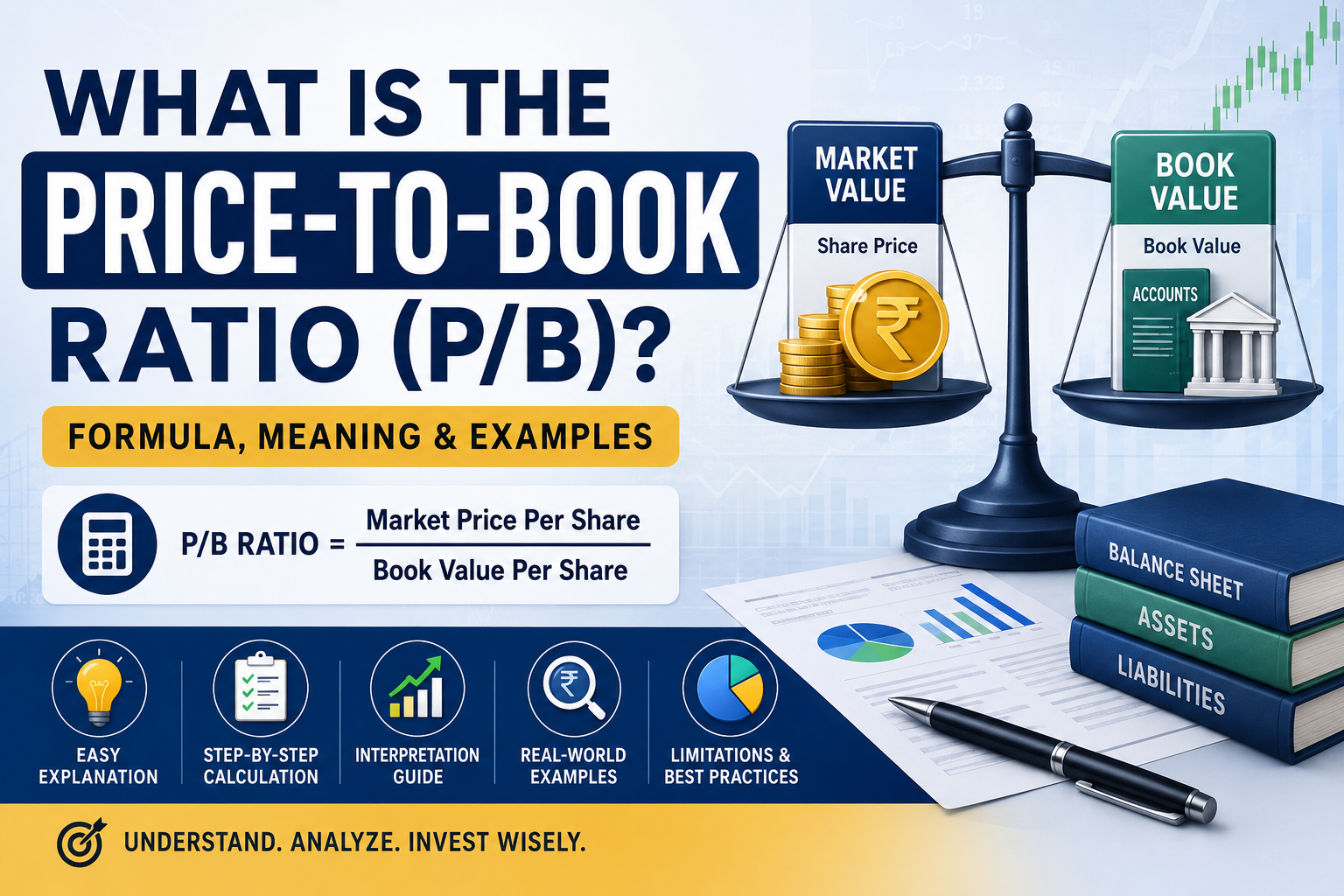
What Is the Price-to-Book Ratio? Formula, Meaning & Examples
What Is the Price-to-Book Ratio (P/B)? Formula, Calculation, Meaning & Examples
When evaluating a stock, looking at its share price alone doesn’t tell you whether the company is expensive, inexpensive, or fairly valued.
A stock trading at ₹100 may be expensive, while another trading at ₹1,000 may be relatively inexpensive. To understand valuation, investors use financial ratios that compare a company’s market value with different measures of its financial performance or assets.
One such metric is the price-to-book ratio (P/B ratio).
The price-to-book ratio compares a company’s market value with its accounting book value. It tells investors how much the market is willing to pay for each ₹1 of the company’s net assets attributable to shareholders.
For example, if a company has a P/B ratio of 3, investors are effectively valuing the company’s equity at ₹3 for every ₹1 of accounting book value.
But there’s an important catch: a low P/B ratio doesn’t automatically mean a stock is undervalued, and a high P/B ratio doesn’t automatically mean it is overvalued.
To use P/B effectively, you need to understand book value, profitability, return on equity (ROE), industry characteristics, asset quality, and the limitations of accounting numbers.
This guide explains everything from the basic P/B formula to more advanced concepts such as justified P/B and the relationship between P/B and ROE.
Table of Contents
What Is the Price-to-Book Ratio?
The price-to-book ratio (P/B) is a stock valuation metric that compares a company’s market value with the book value of its shareholders’ equity.
In simple terms, P/B tells you:
How much are investors paying for each ₹1 of the company’s accounting net assets?
The ratio can be calculated using either of these equivalent formulas:
P/B Ratio = Market Price Per Share ÷ Book Value Per Share
Or:
P/B Ratio = Market Capitalization ÷ Book Value of Equity
The price-to-book ratio is also commonly called the P/B ratio, P/BV ratio, price-to-book value ratio, or market-to-book ratio.
What Does P/B Actually Tell You?
Suppose a company’s book value per share is ₹50 and its stock trades at ₹100.
Its P/B ratio would be:
₹100 ÷ ₹50 = 2×
This means the market is valuing the company’s equity at twice its accounting book value.
However, P/B doesn’t tell you why the market has assigned that valuation.
A company may trade at 2× book because it generates strong returns on equity, has valuable intangible assets, has attractive growth prospects, or has a competitive advantage.
Therefore, P/B is best viewed as a starting point for analysis rather than a final valuation verdict.
What Is Book Value?
To understand P/B, you first need to understand its denominator: book value.
Book value is an accounting measure representing the shareholders’ equity remaining after subtracting a company’s liabilities from its assets.
The basic formula is:
Book Value = Total Assets − Total Liabilities
For example, suppose a company has:
- Assets = ₹1,000 crore
- Liabilities = ₹600 crore
Its book value would be:
₹1,000 crore − ₹600 crore = ₹400 crore
That ₹400 crore represents shareholders’ equity under the accounting framework.
However, book value should not automatically be interpreted as the amount shareholders would receive if the company were liquidated. The actual market value of assets can differ significantly from their accounting carrying values.
Book Value of Equity
Book value of equity generally represents the accounting value attributable to shareholders.
When calculating P/B, it’s important to use the appropriate equity measure and share count consistently.
Book Value Per Share
Investors often work with book value per share (BVPS) because stock prices are quoted on a per-share basis.
The simplified formula is:
Book Value Per Share = Common Shareholders’ Equity ÷ Shares Outstanding
For example, if common shareholders’ equity is ₹400 crore and there are 10 crore shares outstanding:
BVPS = ₹400 crore ÷ 10 crore = ₹40
If the stock trades at ₹120, the P/B ratio is:
₹120 ÷ ₹40 = 3×
Book Value vs Market Value
One of the easiest ways to understand P/B is to separate accounting value from market value.
| Concept | Meaning |
|---|---|
| Book value | Accounting value of shareholders’ equity |
| Market value | Value assigned by investors in the stock market |
| Book value per share | Book value allocated to each share |
| Stock price | Market value assigned to one share |
Book value comes primarily from financial statements, while market value is determined by the stock market.
The difference between the two is one of the central ideas behind the P/B ratio.
Price-to-Book Ratio Formula
The most commonly used formula is:
P/B = Market Price Per Share ÷ Book Value Per Share
For example:
Stock price = ₹150
Book value per share = ₹50
Therefore:
P/B = ₹150 ÷ ₹50 = 3×
The same ratio can be calculated using total values:
P/B = Market Capitalization ÷ Book Value of Equity
Both approaches should produce approximately the same result when the underlying figures are consistent.
How to Calculate the P/B Ratio Step by Step
Calculating P/B is relatively straightforward.
Step 1: Find the Company’s Total Assets
Start with the company’s balance sheet and identify total assets.
These may include cash, investments, property, equipment, inventory, receivables, and other assets.
Step 2: Subtract Total Liabilities
Subtract the company’s total liabilities from its total assets.
Book Value = Total Assets − Total Liabilities
This gives you shareholders’ equity under the relevant accounting framework.
Step 3: Calculate Book Value Per Share
Divide the applicable shareholders’ equity by the appropriate number of shares.
BVPS = Shareholders’ Equity ÷ Shares Outstanding
Step 4: Divide the Share Price by BVPS
Finally:
P/B = Share Price ÷ BVPS
The resulting number tells you how many times the market value exceeds—or falls below—the company’s accounting book value.
Price-to-Book Ratio Example
Let’s use a fictional company called ABC Ltd.
Suppose ABC Ltd. has:
- Total assets = ₹1,000 crore
- Total liabilities = ₹600 crore
- Shareholders’ equity = ₹400 crore
- Shares outstanding = 10 crore
- Current share price = ₹120
First, calculate book value:
₹1,000 crore − ₹600 crore = ₹400 crore
Now calculate book value per share:
₹400 crore ÷ 10 crore shares = ₹40
Finally:
P/B = ₹120 ÷ ₹40 = 3×
What Does a 3× P/B Ratio Mean?
A P/B of 3× means the market is valuing the company’s equity at approximately three times its accounting book value.
It does not automatically mean the company is expensive.
Investors may be willing to pay a premium because the company generates high returns on equity, has strong growth prospects, possesses valuable intangible assets, or has other competitive advantages.
The important question is therefore not simply:
“Is P/B high or low?”
The better question is:
“Why is the market assigning this P/B multiple?”
How to Interpret the Price-to-Book Ratio
P/B is often interpreted around three broad levels: below 1, around 1, and above 1.
But these levels should be treated as starting points rather than rigid valuation rules.
What Does a P/B Below 1 Mean?
A P/B below 1 means the company’s market value is below its reported book value.
For example:
Share price = ₹60
Book value per share = ₹100
P/B = 0.6×
The market is valuing the company’s equity at 60% of its accounting book value.
At first glance, this might appear attractive.
But there could be a good reason for the discount.
The market may expect:
- Future losses
- Asset write-downs
- Weak profitability
- Poor growth
- High financial risk
- Deteriorating asset quality
- Management problems
- Low returns on equity
Therefore:
P/B below 1 does not automatically mean a company is undervalued.
Sometimes a low P/B reflects a genuine opportunity. Other times, it reflects the market’s expectation that the company’s reported book value isn’t worth what the balance sheet suggests.
What Does a P/B of 1 Mean?
A P/B ratio of approximately 1 means the company’s market value is roughly equal to its accounting book value.
In simple terms, investors are paying approximately ₹1 for every ₹1 of book value.
That doesn’t necessarily mean the stock is fairly valued.
Whether 1× book is appropriate depends on the company’s profitability, growth, risk, asset quality, and industry.
What Does a P/B Above 1 Mean?
A P/B above 1 means the market is valuing the company’s equity above its accounting book value.
For example, a P/B of 2 means investors are paying ₹2 for every ₹1 of book value.
A premium can be justified when a company generates attractive returns on its equity or has valuable economic characteristics that aren’t fully reflected in book value.
Is a Higher P/B Ratio Bad?
Not necessarily.
A common beginner mistake is assuming:
Low P/B = good
and
High P/B = bad
Neither rule is reliable.
Consider two hypothetical companies.
Company A trades at 0.7× book but consistently earns a poor return on equity and has deteriorating assets.
Company B trades at 3× book but consistently generates very high returns on equity and has strong competitive advantages.
Simply choosing Company A because its P/B is lower would ignore the economics of the businesses.
This is why P/B needs context.
What Is a Good Price-to-Book Ratio?
There is no universally good P/B ratio.
A P/B that looks expensive for one industry may be perfectly normal for another.
When evaluating P/B, investors should consider the company’s:
- Industry
- Historical P/B
- Peer-group P/B
- ROE
- Growth prospects
- Asset quality
- Debt
- Profitability
- Accounting characteristics
Instead of asking:
“Is 2× P/B good?”
ask:
“Is 2× P/B reasonable for this particular business given its profitability, growth and risk?”
Why You Should Compare P/B With Industry Peers
Different businesses use their balance sheets in very different ways.
A bank, manufacturing company, software company and consumer brand can have dramatically different relationships between book value and economic value.
Comparing their P/B ratios directly can therefore produce misleading conclusions.
A better approach is to compare a company with similar businesses operating under similar economic conditions.
Why Historical P/B Matters
A company’s own historical valuation can also provide useful context.
Suppose a company has historically traded between 1.5× and 2.5× book, but currently trades at 1.2×.
That difference may warrant investigation.
However, historical valuation alone doesn’t prove that the stock is cheap. The company’s fundamentals may have changed.
Why Return on Equity (ROE) Matters When Using P/B
One of the most important concepts in understanding P/B is return on equity (ROE).
ROE measures how efficiently a company generates profit from shareholders’ equity.
A simplified formula is:
ROE = Net Income ÷ Average Shareholders’ Equity
The relationship between ROE and P/B is extremely useful because investors generally have more reason to pay a premium for a company that can generate attractive returns from its equity.
There is also an important mathematical relationship:
P/B = P/E × ROE
When expressed consistently, this relationship helps explain why P/B and P/E are connected.
High ROE + High P/B
A company with consistently high ROE may reasonably trade at a high P/B multiple.
The market may be assigning a premium because the company’s existing equity generates attractive economic returns.
Low ROE + Low P/B
A low P/B combined with persistently poor ROE may not indicate an overlooked bargain.
Instead, the low valuation could reflect the company’s inability to generate attractive returns from its asset base.
Low P/B + Improving ROE
This combination can be more interesting from an analytical perspective.
If a company is trading at a relatively low P/B while its profitability and ROE are improving, an investor may want to investigate whether the market’s valuation has caught up with the company’s changing fundamentals.
That is an analytical observation—not a recommendation to buy the stock.
Why P/B Ratio Is Especially Important for Banks and Financial Companies
The P/B ratio is particularly useful when analyzing many banks and financial institutions.
This is because equity and balance-sheet assets are central to the economics of these businesses.
For banks, analysts often examine P/B alongside:
- ROE
- Net interest margin
- Asset quality
- Capital adequacy
- Loan growth
- Credit costs
- Non-performing assets
A bank trading at a low P/B may deserve that valuation if its asset quality or profitability is weak.
Conversely, a bank trading at a premium may have stronger profitability and better-quality assets.
P/B and Bank Valuation
For financial companies, one useful question is:
“What return is the company generating on the book value for which investors are paying a premium?”
This connects P/B directly with ROE.
A bank earning consistently strong returns on equity may command a higher P/B than a bank with similar book value but significantly weaker profitability.
P/B vs Price-to-Tangible-Book Ratio
Another related metric is the price-to-tangible-book ratio (P/TBV).
Tangible book value generally removes certain intangible assets, particularly goodwill, from book value.
This can be useful when analysts want to focus more heavily on tangible net assets.
When Does the P/B Ratio Work Best?
P/B tends to be more informative when book value has a meaningful relationship with the underlying economics of the business.
Asset-Heavy Businesses
P/B can be useful for companies where physical or financial assets are important to the business model.
Examples can include:
- Banks
- Insurance companies
- Certain manufacturing companies
- Real estate businesses
- Some industrial companies
The usefulness varies considerably within each sector, so industry-specific analysis remains important.
Companies Where Book Value Is Economically Meaningful
P/B becomes more informative when the balance sheet provides a reasonable representation of the resources used to generate future returns.
This is one reason the metric can be more useful for financial institutions than for some technology or platform businesses.
When Does the P/B Ratio Work Poorly?
P/B has important limitations.
Technology and Asset-Light Businesses
Many modern companies create substantial economic value from assets that aren’t fully captured on their balance sheets.
These may include:
- Software
- Intellectual property
- Brand strength
- Customer relationships
- Networks
- Human capital
- Proprietary technology
As a result, book value can significantly understate the economic resources responsible for generating future profits.
A technology company can therefore have a very high P/B ratio without that number alone proving that the company is overvalued.
Companies With Negative Book Value
If liabilities exceed assets, shareholders’ equity can become negative.
In that situation, conventional P/B analysis becomes difficult or meaningless because the denominator is negative.
A negative P/B should therefore not be interpreted as “extremely cheap.”
Instead, it is generally a signal that the conventional P/B framework isn’t appropriate.
Businesses With Large Goodwill Balances
Acquisitions can create significant goodwill on a company’s balance sheet.
Goodwill is an accounting asset, but it doesn’t represent the same kind of tangible resource as cash, inventory, or property.
For this reason, analysts sometimes examine tangible book value in addition to ordinary book value.
Companies With Frequent Share Buybacks
Share repurchases can change shareholders’ equity and the number of shares outstanding.
Because both the numerator and denominator of per-share valuation metrics can change, investors should understand how capital allocation decisions affect book value per share.
P/B Ratio vs P/E Ratio
Two of the most commonly discussed valuation ratios are P/B and P/E.
But they answer different questions.
| Metric | P/B Ratio | P/E Ratio |
|---|---|---|
| Compares price with | Book value | Earnings |
| Main focus | Net assets/equity | Profit |
| Particularly useful for | Many financial and asset-heavy businesses | Profitable operating businesses |
| Key consideration | Asset/equity quality | Earnings quality |
| Major limitation | Intangibles and accounting values | Loss-making or highly cyclical earnings |
Which Is Better: P/B or P/E?
Neither is universally better.
P/E is often more intuitive for companies where earnings provide a meaningful representation of ongoing economic performance.
P/B can be particularly useful where shareholders’ equity is an important part of the business model.
In many cases, using both P/E and P/B, along with other financial metrics, can provide a more complete picture.
P/B Ratio vs P/S Ratio vs EV/EBITDA
Serious fundamental analysis rarely relies on just one valuation multiple.
P/B vs P/S
The price-to-sales (P/S) ratio compares a company’s market value with its revenue.
It can be useful when earnings are temporarily weak or negative, although revenue alone doesn’t tell you how profitable the business is.
P/B instead focuses on the company’s accounting equity.
P/B vs EV/EBITDA
EV/EBITDA compares enterprise value with earnings before interest, taxes, depreciation and amortization.
It is often used to compare operating businesses while reducing the impact of differences in capital structure.
P/B focuses on equity and balance-sheet value, while EV/EBITDA focuses more on the value of the operating business relative to a measure of operating earnings.
Why Investors Should Use Multiple Valuation Metrics
Every valuation ratio has weaknesses.
Using several complementary measures can help investors identify situations where one ratio is giving a misleading impression.
For example, a company could appear cheap on P/B but expensive on P/E.
That discrepancy isn’t necessarily a contradiction. It may simply indicate that the market is assigning a low value to the company’s assets while expecting relatively strong or weak future earnings.
The difference itself can be worth investigating.
Common Mistakes Investors Make When Using P/B
Assuming P/B Below 1 Means “Cheap”
A low P/B can reflect genuine undervaluation, but it can also reflect deteriorating fundamentals.
The correct approach is to ask why the market is applying the discount.
Comparing Completely Different Industries
P/B varies considerably between industries.
A ratio that is normal for one sector may be unusual for another.
Ignoring ROE
P/B without ROE can provide an incomplete picture.
Two companies with identical P/B ratios can deserve very different valuations if their ability to generate returns on equity differs substantially.
Ignoring Asset Quality
This is particularly important for banks and financial companies.
Reported book value is only as useful as the quality of the assets represented on the balance sheet.
Using Outdated Book Value
Book value changes over time as companies earn profits, incur losses, pay dividends, repurchase shares, issue shares, or recognize impairments.
Always consider the date of the underlying financial information.
Treating Book Value as Liquidation Value
Book value is an accounting measure.
It doesn’t guarantee that the company could sell its assets for exactly their carrying values.
How to Use P/B Ratio in Fundamental Analysis
P/B becomes much more useful when incorporated into a structured analytical process.
Step 1: Calculate the P/B Ratio
Start with the current share price and recent book value per share.
Step 2: Compare With Similar Companies
Look at comparable businesses rather than an unrelated industry.
Step 3: Compare With Historical Valuation
Determine whether the current P/B is high, low, or around the company’s historical range.
Step 4: Examine ROE
Ask whether the company’s return on equity supports the valuation premium or discount.
Step 5: Examine Debt and Asset Quality
A low P/B can mean something very different for a financially strong company versus a highly leveraged company with questionable assets.
Step 6: Examine Earnings and Cash Flow
Book value alone doesn’t explain the complete economics of a business.
Look at profitability, earnings quality and cash generation.
Step 7: Understand the Market’s Expectations
Ask:
Why does the market value this company at this P/B?
This is often the most important question.
Step 8: Cross-Check With Other Valuation Methods
Compare the conclusion with metrics such as P/E, P/S, EV/EBITDA, dividend-based methods or discounted cash flow where appropriate.
What Can Cause a Company’s P/B Ratio to Change?
P/B isn’t a fixed characteristic of a company.
It changes as both the market value and book value change.
The ratio can change because of:
- Changes in stock price
- Profits
- Losses
- Dividends
- Share buybacks
- New share issuance
- Asset impairments
- Acquisitions
- Changes in goodwill
- Changes in shareholders’ equity
Why Can P/B Fall Even When the Stock Price Doesn’t?
Because the denominator can change.
If book value per share increases while the stock price stays unchanged, the P/B ratio falls.
For example:
Initial:
Price = ₹100
BVPS = ₹50
P/B = 2×
Later:
Price = ₹100
BVPS = ₹60
Now:
P/B = 1.67×
The stock price didn’t change, but the valuation multiple fell because book value increased.
Why Can P/B Rise Without a Major Change in the Business?
If the stock price rises significantly while book value remains relatively stable, the P/B multiple increases.
For example:
Price = ₹100
BVPS = ₹50
P/B = 2×
If the price rises to ₹150 while BVPS remains ₹50:
P/B = 3×
The company may not have changed dramatically, but investors are now assigning a higher market valuation to each unit of book value.
Advanced Concept: Justified Price-to-Book Ratio
For serious learners, P/B becomes even more interesting when connected with ROE, growth and the cost of equity.
A simplified theoretical relationship is:
Justified P/B ≈ (ROE − g) ÷ (Cost of Equity − g)
Where:
- ROE = Return on Equity
- g = Sustainable growth rate
- Cost of Equity = Required return demanded by shareholders
This framework helps explain a fundamental principle of valuation.
If a company can consistently generate a return on equity greater than its cost of equity, investors may rationally assign a value above book.
If a company consistently earns less than its cost of equity, a valuation below book can potentially be justified.
This is much more informative than simply saying:
“P/B below 1 is cheap.”
The economics behind the ratio matter more than the ratio itself.
Real-World Interpretation: Three Hypothetical Companies
Let’s compare three fictional companies.
Company A: P/B of 0.7× and Low ROE
Suppose Company A trades at 0.7× book and generates a consistently low ROE.
At first glance, the stock may appear cheap relative to its accounting equity.
But the low P/B could be reflecting the company’s poor ability to generate profits from that equity.
The discount may therefore be rational.
Company B: P/B of 1× and Moderate ROE
Company B trades around book value and generates moderate returns.
The market may be assigning a valuation relatively close to the accounting value of the company’s equity.
Whether this is attractive depends on its future growth, risk, profitability and industry position.
Company C: P/B of 3× and High ROE
Company C trades at three times book but consistently produces a high ROE.
The premium could be rational because investors expect the company to continue generating strong returns on its equity.
This example demonstrates why P/B cannot be evaluated in isolation.
Advantages and Limitations of the P/B Ratio
Advantages of P/B
P/B is relatively simple to calculate and understand.
It provides a balance-sheet-based perspective that can complement earnings-based valuation metrics.
It can also be particularly useful for banks, insurers and certain asset-heavy businesses where book equity has meaningful economic relevance.
Additionally, comparing P/B across similar companies can help identify differences in market valuation.
Limitations of P/B
Book value is an accounting measurement and may not reflect the true economic value of a company’s assets.
Intangible-heavy businesses can be particularly difficult to evaluate using P/B.
Negative shareholders’ equity can make the ratio unusable.
Differences in accounting practices, asset quality, acquisitions, goodwill and capital allocation can also complicate comparisons.
Most importantly, P/B should not be treated as a standalone measure of intrinsic value.
Frequently Asked Questions About the Price-to-Book Ratio
What is a good price-to-book ratio?
There is no universally good P/B ratio. A meaningful benchmark depends on the company’s industry, profitability, ROE, growth prospects, asset quality, financial risk and historical valuation.
Is a price-to-book ratio below 1 good?
Not necessarily. A P/B below 1 means the market value is below reported book value, but the discount may reflect weak profitability, poor asset quality, expected losses or other risks.
What does a P/B ratio of 1 mean?
A P/B ratio of 1 means the company’s market value is approximately equal to its accounting book value.
What does a P/B ratio above 1 mean?
A P/B above 1 means the market is valuing the company’s equity at more than its reported book value. A premium may be justified if the company generates strong returns on equity or has attractive future prospects.
Can the price-to-book ratio be negative?
A conventional P/B ratio can become negative when shareholders’ equity is negative. However, a negative P/B is generally not meaningful using the normal interpretation of the ratio.
Why is P/B ratio important for banks?
Book equity is particularly important to banking businesses because their balance sheets and financial assets are central to their operations. Analysts often examine P/B alongside ROE, capital strength and asset quality.
Is P/B better than P/E?
Neither is universally better. P/B focuses on the relationship between market value and book equity, while P/E focuses on market value relative to earnings. The more useful metric depends on the characteristics of the company.
What is the difference between P/B and P/TBV?
P/B compares market value with book value, while P/TBV compares market value with tangible book value. Tangible book value generally excludes certain intangible assets, such as goodwill.
Does a low P/B mean a stock is undervalued?
No. A low P/B can indicate a potential discount, but it can also reflect poor profitability, deteriorating assets, high risk or weak future prospects.
Which industries use P/B ratio the most?
P/B is particularly relevant to banks and other financial institutions. It can also be useful for certain asset-heavy businesses where accounting book value has meaningful economic relevance.
Where can I find book value per share?
Book value and the information needed to calculate book value per share can generally be found in a company’s balance sheet, annual reports and regulatory filings. Investors should use recent financial information and ensure the equity and share-count figures are consistent.
What to Remember About the Price-to-Book Ratio
The price-to-book ratio compares a company’s market value with its accounting book value.
The basic formula is:
P/B = Share Price ÷ Book Value Per Share
A P/B below 1 means the market value is below reported book value, but it doesn’t automatically mean the company is undervalued.
A P/B above 1 means investors are paying a premium to book value, but that premium can be justified when a company generates strong returns on equity and has attractive economic characteristics.
The most useful P/B analysis considers ROE, industry peers, historical valuation, asset quality, profitability, debt and growth.
P/B can be particularly useful for banks and other financial companies, while it may be less informative for asset-light companies whose most valuable resources aren’t fully reflected on their balance sheets.
And for advanced analysis, the relationship between P/B, ROE, growth and cost of equity provides a much deeper understanding of why companies trade at premiums or discounts to book value.
Conclusion: P/B Is a Starting Point, Not a Verdict
The price-to-book ratio is one of the oldest and most useful tools in fundamental analysis, but its usefulness depends heavily on how you interpret it.
The biggest mistake is to look at a P/B of 0.7× and immediately conclude that a company is cheap—or look at a P/B of 5× and automatically conclude that it is expensive.
The number itself isn’t the complete story.
The real question is:
Why is the market willing to pay this much for the company’s book value?
A company trading below book could be undervalued, or it could be struggling with poor profitability and declining asset quality. A company trading at several times book could be expensive, or it could deserve a premium because it consistently generates high returns on equity.
That’s why P/B works best as part of a broader fundamental-analysis framework.
Use it alongside ROE, earnings quality, cash flow, balance-sheet strength, industry comparisons, historical valuation and other appropriate valuation methods.
Most importantly, treat financial ratios as tools for understanding businesses—not as automatic buy or sell signals.
Learning how to interpret the reason behind a valuation is far more valuable than memorizing what number is supposed to be “good.”
Related Posts:
- Financial Ratios Explained: PE, PB, ROE & How to Analyze Any Stock
- Price to Sales Ratio (P/S): Formula, Meaning & Calculation
- P/E Ratio: Meaning, Formula, Examples & How to Analyze It
- What Is EBITDA? Meaning, Formula, Calculation & Examples
- P/E Ratio vs EV/EBITDA: Differences, Formulas & Examples
- What Is the PEG Ratio? Formula, Calculation, Meaning, and How to Use It
- What Is EPS? Earnings Per Share Explained With Formula, Examples & How to Analyze It
- How to Value a Stock: Complete Stock Valuation Guide

You may also like

Price to Sales Ratio (P/S): Formula, Meaning & Calculation
P/E Ratio vs EV/EBITDA: Differences, Formulas & Examples