Upstox vs Zerodha: Charges, Features, Trading Platform & Which Fits Your Investing Style?
Upstox vs Zerodha: Charges, Features, Trading Platform & Which Fits Your Investing Style?
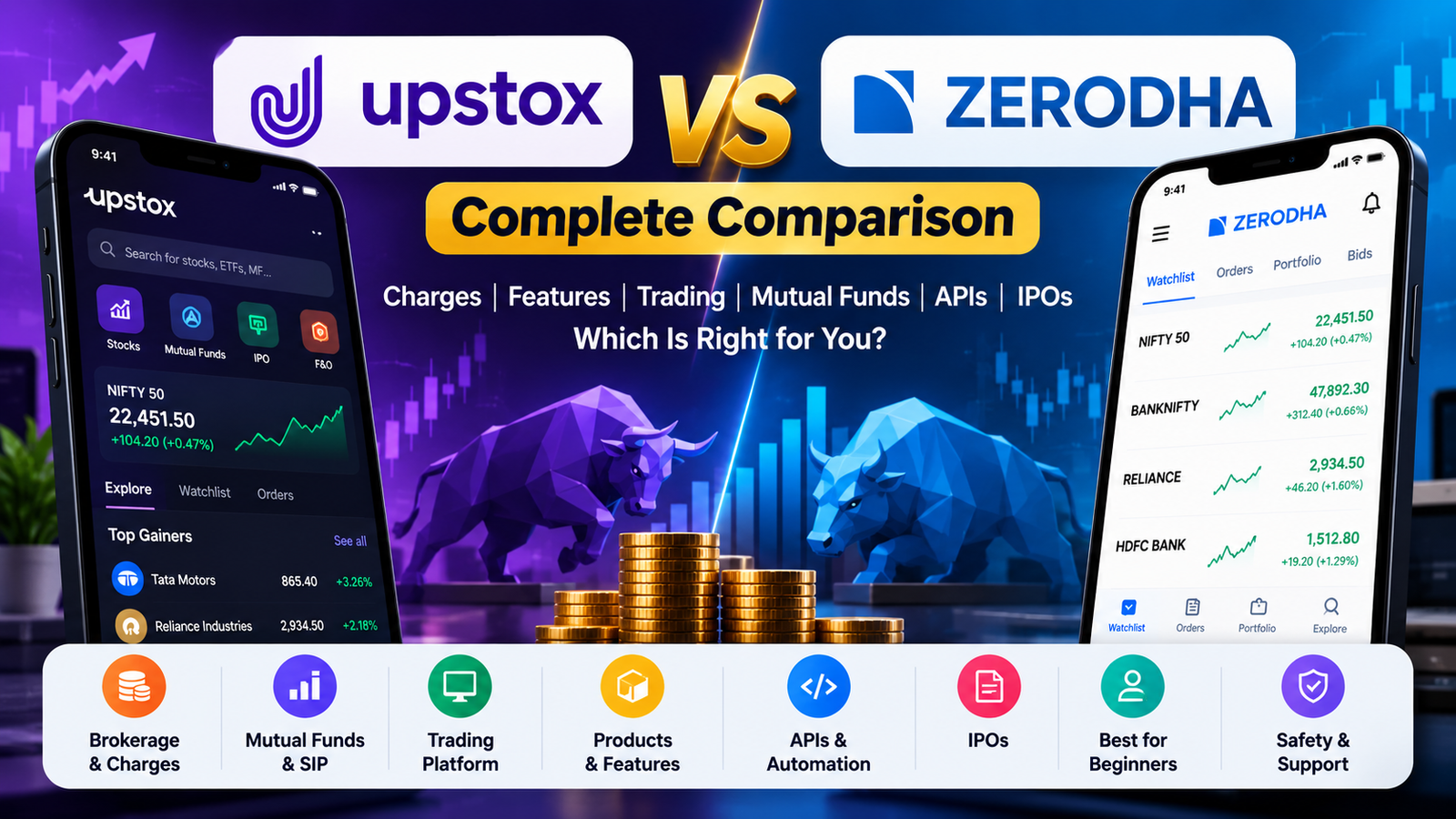
Comparing Upstox vs Zerodha? This detailed guide breaks down brokerage, AMC, DP charges, mutual funds, trading platforms, IPOs, APIs, education, customer support and the real cost of using each broker.
If you already know which platform fits your requirements, you can visit the respective broker before opening an account. Always verify the latest pricing and account terms on the broker’s official website.
Affiliate Disclosure: Some links on this page may be affiliate links. If you use them to open an account, SmartSourav may receive a commission at no additional cost to you. Our comparison is designed to explain the differences between the platforms and does not guarantee investment or trading results.
Choosing a stock broker is easy to underestimate. A ₹20 brokerage fee may look small, but the broker you choose also affects your demat costs, trading interface, order tools, mutual-fund experience, reports, customer support and the overall workflow you use to manage your money.
Upstox vs Zerodha is therefore not simply a question of which broker charges less. The better comparison is: which platform matches the way you actually invest or trade?
Upstox and Zerodha are both established online brokers, but they have developed somewhat different ecosystems. Upstox emphasizes a modern trading experience, integrated charting and a broad set of investment products. Zerodha has built a mature ecosystem around Kite, Console, Coin, Varsity and its developer APIs.
Upstox vs Zerodha: Quick Comparison
| Feature | Upstox | Zerodha |
|---|---|---|
| Account opening | ₹0 | ₹0 for online account opening |
| Equity delivery brokerage | ₹20 per executed order | ₹0 |
| Equity intraday | ₹20 or 0.1%, whichever is lower | ₹20 or 0.03%, whichever is lower |
| Equity futures | ₹20 or 0.05%, whichever is lower | ₹20 or 0.03%, whichever is lower |
| Equity options | ₹20 per executed order | ₹20 per executed order |
| AMC | First year free for eligible new users; non-BSDA ₹300 + GST thereafter | First year free for eligible resident individual accounts opened on/after June 1, 2026; non-BSDA ₹300 + GST thereafter |
| DP charge on equity delivery sell | ₹20 + GST per scrip per day | ₹15.34 for male primary holder; lower by ₹0.25 before GST for female primary holder |
| Direct mutual funds | Available | Available through Coin |
| Trading platform | Upstox Web & Mobile | Kite Web & Mobile |
| Education | Learning Center & Uplearn | Varsity |
The table is a starting point, not a final cost calculator. Brokerage is only one component of trading cost. STT, exchange transaction charges, GST, stamp duty, SEBI charges and DP charges can also affect your total cost.
What Are Upstox and Zerodha?
Both Upstox and Zerodha are online stockbrokers that provide access to Indian securities markets through digital trading platforms. They allow users to invest and trade across products such as equities and derivatives, while also offering additional investment services.
Upstox
Upstox provides a web and mobile trading platform with access to equities, derivatives, mutual funds, IPOs and other investment products. Its ecosystem also includes TradingView-powered charting, APIs and educational resources.
- Modern web and mobile trading experience
- TradingView-integrated charting experience
- Direct mutual funds
- Free trading and market-data APIs
Zerodha
Zerodha is built around a broader ecosystem that includes Kite for trading, Console for reporting and account management, Coin for mutual funds and Varsity for financial education.
- Kite trading platform
- Coin direct mutual-fund platform
- Console portfolio and reporting tools
- Varsity financial education
Upstox vs Zerodha Brokerage and Charges
This is where the comparison becomes interesting. Both brokers use discount-broker pricing, but they are not identical across every segment.
Equity Delivery
Upstox Basic currently charges ₹20 per executed equity-delivery order, while Zerodha charges ₹0 brokerage on equity delivery.
That difference matters most to investors who regularly buy and sell individual stocks for delivery. If you rarely sell and mostly hold, brokerage may still be a small part of your overall cost, but it should not be ignored.
Intraday Trading
Upstox charges ₹20 per executed order or 0.1% of turnover, whichever is lower. Zerodha charges ₹20 or 0.03%, whichever is lower.
Because of the percentage caps, the effective cost depends on the size of your order. Comparing only the ₹20 headline can therefore be misleading.
Futures
Upstox currently lists ₹20 per executed futures order or 0.05%, whichever is lower. Zerodha lists ₹20 or 0.03%, whichever is lower.
Options
Both currently charge ₹20 per executed options order. Remember that a complete options trade may involve separate buy and sell orders, so the brokerage can apply to each executed order.
AMC
AMC requires more attention than a simple “free or paid” label suggests. Upstox currently provides a first-year waiver for eligible new customers, with non-BSDA accounts listed at ₹300 + GST after the waiver period.
Zerodha currently provides a first-year AMC waiver for resident individual accounts opened on or after June 1, 2026. After that, non-BSDA individual accounts are charged ₹300 + GST annually. Eligible BSDA accounts can have lower charges depending on holding value.
DP Charges
DP charges generally apply when securities are debited from your demat account, such as when you sell delivery shares. These are separate from brokerage.
Upstox currently lists ₹20 + GST per scrip per day for equity-delivery sell transactions. Zerodha currently lists ₹13 before GST for a male primary holder, comprising ₹9.50 Zerodha plus ₹3.50 CDSL, resulting in ₹15.34 including GST. Female primary holders receive a ₹0.25 CDSL discount before GST.
Which Is Actually Cheaper: Upstox or Zerodha?
The answer depends on what you do with the account.
Upstox vs Zerodha for Mutual Funds
Both platforms support direct mutual-fund investing, which is important for investors comparing long-term costs.
Upstox Mutual Funds
Upstox states that mutual-fund investments on its platform are direct plans and that it does not charge brokerage for mutual-fund transactions. The underlying mutual fund can still have its own expense ratio, exit load or other applicable costs.
Zerodha Coin
Zerodha offers direct mutual funds through Coin. Coin currently provides access to a large range of direct mutual-fund schemes and supports tools such as SIPs, step-up SIPs, STP and SWP.
Zerodha has also integrated mutual-fund tracking into Kite Web, while Coin remains the dedicated mutual-fund transaction platform.
Which Is Better for SIP Investors?
If your main requirement is straightforward direct mutual-fund investing, either platform can work. Zerodha’s Coin ecosystem is particularly established, while Upstox combines mutual funds with its broader investment interface.
The important question is not simply which app has more funds. It is whether the platform makes it easy for you to select appropriate funds, maintain your SIP discipline and review your portfolio without making unnecessary changes.
Upstox vs Zerodha App and Trading Platform
Upstox Web & Mobile
Upstox focuses strongly on a modern digital trading experience. Its web platform includes an integrated TradingView experience with advanced charting and market-analysis tools.
This can appeal to traders who spend significant time studying charts, indicators, market depth and price behaviour.
Kite + Console + Coin
Zerodha separates several functions across its ecosystem. Kite is designed for trading, Console handles reporting and portfolio information, while Coin is focused on mutual funds.
This separation can feel more structured for experienced users, while beginners may initially need some time to understand which Zerodha product does what.
Which App Is Easier?
“Easy” is subjective. A beginner may prefer a simple interface with fewer decisions. An active trader may prefer more order types, chart controls, watchlists and market information.
Instead of asking which app looks better, ask whether the platform helps you execute your intended workflow accurately and without unnecessary complexity.
Upstox vs Zerodha for Active Traders
Active traders should look beyond brokerage.
Execution workflow, charting, order types, market data, alerts, API availability, margin requirements, reporting and platform stability can all influence the experience.
Upstox currently promotes an integrated TradingView experience and offers free access to its trading and market-data APIs. Its platform also supports tools such as GTT orders.
Zerodha’s Kite provides advanced order features including GTT, basket orders, iceberg orders and order slicing. Zerodha also has a mature API ecosystem through Kite Connect.
Upstox vs Zerodha for Long-Term Investors
For a long-term investor, the most important factors are usually different from those of an active trader.
- Equity-delivery brokerage
- AMC and demat costs
- DP charges when selling
- Mutual-fund availability
- Portfolio reporting
- Ease of tracking investments
- Tax and transaction records
- Quality of educational resources
Zerodha has a clear cost advantage on equity-delivery brokerage because delivery brokerage is ₹0. It also has a mature ecosystem for investors through Kite, Coin, Console and Varsity.
Upstox may still be a suitable choice for investors who prefer its interface, direct mutual-fund access and broader integrated platform.
Upstox vs Zerodha for IPOs
Both platforms provide online IPO application facilities. IPO applications themselves do not become better simply because one app has a more attractive interface.
What matters is whether the application process works smoothly for your bank/UPI setup, whether the IPO is eligible for your account type and whether you understand the risks of investing in newly listed securities.
IPO applications should not be treated as guaranteed short-term profit opportunities. Listing prices can be above or below the issue price.
Products and Investment Options
Both brokers offer more than just stock trading.
| Product / Feature | Upstox | Zerodha |
|---|---|---|
| Stocks | Yes | Yes |
| Intraday | Yes | Yes |
| Futures | Yes | Yes |
| Options | Yes | Yes |
| Mutual funds | Yes, direct plans | Yes, through Coin |
| IPO | Yes | Yes |
| Government securities / bonds | Selected products available | Yes, through its investment ecosystem |
| APIs | Free trading & market-data APIs | Personal API free; paid Connect plan for live/historical data |
Product availability and features can change, so verify the broker’s current product list before opening an account specifically for a particular instrument.
Upstox vs Zerodha for APIs and Automation
This is an important difference for technically inclined traders.
Upstox API
Upstox currently advertises free access to its trading and market-data APIs. Its API ecosystem is designed for connecting custom strategies, applications and trading systems to an Upstox account.
Zerodha Kite Connect
Zerodha offers a Personal API tier at no charge for order management, GTT, alerts and portfolio-related functions. Its paid Connect plan, currently ₹500 per month per API key, adds live market data through WebSockets and historical candle data.
Upstox vs Zerodha for Beginners
Beginners should avoid choosing a broker solely because it has the lowest advertised brokerage.
The first objective should be learning how the market works, understanding risk, knowing the difference between investing and trading, and avoiding unnecessary transactions.
Upstox vs Zerodha for Experienced Investors and Traders
Experienced users should make the decision more granular.
If you trade frequently, calculate your expected monthly turnover and compare the actual brokerage and statutory costs. If you use delivery investing heavily, calculate how often you sell securities and therefore incur DP charges.
If you use APIs, compare market-data access, historical data, order capabilities and subscription costs. If you primarily invest in mutual funds, compare the portfolio workflow and fund-management tools.
The “best” broker can therefore be different for two investors who have identical account sizes but completely different behaviour.
Customer Support: Upstox vs Zerodha
Customer support matters most when something goes wrong: an account problem, failed transaction, settlement issue, order-related question or documentation problem.
Upstox currently offers 24×7 chatbot support and email-based assistance, with customer-support staff available on trading days during specified hours.
Zerodha provides a support portal, ticket system and phone support during its published support hours.
Rather than declaring one universally better, consider which support channels you are comfortable using and whether your issue is likely to require human assistance.
Are Upstox and Zerodha Safe?
“Safe” should not mean that your investments cannot lose value. A broker can be regulated and still expose you to normal market risks.
SEBI maintains a recognised-intermediaries database that investors can use to verify registered market intermediaries.
As of October 2026, SEBI’s records list Zerodha Broking Limited as a registered stock broker and Upstox Securities Private Limited as a registered stock broker in the equity segment.
Tax Reports and Portfolio Records
For investors who make many transactions, reporting can become almost as important as the trading interface.
Keep records of your transactions, contract notes, realised gains, realised losses, dividends and other relevant income. These records can help when preparing tax returns or reconciling your portfolio.
Neither broker should be treated as a substitute for professional tax advice. Tax treatment can depend on the nature of the transaction, holding period, instrument and applicable rules.
Can You Use Upstox and Zerodha Together?
Yes, an investor can have accounts with multiple brokers, subject to the applicable account and regulatory requirements.
However, maintaining two brokers creates additional administrative work. You need to track multiple ledgers, contract notes, portfolios, tax reports and account charges.
There is also an important BSDA consideration. Eligibility for a Basic Services Demat Account can depend on having only one demat account linked to your PAN and meeting the applicable holding-value conditions.
Common Mistakes When Choosing Between Upstox and Zerodha
1. Looking only at brokerage
Brokerage is only one part of total trading cost.
2. Ignoring DP charges
Delivery investors should understand that selling demat-held shares can create DP charges.
3. Choosing based on a referral offer
A temporary promotion should not determine a long-term broker choice.
4. Confusing investing with trading
A platform designed for active traders may offer tools you don’t need as a long-term investor.
5. Chasing leverage
Higher available margin does not mean lower risk. Leverage can increase losses as well as gains.
6. Ignoring reporting
If you trade frequently, make sure you can easily access statements, transaction history and P&L information.
A Practical Upstox vs Zerodha Decision Framework
Instead of asking “Which broker is best?”, answer these questions:
Frequently Asked Questions
Is Upstox better than Zerodha?
Neither is universally better. Zerodha has a strong advantage for equity-delivery investors because delivery brokerage is ₹0, while Upstox may appeal to users who prefer its interface, TradingView integration and API offering.
Which is cheaper, Upstox or Zerodha?
It depends on the transaction. Zerodha is cheaper on equity delivery brokerage and has a lower intraday and futures percentage cap. Both charge ₹20 per executed options order. Total cost also includes taxes, exchange charges and other fees.
Does Upstox charge brokerage on delivery?
Yes. Upstox Basic currently lists ₹20 per executed equity-delivery order, subject to its pricing terms.
Does Zerodha charge brokerage on delivery?
No. Zerodha currently lists ₹0 brokerage on equity-delivery trades. Other applicable statutory charges and DP charges can still apply.
Which is better for options trading, Upstox or Zerodha?
Both currently charge ₹20 per executed options order. The more useful comparison is their trading interfaces, order tools, charting, reporting, API requirements and your personal workflow.
Which is better for long-term investing?
Zerodha has a clear advantage on equity-delivery brokerage, while both platforms can support long-term investing and direct mutual funds. Compare total costs and the investment tools you actually need.
Can I invest in mutual funds through Upstox?
Yes. Upstox offers direct mutual-fund investing without brokerage on the platform. Fund-level costs such as expense ratio and applicable exit loads can still apply.
Can I invest in mutual funds through Zerodha?
Yes. Zerodha offers direct mutual-fund investing through Coin, with features including SIP, STP and SWP.
Can I use Upstox and Zerodha together?
Yes, but maintaining multiple demat accounts can add administrative complexity and may affect BSDA eligibility. Open a second account only if you have a genuine reason to use both platforms.
Which has better trading charts, Upstox or Zerodha?
This is partly a matter of preference. Upstox currently offers an integrated TradingView experience, while Zerodha Kite provides its own advanced charting and trading ecosystem.
Is Upstox safe?
Upstox Securities Private Limited is listed in SEBI’s recognised intermediaries records as a registered stock broker. Regulatory registration does not eliminate market risk or guarantee investment returns.
Is Zerodha safe?
Zerodha Broking Limited is listed in SEBI’s recognised intermediaries records as a registered stock broker. Investors should still understand that market investments carry risk.
Official Resources
Brokerage, AMC, statutory charges, product availability and platform features can change. Verify the latest official information before opening an account or placing a trade.
Putting It All Together
Upstox vs Zerodha is not a comparison where one broker wins every category.
Zerodha has a clear cost advantage for equity-delivery investing because its brokerage is ₹0. It also has a mature ecosystem built around Kite, Coin, Console, Varsity and Kite Connect.
Upstox offers a competitive digital trading experience, direct mutual funds, an integrated TradingView experience and free access to its trading and market-data APIs. For some active traders and technically inclined users, those features may matter more than a small difference in brokerage.
The right way to choose is therefore to start with your own behaviour: how often you trade, what products you use, whether you invest in delivery stocks or mutual funds, whether you need APIs, how important charting is to you, and how much you care about reporting and education.
Before opening an account, compare the latest official charges and features, understand the applicable taxes and regulatory costs, and choose the platform you can use consistently and responsibly.

You may also like
Groww vs Zerodha: Charges, Features & Which Is Right for You?
Price to Sales Ratio (P/S): Formula, Meaning & Calculation