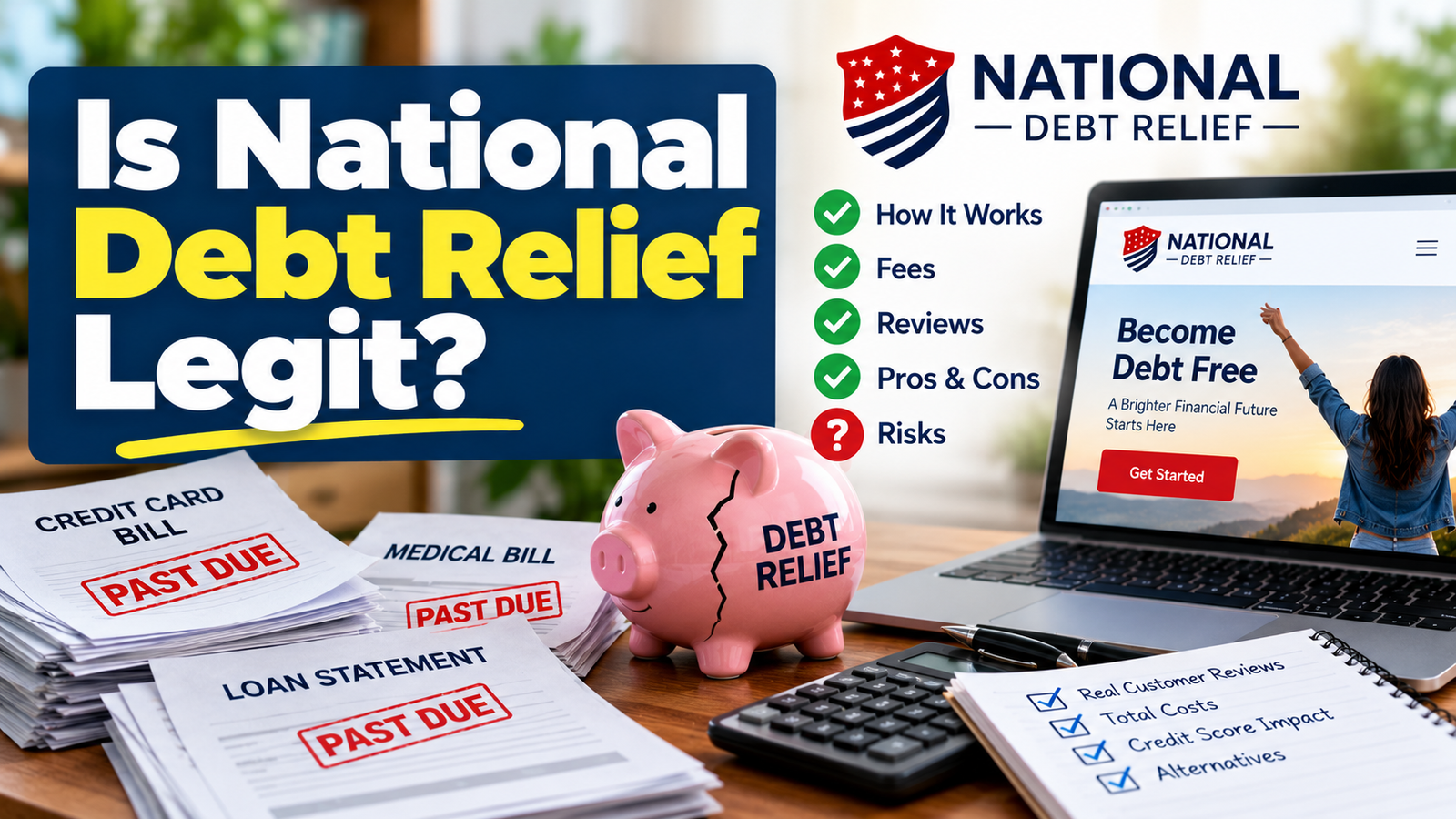
Is National Debt Relief Legit? Review, Fees & Risks
Is National Debt Relief Legit? Review, Fees, and Risks
If you are struggling with credit card bills and other unsecured debts, you may have come across National Debt Relief while searching for ways to become debt-free. But is National Debt Relief legit, or is it a company you should avoid?
National Debt Relief is an established debt settlement company, but its services come with important financial risks. It attempts to negotiate with creditors so eligible customers can settle certain debts for less than the full amount owed. However, settlements are not guaranteed, fees can reduce your savings, and missed payments can damage your credit.
In this review, we explain how National Debt Relief works, how much it may cost, what customers say, and which alternatives you should consider before enrolling.
Table of Contents
Is National Debt Relief Legit?
National Debt Relief is a real debt settlement company that operates in the United States. Its Better Business Bureau (BBB) profile lists an A+ rating and accreditation, which it has held since 2013. These are useful indicators of its business record, although the BBB does not endorse companies or guarantee customer satisfaction.
The company also has a substantial volume of online customer reviews. Its Trustpilot profile shows many positive experiences, alongside complaints about issues such as delays, communication, and unexpected financial demands.
However, a legitimate company is not necessarily the right choice for every borrower. Debt settlement can be expensive and risky, even when the company providing the service is established.
Before signing up, understand the fees, the possibility of lawsuits from creditors, the potential impact on your credit score, and whether a lower-cost solution could work for you.
What Is National Debt Relief?
National Debt Relief is a debt settlement company that helps eligible consumers negotiate with creditors and debt collectors.
Instead of simply combining several debts into a new loan, the company attempts to reach agreements under which creditors accept less than the full outstanding balance.
Its services may be relevant to people dealing with unsecured debts, such as:
- Credit card balances
- Certain personal loans
- Medical bills
- Certain private or unsecured debts, depending on eligibility
Not every debt qualifies. Mortgages, auto loans secured by vehicles, and other secured debts generally require different solutions.
For current eligibility requirements, consult the official National Debt Relief website.
How Does National Debt Relief Work?
The debt settlement process generally involves several stages.
1. Review your debts and finances
You provide information about your outstanding debts, income, expenses, and financial circumstances. The company assesses whether its program may be appropriate for you.
2. Enroll eligible debts
If you qualify and choose to proceed, you agree to the program’s terms and identify the debts included in the arrangement.
3. Build up funds for settlements
You may be asked to make regular deposits into a dedicated account to accumulate money for negotiated settlements and applicable fees.
This is an important distinction: your deposits are not necessarily payments toward your creditors’ bills as they come due.
4. Negotiate with creditors
National Debt Relief attempts to negotiate with creditors or debt collectors. A creditor may agree to accept a reduced amount, but it is not required to accept an offer.
5. Pay agreed settlements
If you approve a settlement, funds are used to pay the creditor according to the agreement. Applicable program fees may also become payable under the contract.
The process can take months or years, depending on your debt, available savings, creditors, and program terms.
Important: Debt settlement does not automatically stop collection calls, interest charges, late fees, or lawsuits. The exact outcome depends on the creditor and your circumstances.
How Much Does National Debt Relief Cost?
Debt settlement companies generally charge fees for successfully negotiated settlements. The exact amount you pay depends on the company’s current agreement and your enrolled debts.
National Debt Relief’s fee schedule should be confirmed directly with the company before enrollment. Independent reviews have commonly described fees in the range of 15%–25% of enrolled debt, but you should not assume this range applies to your particular agreement.
Ask the company to explain in writing:
- How its fee is calculated
- When each fee becomes payable
- Whether account administration charges apply
- How much you may need to deposit each month
- The estimated total cost of the program
- What happens to your money if you cancel
Example: How debt settlement costs can add up
Suppose you have $20,000 in eligible debt and a creditor agrees to settle a $10,000 balance for $6,000.
| Item | Hypothetical amount |
|---|---|
| Original debt being settled | $10,000 |
| Agreed settlement payment | $6,000 |
| Illustrative program fee at 20% of enrolled debt | $4,000 |
| Total settlement plus illustrative fee | $10,000 |
In this simplified example, the settlement and fee together equal the original $10,000 balance. This excludes any interest, late fees, account charges, or tax consequences that might apply.
The example is for illustration only. It is not a quote from National Debt Relief, and actual fees may be calculated differently.
This is why you should compare the total amount you will pay, not just the reduction a creditor agrees to accept.
National Debt Relief Reviews and Complaints
Customer reviews can help you understand the service experience, but they do not guarantee that you will get similar results.
What positive reviews say
Positive customer feedback on Trustpilot and the BBB review page includes praise for:
- Helpful and professional representatives
- Guidance during a stressful financial situation
- Communication and progress updates
- Assistance with negotiating settlements
Some customers report feeling more organized and confident while working toward resolving their debts.
What complaints highlight
The company’s BBB complaints page includes complaints involving billing, customer service, program progress, and dissatisfaction with outcomes.
Some Trustpilot reviewers also mention delays, continued creditor contact, or difficulties obtaining final paperwork.
The BBB page reports complaint totals, but those numbers should be interpreted in context. A complaint is not automatically proof of wrongdoing, and a company response does not necessarily mean the customer considers the issue resolved.
Before enrolling, read recent reviews and look for patterns related to the particular problems you want to avoid. Pay attention to how the company responds, not just its overall rating.
Pros and Cons of National Debt Relief
Potential advantages
- Professional negotiation assistance: The company attempts to negotiate with creditors on your behalf.
- Structured process: A program can provide a defined approach to addressing eligible debts.
- Possible reduced settlement amounts: Some creditors may accept less than the full amount owed.
- Support during financial hardship: Some customers value the guidance and communication they receive.
Potential disadvantages
- No guaranteed results: Creditors may reject settlement offers.
- Potential credit damage: Missed payments and collection activity can hurt your credit history and score.
- Additional costs: Program fees and accumulating interest or late fees may reduce or eliminate savings.
- Collection and lawsuit risks: Creditors may continue collection efforts or take legal action.
- Long timelines: It may take considerable time to accumulate enough money for settlements.
- Possible tax consequences: Some canceled debt may be taxable income.
The advantages matter most when the program produces meaningful savings after all costs. The disadvantages become especially important if you are already struggling to afford monthly expenses.
Is National Debt Relief Safe? Risks to Understand
Even when using an established company, debt settlement can create serious financial consequences.
1. Your credit score may fall
Debt settlement programs often involve stopping or reducing payments to creditors while you save money for settlements. This can result in late payments, delinquent accounts, and collection activity appearing on your credit reports.
If you expect to apply for a mortgage, auto loan, or other credit soon, consider how these effects could influence your plans.
2. Creditors may sue you
A creditor does not have to wait for a debt settlement company to complete negotiations. It may continue collection activity or file a lawsuit over an unpaid debt.
If you receive court papers, do not ignore them. Review the documents and respond by the applicable deadline. Consider speaking with a consumer-law attorney if you need help understanding your rights.
The Consumer Financial Protection Bureau explains why responding to a debt collection lawsuit is important.
3. Your debt may grow before it is settled
Interest, late fees, and penalty charges can accumulate while you are not making the required payments. If creditors refuse to settle, you could end up owing more than you did when you started.
4. Forgiven debt may have tax consequences
Depending on your circumstances, canceled debt may be treated as taxable income under federal tax rules. Certain exclusions or exceptions may apply, including insolvency in qualifying cases.
Review the IRS guidance on canceled debt and Form 1099-C and consult a qualified tax professional if necessary.
5. Watch out for unrealistic promises
Be cautious of any representative who guarantees that every debt will be settled, promises a specific percentage of savings, or claims that lawsuits and collection calls will stop completely.
The FTC explains that covered debt relief services generally cannot collect their fees before they have achieved a qualifying result and the consumer has made a payment under the agreement. Read the FTC’s debt relief services guidance for details.
Who Should Consider National Debt Relief?
A debt settlement program may be worth investigating if you have substantial unsecured debt, are experiencing serious financial hardship, and cannot realistically repay the full balances under your current arrangements.
It may be less suitable if you can afford your minimum payments, qualify for a lower-interest consolidation loan, or could resolve the debt through a less expensive repayment plan.
Before enrolling, calculate how much you can afford to set aside without sacrificing essential expenses such as housing, food, utilities, and healthcare.
Also consider whether you could negotiate directly with creditors or get help from a nonprofit credit counselor.
National Debt Relief Alternatives
Compare these options before committing to debt settlement.
Nonprofit credit counseling
A nonprofit credit counseling agency may help you create a budget or arrange a debt management plan. Depending on the program, creditors may agree to reduce interest rates or waive certain fees.
Start with the National Foundation for Credit Counseling to explore counseling options.
Debt consolidation loan
A consolidation loan combines eligible debts into a new loan. If you qualify for a lower interest rate and can afford the payments, it may simplify repayment and reduce interest costs.
However, approval and terms depend on your credit profile and finances. Consolidation does not eliminate debt by itself.
Balance transfer credit card
A balance transfer card may offer a promotional low or 0% interest period to eligible applicants. Balance transfer fees and the standard interest rate after the promotion can affect the savings.
This option generally works best when you can repay the transferred balance within the promotional period.
Negotiate directly with creditors
You can contact your creditors to ask about hardship programs, reduced interest, payment arrangements, or settlement offers. Get any agreement in writing before paying.
Bankruptcy
For some people facing severe financial hardship, bankruptcy may be a more appropriate legal option than a prolonged debt settlement program. It has significant consequences, so consider consulting a qualified bankruptcy attorney about eligibility and alternatives.
For an overview of these options, see the CFPB’s guide to credit counseling, debt settlement, and debt consolidation.
Questions to Ask Before Signing Up
Before enrolling with National Debt Relief or another provider, ask:
- What is the total estimated cost, including every fee?
- Which of my debts qualify for the program?
- What happens if a creditor refuses to settle?
- Could my creditors sue me while I am enrolled?
- How long might the process take?
- Who controls the dedicated account, and can I withdraw my funds?
- What happens to my money and outstanding fees if I cancel?
- What are my options if I cannot afford the scheduled deposits?
Request written answers and read the contract carefully. Avoid relying solely on verbal promises.
Frequently Asked Questions
Is National Debt Relief a scam?
National Debt Relief is an established debt settlement company with a public business profile and a large volume of customer reviews. However, that does not mean every customer will benefit or that the service is risk-free. Evaluate its current terms, fees, and potential consequences before enrolling.
Does National Debt Relief really reduce debt?
It attempts to negotiate settlements that may be lower than the full balances owed. Whether you save money depends on creditor acceptance, program fees, accumulating interest and penalties, and other costs. Savings are not guaranteed.
How much does National Debt Relief charge?
Fees depend on the agreement and program terms. Ask for a written fee schedule and a personalized estimate of your total cost before signing up.
Will National Debt Relief hurt my credit score?
It can. Missed payments, delinquent accounts, and collection activity associated with debt settlement may damage your credit. The extent and duration of the impact vary by person.
Can creditors sue me while I am enrolled?
Yes. Enrollment does not automatically prevent a creditor or debt collector from pursuing legal action. Respond promptly to any court documents and seek legal advice if needed.
Is National Debt Relief better than debt consolidation?
Neither option is universally better. Debt consolidation may reduce interest if you qualify for favorable loan terms. Debt settlement attempts to negotiate lower payoff amounts but can involve credit damage, fees, and legal risks. Compare the total cost and consequences of both options.
Final Verdict: Should You Use National Debt Relief?
National Debt Relief is an established company that provides debt settlement services, but its legitimacy alone should not determine whether you enroll.
The program may help some consumers negotiate eligible debts, yet it can also lead to damaged credit, additional charges, collection activity, and lawsuits. Fees can significantly reduce the savings a settlement appears to offer.
Before signing up, compare the program with nonprofit credit counseling, direct negotiations with creditors, debt consolidation, and—if appropriate—bankruptcy advice.
The bottom line: Do not choose a debt settlement company based only on its ratings or advertised savings. Calculate your potential total cost, understand the risks, and make sure you can afford the plan before committing.
Disclaimer: This article is for educational purposes only and does not constitute legal, tax, or personalized financial advice. Company terms, fees, reviews, and eligibility requirements may change. Verify current details directly with the provider and consult a qualified professional about your circumstances.

You may also like