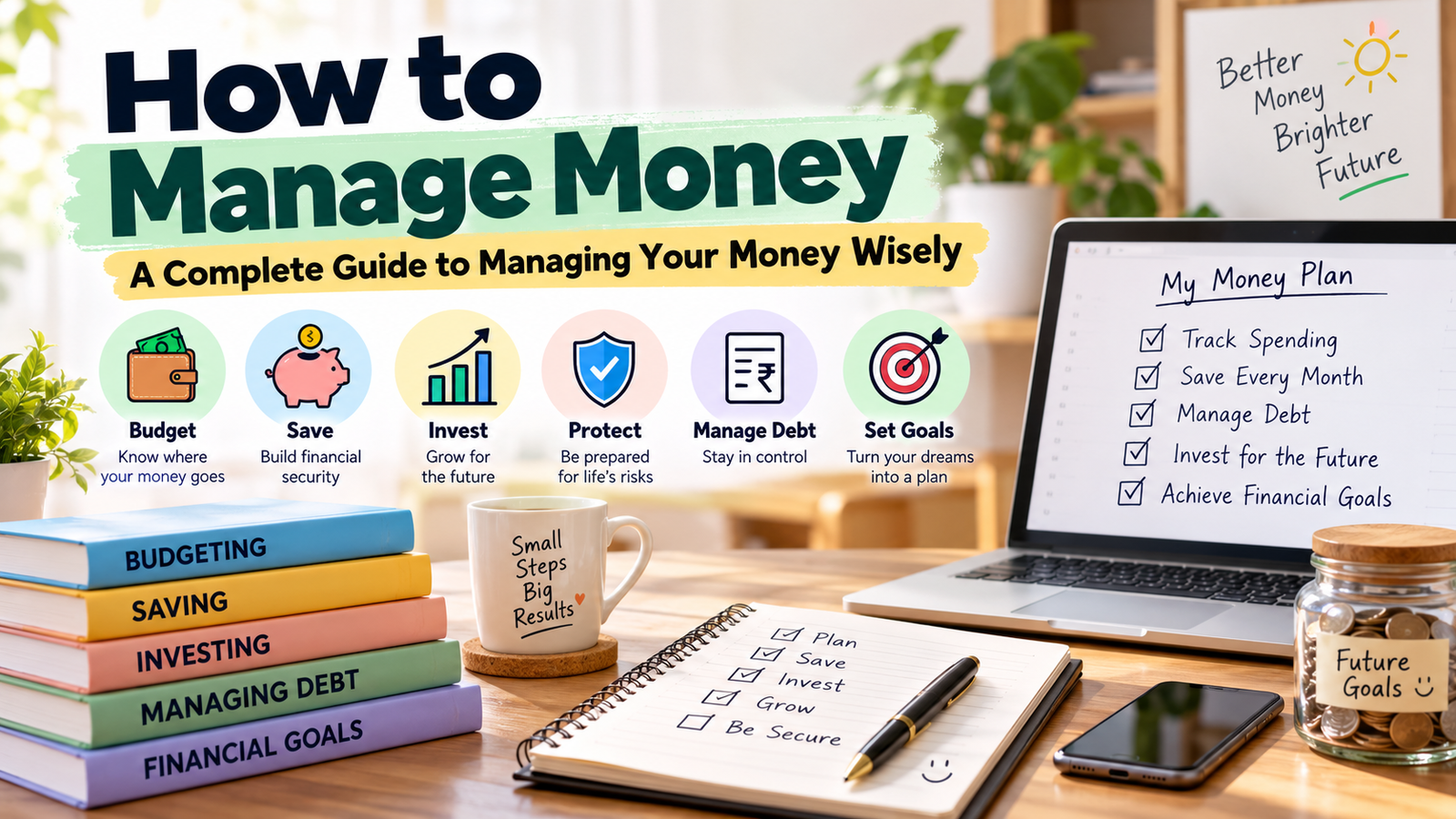
How to Manage Money: A Complete Guide to Managing Your Money Wisely
Learning how to manage money is one of the most important financial skills you can develop. You don’t need a high income, a complicated spreadsheet, or advanced investment knowledge to get started.
Good money management simply means knowing how much money comes in, deciding where it should go, preparing for unexpected expenses, managing debt, protecting yourself from financial risks, and putting some money toward future goals.
A simple money-management system can be thought of as:
Earn → Spend → Save → Protect → Manage Debt → Set Goals → Invest → Review
The important part is not following a perfect formula. It is building a system that works with your income, expenses, responsibilities and goals.
In simple terms: Managing money means giving your money a purpose before you spend it, while making sure you are prepared for both today’s needs and tomorrow’s uncertainties.
Table of Contents
What Does It Mean to Manage Your Money?
Money management is the process of making decisions about your income, spending, savings, debt, protection and investments.
It answers some basic questions:
- How much money do I have coming in?
- How much do I need for essential expenses?
- Where is my money going?
- How much should I save?
- Do I have enough emergency savings?
- Which debts need attention?
- What financial goals am I working toward?
- How much investment risk can I reasonably take?
Managing money is therefore much broader than simply creating a budget.
A budget tells you where your money is expected to go. A complete money-management system also considers savings, debt, financial protection, investing and long-term goals.
Why Earning More Doesn’t Automatically Solve Money Problems
A higher income can make financial goals easier, but it doesn’t guarantee financial security.
For example, imagine two people:
Person A earns ₹80,000 per month but spends ₹82,000.
Person B earns ₹50,000 per month and consistently spends ₹42,000.
Person A earns more, but Person B may have greater monthly financial flexibility because there is money left after expenses.
This is why income and financial health are not the same thing.
Step 1: Know Where Your Money Is Going
Before changing your financial habits, understand your current financial situation.
You cannot manage money effectively if you don’t know where it is going.
Calculate Your Take-Home Income
Start with the amount of money that is actually available to you.
For salaried employees, distinguish between:
- Gross salary
- Deductions
- Take-home salary
For freelancers, business owners and people with variable income, monthly income may change significantly.
In that situation, it can be safer to build your regular budget around a conservative estimate rather than assuming every month will be your best month.
Calculate Your Essential Expenses
Your essential expenses are the costs you generally need to pay to maintain your household and meet important obligations.
They might include:
- Rent or home expenses
- Food
- Electricity
- Transportation
- Education
- Healthcare
- Loan payments
- Insurance premiums
- Essential family expenses
Knowing your essential monthly expenses is particularly useful because this number can help you estimate your emergency-fund needs and understand how much income you need to maintain your basic lifestyle.
Separate Needs, Wants and Financial Obligations
A simple way to understand spending is to divide it into three broad categories.
Needs
Expenses that are necessary for basic living or important obligations.
Examples include food, housing and essential healthcare.
Wants
Expenses that improve your lifestyle but can generally be reduced or postponed.
Examples include:
- Restaurant meals
- Entertainment
- Non-essential shopping
- Some subscriptions
- Luxury purchases
Financial Obligations
These include commitments such as:
- Loan EMIs
- Credit-card payments
- Insurance premiums
- Other contractual financial commitments
The purpose isn’t to eliminate all wants.
The goal is to understand them so you can decide how much you can comfortably spend without damaging your financial goals.
Calculate Your Net Worth
Another useful measure of financial health is net worth.
Formula:
Net Worth = Total Assets − Total Liabilities
Your assets may include:
- Cash
- Bank deposits
- Investments
- Property
- Business assets
- Other valuable assets
Your liabilities may include:
- Home loans
- Vehicle loans
- Personal loans
- Credit-card balances
- Other outstanding debt
Example
Suppose you have:
- ₹3 lakh in savings
- ₹5 lakh in investments
- ₹10 lakh in other assets
Your total assets are ₹18 lakh.
If you owe ₹7 lakh:
₹18 lakh − ₹7 lakh = ₹11 lakh
Your net worth is ₹11 lakh.
Tracking net worth over time can give you a broader picture of financial progress than income alone.
Step 2: Track Your Spending Before Creating a Budget
Many people try to create a budget without first understanding their actual spending.
That can lead to unrealistic budgets.
For one month, track where your money actually goes.
You can use:
- A notebook
- Spreadsheet
- Banking app
- Budgeting app
- Simple notes on your phone
You don’t need an elaborate system.
What Should You Track?
Look at categories such as:
- Housing
- Groceries
- Eating out
- Transportation
- Electricity
- Mobile and internet
- Education
- Healthcare
- Shopping
- Entertainment
- Subscriptions
- Loan payments
- Insurance
- Investments
- Other recurring expenses
Don’t forget expenses that happen only once or twice a year.
For example:
- Insurance premiums
- Vehicle servicing
- School expenses
- Home repairs
- Festivals
- Annual subscriptions
These expenses can make a budget appear successful for several months and then suddenly cause a cash-flow problem.
Why You Should Track Spending Before Cutting It
Imagine you discover that you spend ₹4,000 every month on several subscriptions, frequent restaurant meals and small online purchases.
You may have thought your problem was that your income was too low.
After tracking your expenses, you discover that the real issue is how your money is being allocated.
The purpose of tracking isn’t to make you feel guilty.
It is to give you information.
Once you know what is happening, you can decide what should change.
Step 3: Create a Budget That Matches Your Real Life
A budget is a plan for how you intend to use your income.
It should answer:
“Where should my money go this month?”
A useful budget should be realistic enough that you can follow it consistently.
Popular Budgeting Methods
There is no single budgeting system that works for everyone.
Common approaches include:
- Zero-based budgeting
- 50/30/20 budgeting
- Pay-yourself-first budgeting
- Category-based budgeting
- Simple cash-flow planning
What Is the 50/30/20 Rule?
The 50/30/20 framework divides after-tax income roughly into:
- 50% for needs
- 30% for wants
- 20% for savings and financial goals
It can be a useful starting framework, but it is not a universal financial rule.
Someone living in an expensive city may spend more than 50% on essential costs.
Someone with significant debt may need to allocate more toward debt repayment.
Someone with a low income may not realistically be able to save 20%.
The best budget is usually one that reflects your actual circumstances and can be maintained over time.
Example of a Simple Monthly Budget
Imagine someone earns ₹60,000 per month after deductions.
A hypothetical budget could look like this:
| Category | Amount |
|---|---|
| Essential expenses | ₹30,000 |
| Debt payments | ₹8,000 |
| Emergency savings | ₹5,000 |
| Long-term investing | ₹7,000 |
| Discretionary spending | ₹10,000 |
| Total | ₹60,000 |
These numbers are purely illustrative.
The correct allocation for another person could look completely different because of differences in income, family size, debt, housing costs and financial goals.
Step 4: Separate Your Money Into Purpose-Based Buckets
One practical way to make money management easier is to give different amounts of money different jobs.
Think of your money like water stored in several containers.
If everything is placed into one large container, it becomes difficult to know how much is actually available for each purpose.
You can instead think in terms of:
Bills Bucket
Money reserved for predictable financial obligations.
Everyday Spending Bucket
Money available for normal daily and discretionary expenses.
Emergency Fund
Money reserved for genuine unexpected financial needs.
Goal Fund
Money being accumulated for a specific upcoming goal.
Long-Term Investment Money
Money intended for goals with a longer time horizon and an appropriate level of investment risk.
The actual accounts or products you use can vary. The important idea is purpose-based organization.
Step 5: Automate the Important Parts of Your Money
One of the easiest ways to improve money management is to automate repetitive financial decisions.
Why?
Because relying entirely on willpower can make saving difficult.
If you receive your income and spend first, you may find that little remains at the end of the month.
Instead, you can arrange appropriate automatic transfers for important financial priorities.
For example:
Income arrives → savings transfer → bills → spending money
This is commonly described as paying yourself first.
Automation can be useful for:
- Savings
- Regular bills
- Loan payments
- Long-term contributions
However, automation shouldn’t mean ignoring your finances.
Review your system periodically to make sure:
- Your expenses haven’t changed significantly
- Your savings are still appropriate
- Your debt is under control
- Your goals haven’t changed
- Your investments still match your objectives
Step 6: Build an Emergency Fund
An emergency fund is money set aside specifically for unexpected financial needs.
It can help you deal with events such as:
- Sudden loss of income
- Major essential repairs
- Unexpected healthcare costs
- Urgent family expenses
Without emergency savings, an unexpected expense may force you to:
- Borrow money
- Use expensive credit
- Sell investments at an inconvenient time
- Delay important payments
The Consumer Financial Protection Bureau also highlights emergency savings as a way to reduce the need to rely on credit or loans when unexpected expenses occur.
How Much Should You Keep in an Emergency Fund?
There is no universal number.
You may see recommendations such as three to six months of essential expenses, but this should be treated as a guideline rather than a rule that applies equally to everyone.
Your situation matters.
Consider:
- Monthly essential expenses
- Income stability
- Number of dependents
- Job security
- Business income
- Existing debt
- Insurance coverage
- How quickly you could replace your income
Someone with stable employment may have different requirements from someone whose income changes significantly every month.
Where Should You Keep Emergency Money?
Emergency money has a different job from long-term investment money.
Its primary characteristics should generally include:
- Accessibility
- Liquidity
- Stability
The purpose is not to maximize returns.
If you need emergency money next week, a large temporary decline in its value could create a serious problem.
This is why emergency funds should generally be separated from money intended for long-term investment goals.
Step 7: Manage Debt Before It Controls Your Budget
Debt can be useful when used carefully, but it can also become a major financial burden.
The first step is to know exactly what you owe.
Create a debt list containing:
| Debt | Outstanding Balance | Interest Rate | Monthly Payment | Remaining Term |
|---|---|---|---|---|
| Loan A | ₹2,00,000 | 10% | ₹6,000 | 4 years |
| Loan B | ₹50,000 | 18% | ₹3,000 | 2 years |
The numbers above are only an example.
Once you see all your debt in one place, it becomes easier to decide what needs attention.
Understand the True Cost of Borrowing
Don’t look only at the EMI.
Ask:
- What is the interest rate?
- Are there processing fees?
- What is the total repayment?
- How long will I remain in debt?
- What happens if my income falls?
- Are there penalties or other charges?
Real-world analogy
Borrowing money is like renting money.
The longer you rent it and the higher the cost of borrowing, the more you may eventually pay.
A small monthly payment doesn’t necessarily mean a cheap loan.
Debt Avalanche vs. Debt Snowball
Two popular repayment approaches are the debt avalanche and debt snowball.
Debt Avalanche
You prioritize the debt with the highest interest rate while continuing required payments on other debts.
The main focus is reducing interest costs.
Debt Snowball
You prioritize the smallest debt balance first.
The main appeal is the psychological benefit of eliminating individual debts quickly.
Both are legitimate frameworks.
The appropriate method depends on your debt structure, financial situation and ability to stay consistent.
Be Careful With Credit Cards
A credit card is not additional income.
It is a borrowing facility that can become expensive if balances are carried and interest or other charges apply.
Understand:
- Credit limit
- Outstanding balance
- Minimum payment
- Interest charges
- Payment due date
- Fees and penalties
Paying only the minimum amount can allow debt to remain outstanding for a long time.
Step 8: Save for Specific Financial Goals
Saving becomes easier when you know why you are saving.
Instead of saying:
“I want to save more money.”
Try:
“I want to accumulate ₹3 lakh within two years for a planned expense.”
Now you have:
- A target
- A deadline
- A measurable amount
A simple starting calculation is:
Goal amount ÷ number of months available = approximate monthly contribution
For example:
₹2,40,000 ÷ 24 months = ₹10,000 per month
This is a simple mathematical illustration and does not account for investment returns, taxes or other factors.
Short-, Medium- and Long-Term Goals
Short-Term Goals
These may include:
- Emergency savings
- Annual expenses
- Planned purchases
- Repairs
Medium-Term Goals
Examples include:
- Education
- Vehicle purchase
- Home-related expenses
- Business requirements
Long-Term Goals
Examples include:
- Retirement
- Long-term wealth accumulation
- Future education expenses
The time horizon matters because money needed soon generally should not be exposed to the same level of market uncertainty as money intended for a distant goal.
What If You Have Too Many Financial Goals?
You may want to:
- Buy a house
- Buy a car
- Save for education
- Build retirement savings
- Travel
- Start a business
Trying to fully fund everything at once may make your financial plan unrealistic.
Instead, prioritize goals based on:
- Urgency
- Importance
- Time horizon
- Consequences of delaying them
- Available income
A financial plan is partly an exercise in deciding what not to fund yet.
Step 9: Protect Your Money Before Trying to Grow It
Money management isn’t just about making money.
It is also about preventing one unexpected event from destroying years of progress.
This is where risk management becomes important.
Understand the Role of Insurance
Depending on your circumstances, insurance may help protect against major financial risks.
Examples include:
- Health insurance
- Life insurance where dependents rely on your income
- Vehicle insurance
- Property insurance
- Other relevant forms of protection
Insurance and investing have different purposes.
Insurance asks:
“How can I protect myself from a potentially large financial loss?”
Investing asks:
“How can I allocate money toward a financial goal while accepting investment risk?”
Keeping these purposes separate can make financial decisions easier to understand.
Emergency Savings vs. Insurance
These two forms of protection are not interchangeable.
An emergency fund can help you handle relatively immediate financial shocks.
Insurance can help protect against certain large, potentially unaffordable risks covered by the policy.
For example, having emergency savings does not necessarily eliminate the need for appropriate health insurance.
Similarly, insurance does not replace the need for accessible cash reserves.
Step 10: Start Investing Only After Understanding the Basics
Once your basic money-management system is in place, you can begin learning about investing.
Investing involves putting money into assets with the expectation of earning a return.
Common investment categories include:
- Stocks
- Bonds
- Mutual funds
- ETFs
- Fixed-income products
- Gold
- Real estate
- Other investment assets
Each has different characteristics involving:
- Risk
- Potential return
- Liquidity
- Fees
- Taxes
- Time horizon
There is no investment that can guarantee high returns without corresponding risk.
Saving vs. Investing
One of the most important distinctions in personal finance is understanding when to save and when to invest.
| Saving | Investing |
|---|---|
| Usually focused on nearer-term needs | Usually focused on longer-term goals |
| Emphasizes accessibility and stability | Accepts investment risk |
| Useful for emergency funds | Useful for long-term wealth goals |
| Usually less exposed to market fluctuations | Can fluctuate significantly |
| Suitable for money that may be needed soon | More appropriate when you can tolerate uncertainty |
The key question is:
When will I need this money?
Suppose you need ₹2 lakh six months from now.
Putting that money into a volatile investment could create a problem if the market falls just before you need it.
Now consider money intended for a goal several decades away.
You may have considerably more time to deal with temporary market fluctuations.
The time horizon changes the risk you can reasonably consider.
Step 11: Understand Investment Risk Before Chasing Returns
A responsible investor doesn’t ask only:
“How much can I make?”
They also ask:
“How much can I lose, and can I afford that loss?”
Important investment risks include:
Market Risk
Investment values can fall because of market movements.
Inflation Risk
Your money may lose purchasing power if its growth doesn’t keep up with inflation.
Liquidity Risk
You may not be able to sell an investment quickly at a reasonable price.
Concentration Risk
Having too much money in one investment, company, sector or asset can increase vulnerability to a single adverse event.
Credit Risk
A borrower or issuer may fail to meet its obligations.
Interest-Rate Risk
Certain fixed-income investments can be affected by changes in interest rates.
Understanding these risks is more useful than simply memorizing investment products.
Diversification: Don’t Put Everything in One Basket
Diversification means spreading investments across different assets or investments rather than relying heavily on one.
Imagine carrying ten eggs in one basket.
If you drop the basket, you could lose everything.
If the eggs are distributed across several baskets, one accident may have a smaller effect.
The same basic idea applies to investment concentration.
However, diversification does not guarantee profits or prevent losses.
A broad market decline can affect many investments simultaneously.
Step 12: Understand Risk Tolerance vs. Risk Capacity
These two concepts are particularly important for serious investors.
What Is Risk Tolerance?
Risk tolerance is how comfortable you are with financial uncertainty and investment losses.
For example, two people may experience the same 20% portfolio decline but react very differently.
What Is Risk Capacity?
Risk capacity is how much financial loss your actual financial situation can withstand.
It depends on factors such as:
- Income stability
- Emergency savings
- Debt
- Dependents
- Investment time horizon
- Upcoming financial needs
Why the Difference Matters
Imagine someone who says:
“I am comfortable taking high investment risk.”
But that person also has:
- No emergency fund
- Large debt
- Unstable income
- Money needed for an important goal next year
Their risk tolerance may be high, but their risk capacity may be low.
Financial decisions should consider both.
Step 13: Control Lifestyle Inflation
Lifestyle inflation happens when spending rises as income increases.
Imagine your income increases from ₹50,000 to ₹80,000 per month.
If your expenses immediately increase from ₹45,000 to ₹75,000, your income has increased substantially but your financial flexibility may not have improved much.
Higher income can be used in several ways:
- Improve your lifestyle
- Increase savings
- Reduce debt
- Build emergency reserves
- Fund financial goals
- Invest for the long term
You don’t have to reject lifestyle improvements.
The important point is to make them intentional rather than automatic.
Step 14: Learn to Manage Irregular Income
Traditional monthly budgeting is easier when your income is predictable.
But many people don’t have fixed monthly income.
This includes:
- Freelancers
- Business owners
- Commission-based workers
- Seasonal workers
- Gig workers
Build Your Budget Around Conservative Income
If your income varies significantly, avoid building permanent expenses around your highest-income month.
Instead, consider a conservative income estimate and use stronger months to strengthen:
- Emergency savings
- Tax reserves
- Debt repayment
- Future goals
Manage Irregular Expenses With Sinking Funds
Some expenses aren’t emergencies because you already know they are coming.
Examples:
- Annual insurance
- School fees
- Vehicle maintenance
- Festivals
- Property repairs
- Planned travel
Suppose you expect an annual expense of ₹24,000.
You could set aside:
₹24,000 ÷ 12 = ₹2,000 per month
After a year, you have accumulated the money gradually rather than facing one large bill unexpectedly.
Separate Business and Personal Money
If you are self-employed or operate a small business, mixing personal and business finances can make money management much harder.
Separating them can make it easier to understand:
- Business revenue
- Business expenses
- Personal income
- Taxes
- Business cash flow
- Personal spending
This is particularly important when income is irregular.
Step 15: Review Your Money Every Month
A money-management system should not be created once and forgotten.
A simple monthly review can help you understand whether your system is working.
Review:
- Income
- Spending
- Savings
- Debt
- Emergency fund
- Upcoming expenses
- Financial goals
- Investments
Compare what you planned to what actually happened.
The purpose isn’t to criticize yourself.
It is to identify what needs adjusting.
Your Budget Doesn’t Have to Be Perfect
Suppose you planned to spend ₹8,000 on groceries but actually spent ₹9,500.
That doesn’t automatically mean your budget failed.
Ask:
Why did it happen?
Perhaps food prices increased.
Perhaps you had guests.
Perhaps you underestimated your normal spending.
Or perhaps you made unnecessary purchases.
The answer tells you what to change next month.
A good financial system should learn from real life.
Review Your Financial Plan After Major Life Changes
Your financial system should change when your circumstances change.
Consider reviewing your finances after:
- A new job
- A major salary change
- Marriage
- Having a child
- Taking a large loan
- Buying a home
- Starting or closing a business
- Major changes in insurance needs
- A significant change in financial goals
- Approaching retirement
A plan that was appropriate five years ago may not be appropriate today.
Common Money Management Mistakes
1. Not Knowing Where Your Money Goes
Without visibility, it is difficult to improve spending.
2. Creating an Unrealistic Budget
A budget that ignores your real expenses will eventually break.
3. Treating Credit as Income
A credit limit is not additional wealth.
4. Having No Emergency Reserve
A financial shock can quickly become expensive debt.
5. Ignoring High-Cost Debt
Interest can work against you just as compounding can work for an investor.
6. Investing Money You Need Soon
Market volatility can create problems when money has a short time horizon.
7. Taking Investment Risk You Cannot Afford
Your emotional comfort with risk is not the same as your financial capacity to absorb losses.
8. Concentrating Too Much Money in One Investment
One poor outcome can have an outsized impact on your financial situation.
9. Chasing Past Performance
A strong historical return does not guarantee the same future result.
10. Following Social-Media Financial Advice Blindly
Popularity is not proof that an investment or strategy is suitable for you.
11. Increasing Lifestyle Costs With Every Pay Raise
Higher income can disappear quickly if spending rises at the same rate.
12. Ignoring Fees and Taxes
The return you see before costs isn’t necessarily the return you keep.
13. Comparing Your Financial Life With Other People
You usually don’t know someone else’s complete income, debt, assets, expenses or financial obligations.
14. Constantly Changing Financial Strategies
Frequent changes can make it harder to follow a coherent long-term plan.
15. Overcomplicating Money Management
You don’t need ten accounts, twenty investments and a complicated spreadsheet to manage money well.
A simple system that you actually follow can be more useful.
A Simple Money Management System You Can Start Today
If you’re completely new to money management, don’t try to change everything at once.
Day 1: Find Your Numbers
Write down:
- Monthly income
- Essential expenses
- Other expenses
- Debt
- Savings
- Investments
- Assets
Calculate your net worth.
Week 1: Track Your Spending
Record your actual expenses.
Don’t worry about changing everything yet.
Your first objective is understanding your current behavior.
Week 2: Build Your Budget
Create categories for:
- Essentials
- Debt
- Savings
- Goals
- Discretionary spending
Make the numbers realistic.
Week 3: Build Financial Protection
Review:
- Emergency savings
- Expensive debt
- Health insurance
- Life insurance needs
- Other major financial risks
Week 4: Define Your Financial Goals
Write down:
Goal → Amount Needed → Date Needed → Monthly Contribution
Prioritize your most important goals.
Month 2 and Beyond: Automate and Review
Automate appropriate savings and payments.
Then review your financial system regularly.
Once your basic foundation is in place, continue learning about investing and long-term financial planning.
How to Manage Money on Different Income Levels
The basic principles of money management are similar, but the priorities can change depending on your financial situation.
If You Have a Low or Irregular Income
Focus first on:
- Understanding cash flow
- Controlling essential expenses
- Avoiding expensive debt
- Building even a modest emergency reserve
- Increasing income where possible
Don’t feel pressured to copy the financial strategy of someone earning several times your income.
If You Have a Stable Middle Income
You may have more flexibility to focus on:
- Emergency savings
- Debt management
- Insurance
- Financial goals
- Long-term investing
- Retirement planning
If You Have a High Income
Higher income creates additional opportunities, but also different challenges.
Pay attention to:
- Lifestyle inflation
- Taxes
- Concentration risk
- Asset allocation
- Long-term goals
- Estate and legacy planning where relevant
The objective isn’t simply to earn more.
It is to convert income into financial resilience and long-term assets appropriate for your goals.
How to Manage Money as a Long-Term Investor
Once you become a more experienced investor, money management becomes more than budgeting.
You need a system for making investment decisions.
Separate Your Financial Plan From Market Noise
Financial markets can change every day.
Your financial goals usually don’t.
If your retirement goal hasn’t changed simply because the market moved today, there may be no reason for your entire financial plan to change today either.
This does not mean ignoring important market or economic developments.
It means separating short-term market movements from long-term financial objectives.
Build an Investment Plan Around Your Goals
A long-term investment plan can consider:
- Financial objective
- Time horizon
- Risk capacity
- Risk tolerance
- Asset allocation
- Diversification
- Contribution strategy
- Costs
- Taxes
- Review process
This is different from asking:
“What should I buy today?”
The first question is:
“What financial problem am I trying to solve?”
Don’t Confuse Activity With Progress
Buying and selling investments frequently can feel productive.
But activity itself does not equal financial progress.
You can make progress by:
- Saving consistently
- Reducing expensive debt
- Increasing your emergency reserve
- Maintaining appropriate diversification
- Investing according to a long-term plan
- Avoiding unnecessary costs
- Staying within your risk capacity
Sometimes not making an unnecessary financial change is itself a good decision.
Measure Your Financial System, Not Just Investment Returns
Investment returns are only one part of financial progress.
Also track:
- Net worth
- Savings rate
- Debt reduction
- Emergency-fund size
- Progress toward major goals
- Investment diversification
- Overall financial risk
For example, your investments may have had a weak month while your overall financial position improved because your debt declined and savings increased.
How Taxes, Fees and Inflation Affect Money Management
A financial return isn’t necessarily the same as your real-world financial result.
Consider the conceptual relationship:
Investment return − fees − taxes − inflation = effect on your purchasing power
The actual calculation depends on the investment, tax rules, inflation rate and time period.
Why Fees Matter
Investment costs can reduce the amount of money that remains invested.
Always understand applicable:
- Management fees
- Transaction costs
- Platform or account charges
- Other expenses
Why Taxes Matter
Different forms of income and investment gains may receive different tax treatment depending on your country and circumstances.
Tax rules can change, so use current information from the relevant tax authority or a qualified tax professional.
Why Inflation Matters
If your money grows by 5% while inflation is also high, your purchasing power may not increase by the same amount.
This is why long-term financial planning should consider real purchasing power, not only the number shown in your account.
How to Know Whether Your Money Management Is Improving
Don’t judge your finances using only one number.
Look at several indicators.
Cash-Flow Health
Are you consistently spending less than your available income?
Savings Progress
Are your financial reserves growing?
Emergency-Fund Progress
Could you handle a reasonable unexpected expense without immediately borrowing?
Debt Burden
Is expensive debt declining?
Net Worth
Is the difference between your assets and liabilities improving over time?
Goal Progress
Are you moving toward your important financial goals?
Investment Risk
Does your investment portfolio still match your goals, time horizon and risk capacity?
Financial progress is multidimensional.
Financial Safety and Responsible Money Management
Managing money well also means knowing what not to believe.
Be cautious when someone promises:
- Guaranteed high returns
- Little or no risk
- Immediate wealth
- Secret investment strategies
- Guaranteed stock-market profits
- “Risk-free” trading opportunities
High potential returns generally involve meaningful risk, and promises of high returns with little or no risk are a recognized warning sign for investment fraud.
Before acting on financial information, consider:
- Do I understand the product?
- What could I lose?
- What fees apply?
- When will I need this money?
- Is the investment liquid?
- Is it diversified?
- What taxes may apply?
- Is the information current?
- Is the person providing regulated financial advice appropriately authorized?
For investors in India, SEBI’s investor-education resources provide information on investing, risk, diversification and investor protection.
Frequently Asked Questions About Managing Money
How do I start managing my money?
Start by calculating your income, essential expenses, debt, savings and assets. Then track your spending, create a realistic budget, build an emergency reserve, manage expensive debt and define your financial goals. Once the foundation is established, learn about investing according to your goals and risk.
What is the best way to manage money every month?
A simple monthly system is to review your income, plan essential expenses, allocate money toward savings and financial goals, make required debt payments, and set aside a realistic amount for discretionary spending. Review what actually happened at the end of the month and adjust the next month’s plan.
What is the 50/30/20 rule?
The 50/30/20 rule is a budgeting framework that suggests allocating roughly 50% of after-tax income to needs, 30% to wants and 20% to savings or financial goals. It is a guideline rather than a rule that works equally well for every household.
Is the 50/30/20 rule suitable for everyone?
No budgeting percentage is universally appropriate. Housing costs, income, family responsibilities, debt and financial goals can make a different allocation more realistic.
How much money should I save every month?
There is no single percentage that is appropriate for everyone. Consider your income, essential expenses, debt, emergency savings, financial goals and income stability. The most useful savings amount is one that you can maintain consistently while meeting your important obligations.
How much should I keep in an emergency fund?
A commonly used starting point is several months of essential expenses, but the appropriate amount depends on your income stability, dependents, debt, insurance and financial responsibilities. Someone with highly variable income may need a different reserve from someone with very stable income.
Should I save money before investing?
For many people, building accessible emergency savings before taking substantial investment risk can improve financial resilience. However, the appropriate sequence depends on your income, debt, goals and circumstances.
Should I pay off debt or save money first?
This depends on the type and cost of your debt and whether you already have an emergency reserve. High-cost debt can be particularly important to address, but maintaining some accessible savings can also help prevent new borrowing when unexpected expenses occur.
How can I manage money when my income is low?
Start with visibility and cash-flow control. Identify essential expenses, avoid unnecessary high-cost debt, build savings gradually and look for realistic ways to increase income. Don’t assume that strategies designed for high-income households will automatically work for you.
How can I manage money when my income changes every month?
Use a conservative estimate of expected income rather than budgeting around your best month. Keep a cash buffer, separate predictable annual expenses into sinking funds and use stronger-income months to strengthen your financial reserves and goals.
How often should I review my budget?
A monthly review is a practical starting point. You should also review your financial plan after major life changes such as a new job, marriage, having a child, taking a large loan or changing your financial goals.
How can I stop overspending?
Start by identifying when and why overspending happens. Track discretionary purchases, separate spending money from money reserved for bills and goals, reduce unnecessary recurring expenses and automate savings. The goal is to build a system rather than relying entirely on willpower.
How do I manage money without a spreadsheet?
You can use separate bank accounts or purpose-based money buckets, automatic transfers, banking-app transaction history and a simple monthly review. A spreadsheet is helpful but not essential.
How do I start investing after learning to manage my money?
Begin by understanding your financial goal, time horizon, risk capacity and the investment categories available to you. Learn about diversification, fees, taxes and liquidity before choosing investments. Avoid making decisions simply because an asset has recently performed well.
What is the most important money-management habit?
There isn’t one universal habit that guarantees financial success. Consistently knowing where your money goes, spending within your means, maintaining appropriate savings, managing debt and working toward defined goals creates a stronger overall system than any single money-saving trick.
Putting It All Together: How to Manage Money Wisely
Managing money is not about finding a perfect budgeting formula.
It is about building a system that helps you make better decisions repeatedly.
A simple framework is:
Know Your Numbers → Control Cash Flow → Save → Protect → Manage Debt → Set Goals → Invest Carefully → Review → Adjust
Start by understanding your current financial position.
Then create a realistic budget and build accessible savings. Manage expensive debt, protect yourself against major financial risks and give your long-term goals a clear purpose.
When you’re ready to invest, don’t start with the question:
“What will make the most money?”
Start with:
“What is this money for, when will I need it, and how much risk can I reasonably afford?”
That shift—from chasing returns to managing goals and risk—is an important part of becoming a more informed long-term investor.
You don’t need to transform your finances overnight.
Start with one habit, make it consistent, review what works and adjust as your circumstances change.
Good money management is not about predicting the future. It is about being better prepared for it.
Important Financial Disclaimer
This article is intended for general educational and informational purposes. It is not personalized financial, investment, tax or legal advice.
Investments involve risk, and past performance does not guarantee future results. Financial products differ in risk, liquidity, costs and tax treatment. Before making an important financial decision, consider your individual circumstances and verify current information from relevant regulators, financial institutions or appropriately qualified professionals.
For readers in India, consult current information from official sources such as SEBI, RBI and the Income Tax Department when making decisions affected by financial regulations or tax rules.

You may also like

What Is Personal Finance? Why It Matters to Everyone