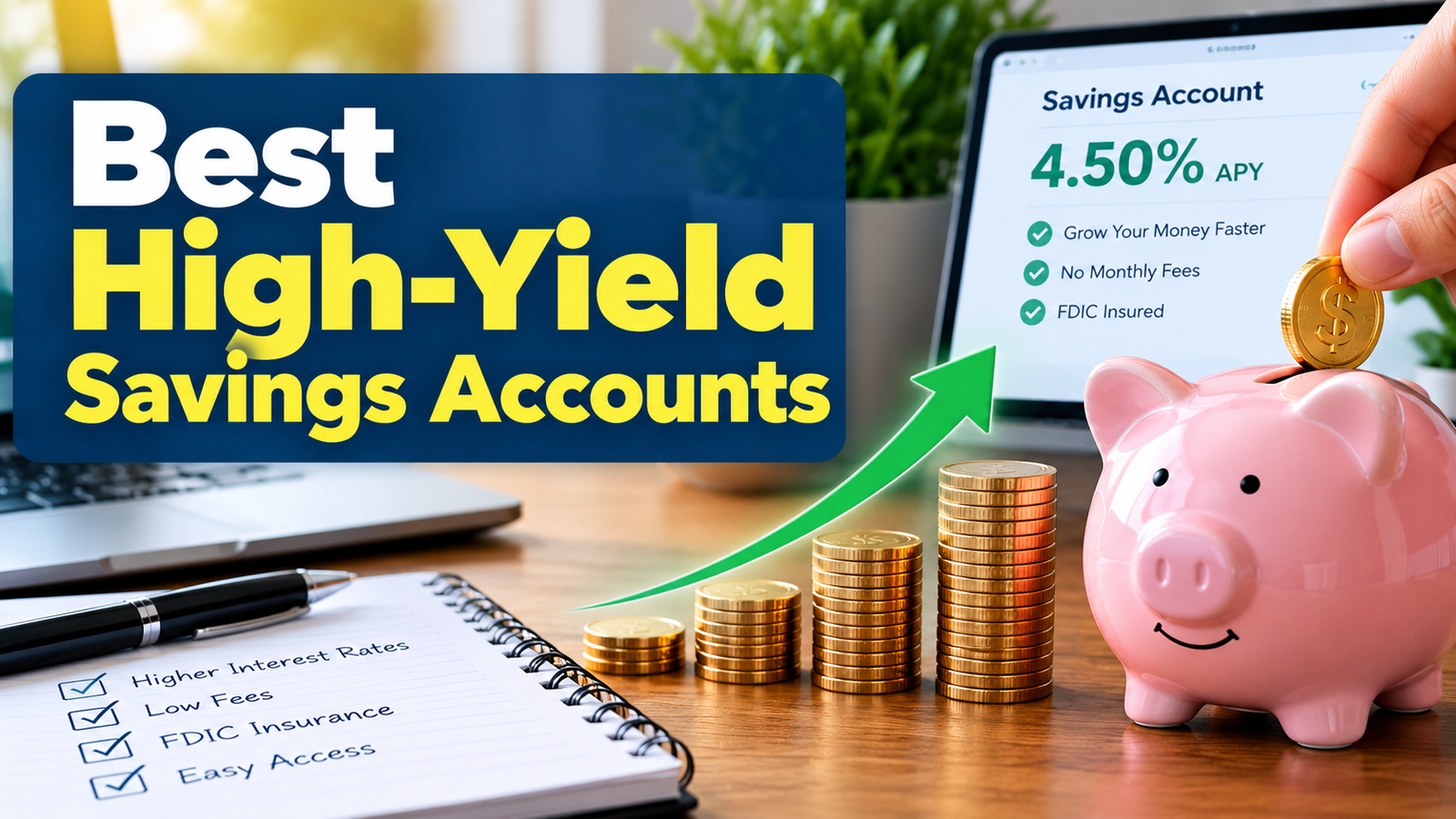
Best High-Yield Savings Accounts: Top Picks
Best High-Yield Savings Accounts in 2026: Top Picks Compared
If you want your savings to earn more interest without taking investment risk, a high-yield savings account (HYSA) may be worth considering. These accounts typically offer higher interest rates than traditional savings accounts while allowing you to keep your money accessible for emergencies, upcoming expenses, and other short-term goals.
The best high-yield savings accounts in 2026 combine a competitive annual percentage yield (APY) with low fees, convenient transfers, and deposit insurance. Some accounts advertise especially high rates, but you may need to meet direct-deposit or monthly-deposit requirements to qualify.
In this guide, we compare popular U.S. savings accounts, explain how much interest you could earn, and show you what to consider before opening an account.
Rate disclaimer: APYs and account terms can change at any time. Rates below are examples reported in October 2026 and should be verified on each bank’s official website before applying.
Table of Contents
Best High-Yield Savings Accounts at a Glance
The following accounts are worth comparing based on their rates, features, and intended use.
| Savings account | Reported APY | Best for |
|---|---|---|
| SoFi Checking and Savings | Up to 4.40% with qualifying conditions | Combined checking and savings |
| Newtek Bank Personal High Yield Savings | 4.20% | Competitive savings without a complex account bundle |
| EverBank Performance Savings | 4.20% | Competitive online savings |
| CIT Bank Platinum Savings | Up to 4.25% | Savers who can meet balance requirements |
| Peak Bank Envision High-Yield Savings | 4.27% | Comparing high standard rates |
| Marcus by Goldman Sachs | 3.50% | Straightforward online savings |
| Capital One 360 Performance Savings | 3.20% | Online savings with access to a branch network |
| Synchrony Bank High Yield Savings | 3.55% | Online savings with certain ATM-access features |
Rates shown were reported in October 2026 by current savings-account comparisons and are not guaranteed to remain available. Some rates require qualifying deposits or minimum balances. Confirm the APY, eligibility rules, and fees directly with the bank before opening an account.
1. SoFi Checking and Savings: Best for Combined Banking
SoFi Checking and Savings combines checking and savings features in one account, making it an option for people who want to manage everyday spending and savings through the same banking platform.
Why consider it?
- Combines checking and savings features.
- Offers a mobile-first banking experience.
- May provide a higher savings APY when you meet qualifying conditions.
- Can make it convenient to move money between everyday spending and savings.
SoFi reported an APY of up to 4.40% in October 2026, including a temporary APY boost. Eligibility requirements apply, and the advertised rate is not necessarily available to every customer.
Potential drawback: You may need eligible direct deposits or qualifying deposits to receive the enhanced rate. Check the standard APY, promotional period, and eligibility requirements before applying.
Visit SoFi for current account details.
2. Newtek Bank Personal High Yield Savings: Best for a Competitive Standard Rate
Newtek Bank is worth comparing if your priority is earning a competitive savings rate without necessarily opening a bundled checking account.
Its Personal High Yield Savings account was reported at 4.20% APY in October 2026.
Why consider it?
- Competitive reported APY.
- Online account management.
- An option for savers who want to compare standalone savings accounts.
- May suit people building an emergency fund or saving for a planned expense.
Before opening the account, confirm the current APY, minimum opening deposit, withdrawal procedures, and any applicable account restrictions.
Visit Newtek Bank to review its current savings products.
3. EverBank Performance Savings: Best for Comparing Online Savings Rates
EverBank Performance Savings is another account to consider when comparing competitive online savings options.
The account was reported at 4.20% APY in October 2026.
Why consider it?
- Competitive reported rate.
- Online account management.
- An alternative to traditional branch-based savings accounts.
- Useful for comparing how different banks price their savings products.
Remember that a competitive APY today does not guarantee that the account will remain among the highest-paying options in the future. Savings rates are variable and can change as market conditions change.
Check EverBank for the latest rate and account terms.
4. CIT Bank Platinum Savings: Best for Savers With Larger Balances
CIT Bank offers multiple savings products, including Platinum Savings. Its advertised rate can depend on the balance you maintain and the terms in effect when you open the account.
The account was reported at up to 4.25% APY in October 2026.
Why consider it?
- Multiple savings products to compare.
- Potentially competitive rates for eligible balances.
- Online account management.
- An option for people who can maintain the balance required for the advertised APY.
Potential drawback: The highest APY may not apply to every balance. Review the minimum balance required to earn the top rate and the rate paid on any lower balance tier.
Visit CIT Bank to verify the current terms.
5. Peak Bank Envision High-Yield Savings: Best for a High Reported APY
Peak Bank Envision High-Yield Savings is worth researching if you are comparing accounts primarily on the rate offered.
The account was reported at 4.27% APY for new accounts in October 2026.
Why consider it?
- Competitive reported APY.
- An option to compare with better-known online banks.
- Potentially attractive for savers who prioritize interest earnings.
Before applying, verify whether the reported rate applies to your intended balance, whether any eligibility requirements exist, and how easily you can transfer money to and from an external bank.
Visit Peak Bank to confirm the account’s current APY and terms.
6. Marcus by Goldman Sachs: Best for Straightforward Online Savings
Marcus by Goldman Sachs is an established online savings option for people who want a dedicated account for their savings.
Its Online Savings Account was reported at 3.50% APY in October 2026.
Why consider it?
- A dedicated online savings account.
- No minimum opening deposit reported in the October comparison.
- No monthly maintenance fee advertised for the account.
- A straightforward option for separating savings from everyday spending.
One important consideration is that Marcus does not offer a traditional checking account as part of this savings product. You may need to connect an external bank to move money.
Visit Marcus to check the current APY and transfer options.
7. Capital One 360 Performance Savings: Best for Online Savings With Branch Access
Capital One 360 Performance Savings may appeal to people who want an online savings account from a bank with a physical branch and café network.
The account was reported at 3.20% APY in October 2026.
Why consider it?
- No minimum opening deposit reported.
- No monthly maintenance fee advertised.
- Mobile and online account management.
- Access to Capital One locations for certain banking services.
The main trade-off is that its reported APY was lower than those of several other accounts in this comparison. If earning the highest possible interest is your main goal, compare the difference in interest against the convenience of the bank’s wider services.
Visit Capital One for current terms.
8. Synchrony Bank High Yield Savings: Best for Online Savings With ATM Features
Synchrony Bank High Yield Savings is another option for savers who want an online account and convenient access to funds.
It was reported at 3.55% APY in October 2026.
Why consider it?
- No minimum opening deposit reported in the October comparison.
- No monthly fee advertised for the savings account.
- Online account management.
- ATM-access features may be useful for customers who need occasional cash access.
Check the current rules for ATM withdrawals, transfer limits, and any applicable reimbursement policies before opening the account.
Visit Synchrony Bank for the latest information.
What Is a High-Yield Savings Account?
A high-yield savings account is a savings deposit account that pays a relatively high interest rate compared with many traditional savings accounts.
For example, suppose you deposit $10,000 into an account earning 4.00% APY. If the rate remains unchanged for a full year and the money stays deposited, you would earn approximately $400 in interest.
A traditional savings account paying 0.40% APY would earn approximately $40 on the same balance over one year.
The difference is $360 in additional interest, before taxes, under these illustrative assumptions.
High-yield savings accounts are commonly offered by online banks because their operating costs may be lower than those of banks that maintain extensive branch networks. However, online accounts are not automatically better: fees, service quality, access to money, and deposit insurance still matter.
How Much Can You Earn With a High-Yield Savings Account?
Your interest earnings depend on your balance, the APY, and how long the money remains in the account.
The following table shows approximate earnings at an illustrative 4.00% APY.
| Starting balance | Approximate interest after one year | Approximate ending balance |
|---|---|---|
| $1,000 | $40 | $1,040 |
| $5,000 | $200 | $5,200 |
| $10,000 | $400 | $10,400 |
| $25,000 | $1,000 | $26,000 |
| $50,000 | $2,000 | $52,000 |
These estimates assume the APY remains at 4.00% for the entire year, with no additional deposits or withdrawals. Actual results can differ because savings account rates are variable and interest may compound during the year.
What Does APY Mean?
APY stands for annual percentage yield. It reflects the annual return on a deposit, including the effect of compounding.
When comparing savings accounts, use APY rather than comparing advertised interest rates alone. APY gives you a more useful basis for comparing how much interest different accounts could earn over a year.
How to Choose the Best High-Yield Savings Account
The highest APY is important, but it should not be your only consideration. Compare these factors before opening an account.
1. Compare the Ongoing APY
Some accounts advertise promotional rates or temporary boosts. Find out what rate applies after the promotion ends and whether you must meet ongoing requirements.
2. Check Minimum Deposits and Balances
Some accounts let you open an account with $0, while others require an initial deposit or a specific balance to earn their highest APY.
Choose an account that fits the amount you can comfortably save.
3. Avoid Unnecessary Fees
Monthly maintenance fees can reduce your interest earnings. Look for accounts with no monthly fee, and review any possible charges for wire transfers, special services, or other transactions.
4. Consider Access to Your Money
An emergency fund should be reasonably accessible. Check how quickly you can transfer money to your checking account, whether external transfers are supported, and whether ATM access is available.
5. Verify Deposit Insurance
For a bank account, check whether the bank is insured by the Federal Deposit Insurance Corporation (FDIC). Eligible deposits at federally insured credit unions are generally insured by the National Credit Union Administration (NCUA).
6. Review the Banking Experience
Mobile app quality, customer support, account alerts, and automatic transfers can make saving easier. Choose an account that you will find convenient to manage.
Are High-Yield Savings Accounts Safe?
High-yield savings accounts can be a relatively low-risk place to keep cash when the account is held at an appropriately insured bank or credit union.
The standard FDIC insurance limit is $250,000 per depositor, per insured bank, per ownership category. Eligible deposits at federally insured credit unions receive coverage through the NCUA, subject to its applicable rules and limits.
FDIC insurance covers eligible deposits if an insured bank fails. It does not protect you against inflation, falling interest rates, or losses on investment products that are not insured deposits.
If you use a financial technology company or banking platform, verify which bank actually holds your money and how the deposit insurance arrangement works. Do not assume that every financial product advertised by a financial company is insured.
You can learn more from the FDIC’s official deposit insurance guidance.
High-Yield Savings Account vs. Other Savings Options
A high-yield savings account is not the only way to save money. The best choice depends on when you need the money and how much flexibility you want.
| Account type | Main advantage | Main drawback |
|---|---|---|
| High-yield savings account | Competitive variable APY with accessible savings | Rate can fall |
| Traditional savings account | Often convenient with an existing bank | May pay a lower APY |
| Certificate of deposit (CD) | May offer a fixed rate for a set term | Early withdrawal may trigger a penalty |
| Money market deposit account | May combine interest with certain payment features | May have balance requirements or fees |
| Money market mutual fund | May offer competitive short-term investment returns | Not FDIC-insured and can lose value |
For emergency savings or money you may need soon, a high-yield savings account can be a useful option because you generally do not have to lock the money away for a fixed term.
For money you know you will not need for a set period, comparing CDs may also be worthwhile.
Are High-Yield Savings Accounts Taxable?
In the United States, interest earned on a savings account is generally taxable income for federal income tax purposes, even if you leave the interest in the account.
A bank may issue Form 1099-INT when reporting requirements are met. You should include taxable interest as required when filing your tax return.
For details about reporting interest income, see the IRS guidance on interest income.
Frequently Asked Questions
What is a good APY for a high-yield savings account?
A good APY is one that compares favorably with available accounts while offering terms that fit your needs. Rates change frequently, so compare current offers, fees, and eligibility requirements before choosing.
Which bank has the highest savings account rate right now?
There is no permanent highest-paying bank. The top advertised rate can change, and some accounts require qualifying deposits, minimum balances, or promotional eligibility. Verify the current APY directly with the bank.
How much interest will $10,000 earn in a high-yield savings account?
At an illustrative 4.00% APY, $10,000 would earn approximately $400 over one year if the rate remained unchanged and no money was added or withdrawn.
Can I lose money in a high-yield savings account?
Eligible deposits at an FDIC-insured bank or NCUA-insured credit union are protected up to applicable insurance limits. However, rates can fall, and inflation can reduce the purchasing power of your savings.
Can I withdraw money whenever I need it?
Generally, savings accounts allow withdrawals and transfers, but the methods, processing times, and applicable restrictions depend on the bank. Review the account terms before depositing money you may need urgently.
Do high-yield savings account rates change?
Yes. Most HYSAs have variable rates, meaning the bank can change the APY. Your interest earnings may increase or decrease over time.
How many high-yield savings accounts can I open?
You can generally open accounts at multiple banks, subject to each institution’s eligibility rules. Multiple accounts can help you separate savings goals, but make sure you understand how deposit insurance limits apply across your accounts.
Final Thoughts: Which High-Yield Savings Account Is Best for You?
The best high-yield savings account is not necessarily the one with the biggest advertised APY. It is the account that offers a competitive rate, reasonable fees, convenient access to your money, and deposit insurance that fits your needs.
If you want to combine checking and savings, compare SoFi’s qualifying rate requirements. If you prefer a dedicated online savings account, consider options such as Newtek Bank, EverBank, or Marcus. If in-person banking access matters, Capital One may be worth a closer look.
Before opening an account, verify the current APY, minimum balance requirements, fees, and insurance status on the bank’s official website. Since savings rates can change at any time, reviewing your account periodically can help you make sure your money continues to work for your goals.
Disclaimer: This article is for educational purposes and is not individualized financial advice.

You may also like