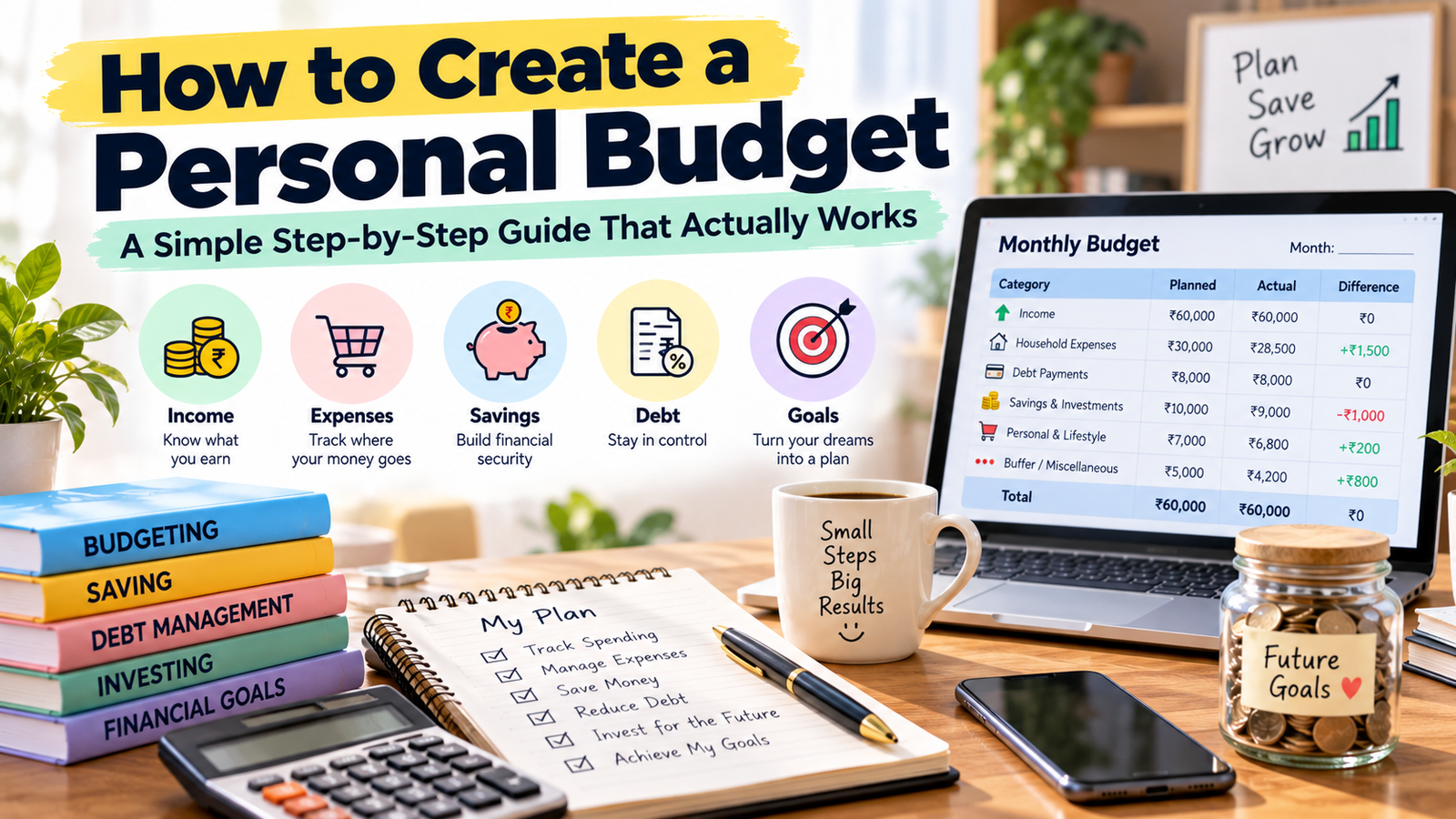
How to Create a Personal Budget: A Simple Step-by-Step Guide That Actually Works
How to Create a Personal Budget: A Simple Step-by-Step Guide That Actually Works
Managing money becomes much easier when you know where your money is going.
You may earn a good income and still feel that there is never enough money left at the end of the month. The problem is often not simply how much you earn. It is how your income is divided between expenses, debt, savings, goals, and unexpected costs.
That is where a personal budget helps.
A budget is simply a plan for your money. It tells you how much you expect to receive, where that money should go, and how much you want to keep for future needs.
The good news is that you do not need complicated spreadsheets or financial expertise to create one.
This guide explains how to create a personal budget step by step, including how to handle irregular expenses, debt, savings, variable income, and unexpected costs.
Table of Contents
What Is a Personal Budget?
A personal budget is a plan that matches your income with your expected expenses and financial goals.
In simple terms:
Income − Expenses − Savings = Remaining Money
A good budget does more than record what you already spent. It helps you decide before spending how your money should be used.
For example, suppose your monthly take-home income is ₹60,000. Instead of spending first and saving whatever remains, you can create a plan such as:
- Household and essential expenses: ₹30,000
- Debt payments: ₹8,000
- Emergency savings: ₹5,000
- Long-term goals: ₹7,000
- Personal and entertainment expenses: ₹7,000
- Monthly buffer: ₹3,000
The numbers will be different for every household. The important part is that your money has a purpose.
Why Should You Create a Personal Budget?
A budget can help you answer questions that are otherwise difficult to answer:
- How much can I safely spend each month?
- Why does my salary disappear so quickly?
- How much can I save?
- Can I afford a new EMI?
- How much should I keep for emergencies?
- Am I spending too much on wants?
- Can I invest while paying off debt?
- Will I have enough money for an annual insurance premium or school expense?
A budget also gives you an early warning when your spending starts moving in the wrong direction.
Think of it like a dashboard in a car. You do not need to stare at it every minute, but you need to know your speed, fuel level, and warning lights.
How to Create a Personal Budget Step by Step
Creating a budget becomes much easier when you do it in the right order.
Step 1: Calculate Your Real Monthly Income
Start with the money that actually reaches your bank account.
If you receive a salary, use your take-home pay, not your CTC or gross salary.
For example:
Gross salary: ₹70,000
Deductions: ₹8,000
Take-home income: ₹62,000
Your budget should normally be based on the ₹62,000 you can actually use.
If your income changes every month because you are a freelancer, business owner, commission-based worker, or seasonal worker, use a conservative estimate rather than your best month.
For example, if your recent monthly income was:
₹45,000 → ₹52,000 → ₹38,000 → ₹60,000
You should not build your essential monthly lifestyle around ₹60,000.
A safer approach is to budget around a lower, sustainable income level and treat unusually high income as an opportunity to strengthen savings, repay debt, or fund future goals.
Step 2: List Every Expense
Now look at where your money actually goes.
Do not try to guess.
Check your bank statements, UPI history, credit card statements, cash spending, subscriptions, loan payments, and other records.
Include both large and small expenses.
For example:
Home
- Rent or home loan
- Electricity
- Gas
- Internet
- Mobile bills
- Maintenance
Food
- Groceries
- Vegetables
- Eating out
- Food delivery
Transport
- Fuel
- Public transport
- Vehicle maintenance
- Insurance
Financial commitments
- EMIs
- Insurance premiums
- Investments
- Savings
Personal
- Clothing
- Entertainment
- Shopping
- Hobbies
Small expenses matter because they can become significant when repeated every week or every month.
Step 3: Divide Expenses Into Useful Categories
You do not need 20 different categories.
Start with four broad groups:
1. Essential expenses
These are expenses you generally need to maintain your household.
Examples include food, housing, utilities, basic transportation and necessary healthcare.
2. Financial commitments
These include EMIs, debt payments, insurance premiums and other obligations.
3. Savings and financial goals
This can include emergency savings, short-term goals, retirement savings and long-term investments.
4. Discretionary spending
These are expenses that improve your lifestyle but can usually be reduced when necessary.
Examples include eating out, entertainment, shopping and subscriptions.
This classification makes your budget easier to understand without tracking every rupee separately.
Step 4: Calculate How Much Money Is Available
Now subtract your planned expenses from your income.
For example:
Monthly take-home income: ₹60,000
Essential expenses: ₹30,000
Debt payments: ₹8,000
Savings: ₹10,000
Discretionary spending: ₹7,000
Total planned allocation = ₹55,000
That leaves:
₹60,000 − ₹55,000 = ₹5,000
That ₹5,000 can act as a monthly buffer.
Having a buffer is important because real life rarely follows a perfect budget.
A repair, medicine, family event, higher electricity bill or unexpected travel expense can easily disrupt a budget with zero flexibility.
Step 5: Choose a Budgeting Method
There is no single budgeting system that works for everyone.
The 50/30/20 Rule
A popular starting point is:
- 50% for needs
- 30% for wants
- 20% for savings and debt repayment
It is useful as a framework, but it should not be treated as a universal rule.
If you live in an expensive city, have significant debt, support family members, or have an irregular income, your numbers may look very different.
Zero-Based Budgeting
With zero-based budgeting, every rupee is given a job.
For example:
₹60,000 income − ₹60,000 planned expenses, savings and goals = ₹0
This does not mean you spend everything.
Savings, investments, debt repayment and emergency-fund contributions are also assigned jobs.
Pay Yourself First
Here, you move a predetermined amount toward savings or financial goals as soon as your income arrives.
The remaining money is then used for expenses.
A Hybrid Approach
For many people, a simple hybrid system works well:
Income → Savings → Essential expenses → Debt → Discretionary spending → Buffer
The best method is the one you can consistently follow.
Step 6: Create Your First Monthly Budget
Now put everything together.
Suppose a household has ₹60,000 of monthly take-home income.
A simple example could look like this:
| Category | Monthly Amount |
|---|---|
| Essential household expenses | ₹30,000 |
| Debt payments | ₹8,000 |
| Emergency/short-term savings | ₹5,000 |
| Long-term financial goals | ₹7,000 |
| Discretionary spending | ₹7,000 |
| Buffer | ₹3,000 |
| Total | ₹60,000 |
This is only an educational example.
Your actual percentages should reflect your income, responsibilities, debt, financial goals and cost of living.
The objective is not to copy someone else’s budget. It is to create a plan that works for your household.
Step 7: Don’t Forget Annual and Irregular Expenses
One of the biggest budgeting mistakes is planning only for monthly bills.
Some expenses arrive once or twice a year:
- Insurance premiums
- School or college fees
- Vehicle insurance
- Property-related expenses
- Festivals and family events
- Annual subscriptions
- Vehicle servicing
- Medical expenses
- Travel
Suppose your annual vehicle insurance costs ₹12,000.
Instead of being surprised when the bill arrives, set aside:
₹12,000 ÷ 12 = ₹1,000 per month
This is sometimes called a sinking fund.
You can use the same idea for other predictable expenses.
The expense may not happen every month, but your preparation can.
Step 8: Build a Budget for Irregular Income
Budgeting becomes more difficult when income changes every month.
This is common for freelancers, business owners, farmers, commission-based workers and people with seasonal income.
The solution is not to guess your highest possible income.
Instead:
- Estimate a conservative monthly income.
- Cover essential expenses first.
- Maintain a larger cash reserve.
- Treat unusually high income separately.
- Avoid increasing fixed expenses simply because you had a good month.
For example, if you earn ₹80,000 in one month and ₹40,000 the next, increasing your monthly commitments based on the ₹80,000 month can create problems later.
A flexible budget is much safer for variable income.
Step 9: Give Savings a Specific Purpose
“Save more money” is a good intention, but it is not a complete financial goal.
Give your savings a job.
You might have separate goals for:
Emergency fund
Money for genuine unexpected situations.
Short-term goals
Such as a vacation, vehicle repair or planned purchase.
Medium-term goals
Such as education or a home-related expense.
Long-term goals
Such as retirement or long-term wealth building.
When every savings contribution has a purpose, it becomes easier to stay consistent.
Step 10: Include Debt in Your Budget
If you have loans or credit card debt, debt payments should be included before discretionary spending.
Start by listing:
- Outstanding balance
- Interest rate
- Minimum payment
- Remaining tenure
- Any prepayment conditions
Your budget should show whether your current income can comfortably handle your debt obligations.
Avoid treating new EMIs as if they were free money.
Before taking on another loan, add the proposed EMI to your existing budget and check whether you would still have enough room for savings, essential expenses and unexpected costs.
Step 11: Automate What You Can
A budget becomes easier when good financial decisions happen automatically.
For example, after receiving your income:
Income arrives → savings transfer → bill payments → investment contribution → remaining spending money
Automation reduces the need to make the same decision every month.
You can automate recurring bills and transfers where appropriate, while still reviewing your accounts regularly.
Step 12: Track Your Actual Spending
Creating a budget is only half the job.
You also need to compare the plan with reality.
Suppose you budget ₹7,000 for eating out and entertainment but actually spend ₹10,000.
That does not mean your budget failed.
It tells you something useful.
Perhaps ₹7,000 was unrealistic.
Or perhaps another category can be reduced.
The purpose of tracking is not to feel guilty about every purchase. It is to understand your spending patterns and make better decisions.
Step 13: Review Your Budget Every Month
Your budget should change when your life changes.
Review it at least once a month.
Ask:
- Did I spend more or less than expected?
- Which category went over budget?
- Did my income change?
- Did I save what I planned?
- Did any unexpected expense occur?
- Do I need to change next month’s targets?
You should also review your budget after major life events such as a new job, marriage, childbirth, moving house, taking a loan or experiencing a significant change in income.
A budget is not a contract.
It is a tool that should adapt to your life.
Why Do Personal Budgets Fail?
Most budgets do not fail because the person cannot do mathematics.
They fail because the budget is unrealistic.
Common problems include:
Making the budget too restrictive
If your budget leaves no room for normal enjoyment, you may eventually abandon it.
Forgetting irregular expenses
Annual and occasional expenses can destroy an otherwise good monthly plan.
Using gross income
Budgeting money that never reaches your bank account creates unrealistic expectations.
Ignoring small recurring expenses
Subscriptions, delivery charges and frequent small purchases can add up.
Having no buffer
A budget with every rupee already allocated has little protection against surprises.
Never reviewing the budget
Your expenses and priorities change. Your budget should change with them.
How to Create a Personal Budget Without a Spreadsheet
You do not need Excel or a complicated budgeting application.
A notebook can be enough.
Create five sections:
Monthly income
Essential expenses
Debt and financial commitments
Savings and goals
Discretionary spending
At the end of each month, compare your planned amount with your actual spending.
You can also use a simple spreadsheet, banking app or budgeting application if that makes tracking easier.
The tool is less important than the habit.
A Simple Budget for Couples and Families
For families, budgeting should include household income and shared expenses.
Start by identifying:
- Total household income
- Housing costs
- Food
- Utilities
- Education
- Healthcare
- Debt
- Insurance
- Family support
- Savings
- Personal spending
It can also help to decide which expenses are shared and which are personal.
The goal is not to control every purchase made by another family member. The goal is to make sure everyone understands the household’s major financial priorities.
What About Investing?
A personal budget should create room for long-term investing, but investing should come after understanding your basic financial position.
Before investing aggressively, consider whether you have:
- A manageable level of high-cost debt
- An emergency reserve appropriate to your circumstances
- Adequate insurance and financial protection
- Stable cash flow
- Clearly defined financial goals
When you do invest, remember that investments can lose value.
Your budget should therefore separate money needed for near-term expenses from money that can remain invested for the long term.
How Do You Know If Your Budget Is Working?
A successful budget does not mean you never spend more than planned.
A budget is working when it helps you:
- Pay important bills on time
- Avoid unnecessary debt
- Build savings consistently
- Prepare for irregular expenses
- Make progress toward financial goals
- Understand where your money is going
- Handle unexpected costs without completely disrupting your finances
The goal is financial control, not financial perfection.
A Simple 30-Day Budget Challenge
If you have never created a budget before, start small.
Week 1: Observe
Track every expense without trying to change your behavior.
Week 2: Categorize
Divide your spending into essential, financial, savings and discretionary categories.
Week 3: Plan
Create your monthly budget and identify areas that need adjustment.
Week 4: Automate and review
Set up useful automatic payments or savings transfers and review your first week’s results.
After 30 days, you will have much better information about how your money actually behaves.
Frequently Asked Questions
What is the easiest way to create a personal budget?
Start with your take-home income, list your actual expenses, divide them into a few broad categories, assign money to savings and goals, and leave a small buffer for unexpected costs.
How much money should I save each month?
There is no single percentage that is appropriate for everyone. The amount depends on your income, expenses, debt, emergency savings and financial goals. The important thing is to make saving a planned part of your budget rather than relying on whatever remains at the end of the month.
Is the 50/30/20 rule necessary?
No. The 50/30/20 rule is a useful framework, but it is not a requirement. Your budget should reflect your actual circumstances.
How do I budget with an irregular income?
Use a conservative estimate of your income, keep essential expenses manageable, maintain a larger cash reserve and avoid increasing fixed expenses based on unusually high-income months.
Should debt repayment be included in a budget?
Yes. Debt payments are an important part of your monthly cash flow and should be included when deciding how much money is available for other expenses and goals.
How often should I review my budget?
A monthly review is a practical starting point. You should also review your budget whenever your income, expenses, debt or family circumstances change significantly.
Can I create a personal budget without an app?
Yes. A notebook, spreadsheet or simple list can be enough. The most important part is consistently comparing your plan with your actual spending.
Putting It All Together
Learning how to create a personal budget is not about restricting every rupee you spend.
It is about making your money more intentional.
Start with your real income. Understand your actual spending. Separate essential expenses from discretionary spending. Plan for annual and unexpected costs. Include debt and savings in the same picture. Then review and adjust the plan every month.
Your first budget will probably not be perfect—and that is completely fine.
The more important skill is learning to understand your cash flow and make financial decisions based on numbers rather than guesswork.
A good personal budget gives you something more valuable than a list of expenses: a clearer picture of what your money can realistically do for you.
Official Financial Education Resources
Want to learn more about budgeting, saving, spending, and financial planning? These official resources can help:
United States
- Consumer.gov – Making a Budget: Learn the basic steps for creating and using a monthly budget.
- Consumer Financial Protection Bureau (CFPB) – Assess Your Spending: Learn how to review your actual spending and account for less-frequent expenses.
- MyMoney.gov – Spend: Explore federal financial-education guidance on budgeting, spending, and financial goals.
- FDIC – Money Smart for Adults: Access free financial-education resources covering income, expenses, saving, credit, and borrowing.
- IRS – Tax Withholding Estimator: U.S. taxpayers can use this official tool to estimate federal tax withholding and review their paycheck withholding.
India
- SEBI Financial Education – Budgeting: Basic guidance on budgeting, income, expenses and financial planning.
- RBI Financial Awareness (FAME): Educational material covering budgeting, saving and responsible borrowing.
- RBI Financial Education Resources: Practical guidance on saving and preparing for planned and unexpected expenses.
- Income Tax Department e-Filing Portal: Official Government of India portal for income-tax filing and taxpayer services.
- Income Tax Department – File Your Income Tax Return: Official information and guidance on ITR filing, e-Verification and related services.
These resources are provided for educational purposes. Financial rules, taxes, and financial products vary by country and can change over time. Check the relevant government website for the latest information before making financial or tax decisions.
Tag:50/30/20 budget rule, budgeting for beginners, budgeting methods, household budget, how much should I save each month, how to budget money, how to budget money every month, how to budget with debt, how to create a budget with irregular income, how to create a household budget, how to create a monthly budget, how to create a personal budget for beginners, how to create a personal budget in India, how to make a budget for your salary, how to make a personal budget, how to manage money, how to track monthly expenses, monthly budget plan, personal budget, personal budget example, personal budgeting

You may also like

What Is Personal Finance? Why It Matters to Everyone