What Is Personal Finance? Why It Matters to Everyone
Personal finance is the process of managing your money—including how you earn, spend, save, borrow, protect and invest it—to meet your current needs and future financial goals.
You do not need to be wealthy to understand personal finance. In fact, learning the basics can be especially useful when you are just starting your career, managing a family, paying off debt, or trying to build your first savings.
Think of personal finance like managing a household journey. Your income is the fuel coming in, your expenses are the fuel being used, your savings are the reserve tank, insurance helps protect you from major financial accidents, and investing is one possible way to grow money for longer-term goals.
This guide explains personal finance from the ground up—from budgeting and emergency funds to debt, insurance, investing, diversification, compound growth and retirement planning.
In simple terms: Good personal finance is not about becoming rich quickly. It is about building a financial system that helps you manage today’s needs while preparing for tomorrow.
Table of Contents
What Is Personal Finance?
Personal finance refers to the decisions and habits involved in managing an individual’s or family’s money.
It includes:
- Earning income
- Managing everyday expenses
- Creating a budget
- Saving money
- Building an emergency fund
- Managing debt
- Using insurance for financial protection
- Investing for long-term goals
- Planning for retirement
- Understanding taxes
- Managing financial risk
The Reserve Bank of India describes financial planning as assessing your current position, identifying short-, medium- and long-term needs, estimating their costs and planning how much to save toward them.
Personal finance therefore isn’t simply about how much money you make. It is about what you do with that money.
Someone earning ₹1 lakh per month but spending ₹1.1 lakh may have a weaker financial position than someone earning ₹60,000 and consistently living below their income.
The 6 Main Parts of Personal Finance
A useful way to understand personal finance is to divide it into six interconnected areas.
1. Earning
This is the money coming into your household. Examples include:
- Salary
- Business income
- Freelance income
- Rental income
- Interest or other investment income
2. Spending
This is where your money goes. Examples include:
- Food
- Housing
- Electricity
- Transportation
- Education
- Healthcare
- Entertainment
3. Saving
Saving means setting money aside rather than spending it immediately. Savings can help you prepare for:
- Emergencies
- Upcoming purchases
- Short-term goals
- Planned expenses
4. Borrowing
Borrowing allows you to use money today and repay it later, usually with interest. Examples include:
- Home loans
- Education loans
- Vehicle loans
- Personal loans
- Credit-card balances
5. Investing
Investing means putting money into assets with the expectation that they may generate a return over time. Examples can include:
- Stocks
- Bonds
- Mutual funds
- Exchange-traded funds (ETFs)
- Other investment assets
Investments carry risk, and their value can rise or fall.
6. Protection
Financial protection includes measures designed to reduce the impact of major unexpected events. Examples include:
- Emergency savings
- Health insurance
- Life insurance where appropriate
- Property or vehicle insurance
- Appropriate risk management
These six areas are connected.
For example:
Income → Expenses → Savings → Emergency Fund → Debt Management → Goals → Investing → Review
A weakness in one area can affect the others.
Why Is Personal Finance Important?
Personal finance matters because money affects almost every part of daily life.
A good financial system can help you:
- Pay regular bills
- Handle unexpected expenses
- Avoid unnecessary high-cost debt
- Save for important goals
- Protect your family
- Prepare for retirement
- Invest according to your objectives
- Reduce financial uncertainty
But personal finance is not the same as trying to become rich.
Financial Stability vs. Wealth Building
These are different objectives.
Financial stability means being able to manage your regular financial obligations and absorb reasonable unexpected expenses.
Wealth building involves gradually accumulating assets that may increase in value or generate income over time.
You generally need a financial foundation before taking significant investment risk.
For example, investing money that you may need next month can create a problem if the investment falls in value at exactly the wrong time.
Step 1: Understand Your Financial Starting Point
Before deciding where your money should go, understand where it is going now.
Calculate Your Income
Start with the money you actually have available to use.
For employees, distinguish between:
- Gross salary
- Deductions
- Take-home income
For business owners and freelancers, income may fluctuate from month to month.
In that situation, budgeting around your most predictable income can provide more flexibility than assuming every month will be your best month.
Understand Your Expenses
Divide your expenses into useful categories.
Fixed Expenses
These are expenses that tend to remain relatively stable.
Examples:
- Rent
- Loan payments
- Insurance premiums
- School fees
Variable Expenses
These change from month to month.
Examples:
- Groceries
- Electricity
- Fuel
- Entertainment
Essential Expenses
These are expenses necessary for basic living and important obligations.
Discretionary Expenses
These are expenses you can potentially reduce or postpone.
Examples:
- Eating out
- Entertainment
- Non-essential shopping
The purpose isn’t to eliminate every enjoyable expense.
It is to understand where your money is going so that you can make deliberate decisions.
Calculate Your Net Worth
One of the simplest ways to understand your financial position is to calculate your net worth.
Formula:
Net Worth = Total Assets − Total Liabilities
Assets may include:
- Cash
- Bank deposits
- Investments
- Property
- Business assets
- Other valuable assets
Liabilities may include:
- Home loans
- Vehicle loans
- Personal loans
- Credit-card balances
- Other outstanding debts
Example
Suppose you have:
- ₹3 lakh in savings
- ₹5 lakh in investments
- ₹10 lakh of other assets
Your total assets are ₹18 lakh.
If you have ₹7 lakh of outstanding debt:
Net worth = ₹18 lakh − ₹7 lakh = ₹11 lakh
Your net worth is a snapshot of your financial position at a particular point in time.
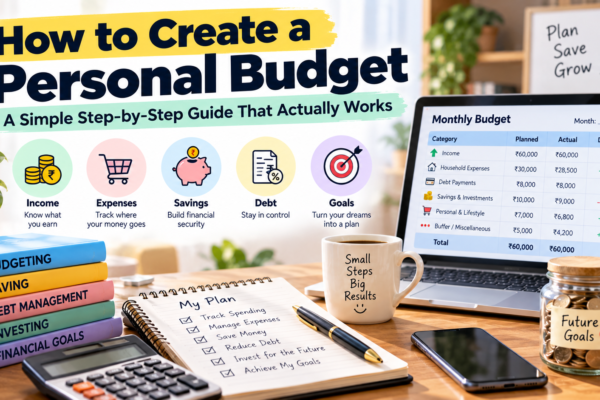
Step 2: Create a Budget You Can Actually Follow
A budget is simply a plan for your future income and expenses.
The RBI describes a budget as a plan of future income and expenses that can help you control spending and plan savings.
A budget does not have to be complicated.
A simple version could look like:
| Category | Monthly Amount |
|---|---|
| Take-home income | ₹60,000 |
| Essential expenses | ₹32,000 |
| Debt payments | ₹8,000 |
| Savings | ₹8,000 |
| Long-term investing | ₹7,000 |
| Discretionary spending | ₹5,000 |
The numbers above are only an illustration—not a recommended allocation.
What About the 50/30/20 Rule?
You may have heard of the 50/30/20 budgeting rule:
- 50% for needs
- 30% for wants
- 20% for savings and financial goals
It can be a useful starting framework, but it isn’t a universal law.
Someone living in a high-cost city may spend much more than 50% on essential expenses. Someone with substantial debt may need a different allocation.
Your budget should reflect your:
- Income
- Housing costs
- Family size
- Debt
- Financial goals
- Location
- Existing savings
A realistic budget that you can maintain is generally more useful than a perfect-looking budget that you abandon after two weeks.
Budget for Irregular Expenses Too
One common budgeting mistake is planning only for monthly bills.
Some expenses arrive only once or a few times a year.
For example:
- Insurance premiums
- School expenses
- Vehicle servicing
- Home repairs
- Festivals
- Annual subscriptions
- Travel
If you know an expense is coming, divide its expected cost across the months leading up to it.
For example, if you expect a ₹24,000 annual expense, setting aside ₹2,000 per month would give you ₹24,000 after 12 months.
This is sometimes called a sinking fund.
Step 3: Build the Habit of Saving
Saving and investing are related, but they are not the same.
Saving vs. Investing
| Saving | Investing |
|---|---|
| Usually focused on short-term or emergency needs | Usually focused on longer-term growth |
| Emphasis on accessibility and stability | Accepts investment risk |
| Useful for emergency reserves | Useful for long-term goals |
| Examples include suitable bank savings/deposit products | Examples include stocks, bonds, mutual funds and ETFs |
Investor.gov similarly distinguishes saving for short-term goals and emergencies from investing for longer-term growth.
A useful principle is:
Don’t invest money simply because you have money. First ask when you will need it.
Money needed soon may need a different approach from money intended for a goal decades away.
How Much Should You Save?
There is no single savings percentage that works for everyone.
Your appropriate savings amount depends on:
- Income
- Expenses
- Debt
- Family responsibilities
- Upcoming goals
- Income stability
- Existing savings
If you currently have little or no savings, starting with a manageable amount is better than waiting until you can save a large amount.
You can also automate transfers to a savings account shortly after receiving income.
Automation can reduce the temptation to spend money that you intended to save.
Step 4: Build an Emergency Fund
An emergency fund is money kept aside for unexpected financial needs.
Imagine your refrigerator breaks, your vehicle needs a major repair, or your income temporarily stops.
Without savings, you might have to borrow money or sell investments at an inconvenient time.
An emergency fund can provide a financial buffer against such situations. The Consumer Financial Protection Bureau notes that without emergency savings, unexpected expenses can push people toward high-interest borrowing.
How Large Should an Emergency Fund Be?
There is no universal number.
Consider:
- Monthly essential expenses
- Job stability
- Number of dependents
- Health and insurance coverage
- Business income variability
- Existing debt
- How quickly you could replace your income
Someone with stable employment and two incomes may have a different cash-reserve requirement from a self-employed person with irregular income.
The important point is that your emergency reserve should be accessible and relatively stable, rather than dependent on the stock market being favorable when you need it.
Step 5: Understand Debt
Debt is not automatically good or bad.
Its financial impact depends on factors such as:
- Interest rate
- Fees
- Loan duration
- Purpose of borrowing
- Repayment capacity
- Total amount owed
Understand the True Cost of Borrowing
Suppose you borrow ₹1 lakh.
The important question isn’t only:
“What is my monthly EMI?”
Also ask:
- What is the interest rate?
- What fees are involved?
- How long will I repay it?
- What is the total repayment?
- What happens if my income falls?
A low monthly payment can sometimes hide a long repayment period.
Real-world analogy
Borrowing money is like renting money.
The longer you rent it and the higher the price of the rental, the more you may ultimately pay.
High-Interest Debt Deserves Attention
Credit-card balances and certain forms of high-cost borrowing can become expensive when balances remain unpaid.
Interest can compound over time, meaning interest can effectively build on previously accumulated interest.
This creates an important personal-finance principle:
The cost of debt should be considered alongside the potential return from investing.
If a person has expensive debt and limited savings, simply investing more without addressing that debt may not improve their overall financial position.
Debt Repayment Strategies
Two commonly discussed methods are:
Debt Avalanche
Pay extra toward the debt with the highest interest rate first while maintaining required payments on other debts.
Debt Snowball
Pay extra toward the smallest balance first, while maintaining required payments elsewhere.
The avalanche method focuses on interest cost.
The snowball method focuses on quickly eliminating individual balances.
Neither method needs to be treated as a universal rule. The appropriate approach depends on your circumstances, debt terms and ability to maintain the plan.
Step 6: Protect Your Financial Foundation
Personal finance is not only about increasing returns.
It is also about limiting the damage caused by events you cannot predict.
This is where risk management becomes important.
Insurance as Financial Protection
Insurance can transfer certain financial risks to an insurer in exchange for a premium, subject to the policy terms.
Depending on your circumstances, relevant forms of insurance may include:
- Health insurance
- Life insurance
- Motor insurance
- Property insurance
- Income/disability protection where available and appropriate
The purpose of insurance is primarily protection, not simply investment growth.
Insurance vs. Investment
These are different financial functions.
Insurance addresses risks such as:
“What happens financially if an unexpected event occurs?”
Investing addresses questions such as:
“How can I allocate money toward a long-term financial goal while accepting investment risk?”
Keeping these objectives separate can make financial decisions easier to understand.
Step 7: Turn Financial Wishes Into Specific Goals
“I want to save more” is a general intention.
A financial goal is more specific.
For example:
“I want to accumulate ₹6 lakh over the next three years for a planned expense.”
A useful financial goal should identify:
- What you want
- How much it may cost
- When you need it
- How much you need to save or invest
Short-, Medium- and Long-Term Goals
Short-Term
Usually goals that are relatively close in time.
Examples:
- Emergency savings
- Upcoming major expense
- Short-term purchase
Medium-Term
Examples:
- Education
- Vehicle
- Home-related expense
- Business expansion
Long-Term
Examples:
- Retirement
- Long-term wealth building
- Children’s future education
The longer the time horizon, the more opportunity you generally have to manage short-term market fluctuations—but that does not mean long-term investments are guaranteed to make money.
Step 8: Understand Investing Before You Start
Investing means putting money into assets with the expectation of generating a return over time.
Common investment categories include:
- Stocks
- Bonds
- Mutual funds
- ETFs
- Deposits and other fixed-income instruments
- Real estate
- Gold and other assets
Each has different characteristics involving:
- Risk
- Potential return
- Liquidity
- Fees
- Tax treatment
- Time horizon
Investor.gov notes that investment products differ in their risk, return, fees and liquidity, and that all investments involve some degree of risk.
Saving vs. Investing: A Simple Example
Imagine you need ₹2 lakh for a planned expense in six months.
That money has a short time horizon.
If you put it into a volatile investment and the market falls just before you need the money, you may have to sell at a loss.
Now imagine you are setting aside money for a goal several decades away.
You may have much more time to tolerate market fluctuations.
This is why time horizon matters.
Investment decisions should be connected to the purpose and timing of the money—not simply to the possibility of earning a higher return.
Understanding Risk and Return
A fundamental investment principle is that higher potential returns generally come with greater risk.
There is no legitimate investment that can guarantee high returns with little or no risk.
Promises of high returns with little or no associated risk are a recognized warning sign for potential investment fraud.
Before investing, ask:
- What can I potentially earn?
- What can I potentially lose?
- How volatile can the investment be?
- When will I need the money?
- How easily can I sell it?
- What fees and taxes apply?
- Do I understand the investment?
What Is Diversification?
Diversification means spreading your money across different investments rather than relying heavily on one investment.
The classic analogy is:
Don’t put all your eggs in one basket.
If one investment performs poorly, other investments may reduce the impact on the overall portfolio.
SEBI’s investor education material also describes diversification as spreading investments across different asset classes and notes that diversification does not guarantee protection from losses.
Diversification can happen across:
- Asset classes
- Companies
- Industries
- Geographic markets
- Investment types
However, owning many investments does not automatically mean you are diversified.
For example, several funds may own many of the same companies.
What Is Asset Allocation?
Asset allocation means deciding how your investment portfolio is divided among different asset classes.
For example, a portfolio could contain combinations of:
- Equity
- Debt/fixed income
- Cash
- Gold
- Other assets
The appropriate allocation depends on factors such as:
- Financial goals
- Time horizon
- Risk tolerance
- Risk capacity
- Financial circumstances
SEBI describes asset allocation in terms of balancing risk and return according to financial goals, risk tolerance and investment horizon.
Asset allocation is not a one-time decision. Your circumstances and goals can change over time.
Risk Tolerance vs. Risk Capacity
These terms are often confused.
Risk Tolerance
Risk tolerance describes how comfortable you are with investment losses and uncertainty.
For example, two investors may have the same income but very different emotional reactions to a 20% portfolio decline.
Risk Capacity
Risk capacity is about how much financial loss your actual circumstances can withstand.
Consider:
- Income stability
- Emergency savings
- Debt
- Dependents
- Investment horizon
- Upcoming financial needs
Someone may have a high tolerance for market fluctuations but a low financial capacity to absorb a large loss.
That distinction matters.
Step 9: Understand Compound Growth
Compounding is one of the most important concepts in long-term investing.
Suppose you invest ₹10,000 and it grows by 10%.
After one period, it becomes ₹11,000.
If the next 10% return applies to ₹11,000 rather than the original ₹10,000, the growth occurs on both the original money and the previous growth.
That is the basic idea of compounding.
Real-world analogy
Think of a snowball rolling down a hill.
At first, it may be small.
But as it continues rolling, it can gather more snow, which gives it a larger base for the next stage.
Investor.gov similarly describes compound growth as earning returns on both the original money and accumulated returns.
Important warning
Compounding is not a guarantee of investment returns.
Actual investment returns can be negative, uneven or unpredictable.
The examples used to explain compounding are mathematical illustrations, not promises about future investment performance.
Why Time Matters More Than Trying to Predict the Market
A long-term investor does not necessarily need to predict what the market will do next week.
Instead, the focus can be on:
- Investing according to a defined goal
- Maintaining an appropriate asset allocation
- Diversifying
- Controlling costs
- Contributing consistently
- Managing risk
- Reviewing the plan periodically
This does not eliminate market risk.
It simply shifts the focus from trying to forecast every short-term movement to managing the factors an investor can reasonably control.
Inflation: The Hidden Risk to Your Money
Inflation means that the prices of goods and services generally rise over time.
Suppose ₹1 lakh is enough to purchase a particular basket of goods today.
If prices rise significantly over the next decade, the same ₹1 lakh may buy considerably less.
This is why personal finance is not only about accumulating more rupees.
It is also about preserving and potentially growing purchasing power.
A financial plan should therefore consider both:
- Nominal money growth
- Real purchasing power after inflation
Step 10: Understand Investment Risk Management
Risk management is one of the most important differences between simply investing and managing a portfolio responsibly.
Major Investment Risks
Market Risk
The value of an investment can decline because of market movements.
Inflation Risk
Your money may lose purchasing power if its growth does not keep pace with inflation.
Liquidity Risk
You may not be able to sell an investment quickly at a reasonable price.
Concentration Risk
Too much money in one company, asset or sector can make your finances vulnerable to a single adverse event.
Interest-Rate Risk
Certain investments, particularly fixed-income assets, can be affected by changes in interest rates.
Credit Risk
A borrower or issuer may fail to meet its obligations.
Avoid Concentrating Too Much Money in One Investment
Imagine someone has 90% of their investment portfolio in a single company.
Even if they understand that company well, their entire financial outcome is heavily dependent on one asset.
Diversification can reduce concentration risk.
However, diversification does not eliminate losses.
A broad market decline can affect many investments at the same time.
Don’t Confuse Investment With Speculation
Investing generally involves allocating capital with a longer-term objective and an understanding of the risks involved.
Speculation often places greater emphasis on short-term price movements.
Neither term automatically tells you whether a particular activity is appropriate for you.
The important question is:
Does the level of risk match your financial goal, time horizon and ability to absorb losses?
This distinction is especially important when dealing with highly volatile or leveraged products.
Step 11: Understand Taxes
Taxes are an important part of personal finance because your gross income or investment return is not necessarily the amount you ultimately keep.
Depending on your country and circumstances, financial decisions can have tax implications involving:
- Employment income
- Business income
- Interest
- Dividends
- Capital gains
- Property
- Retirement accounts
- Deductions or exemptions
Tax rules can change.
If you are in India, verify current tax rules with the Income Tax Department or an appropriately qualified tax professional before making an important decision.
If you live elsewhere, use the relevant tax authority for your jurisdiction.
The goal of tax planning should be lawful and informed decision-making—not avoiding taxes illegally.
Step 12: Start Thinking About Retirement
Retirement planning is essentially planning for a future period when your employment or business income may decline or stop.
It can involve several risks:
- Inflation
- Longer-than-expected lifespan
- Healthcare costs
- Market volatility
- Insufficient savings
- Changes in income
Ask These Questions
- How much do I spend today?
- How might my expenses change later?
- When might I stop working?
- How long might my retirement last?
- What income sources may I have?
- How much might healthcare cost?
- How will inflation affect future expenses?
The earlier you identify the problem, the more time you have to adjust your savings and investment strategy.
A Simple Personal Finance Priority Order
There is no universal sequence that works perfectly for every person, but a useful framework is:
1. Know your numbers
Understand your income, expenses, assets and liabilities.
2. Control cash flow
Create a realistic budget.
3. Build savings
Start creating financial reserves.
4. Establish emergency protection
Keep an appropriate emergency reserve.
5. Manage expensive debt
Understand interest costs and repayment priorities.
6. Protect against major risks
Review relevant insurance and other protections.
7. Define your goals
Know what you are saving and investing for.
8. Invest according to the goal
Consider time horizon, risk and diversification.
9. Consider taxes and retirement
Include long-term financial planning.
10. Review periodically
Adjust as your life and financial circumstances change.
This is a framework—not personalized financial advice.
For some people, these steps may overlap or occur in a different order.
A Simple Personal Finance Example
Consider a fictional person named Rahul.
Rahul earns ₹60,000 per month.
His monthly plan might look like this:
| Category | Amount |
|---|---|
| Essential expenses | ₹30,000 |
| Debt repayment | ₹8,000 |
| Emergency savings | ₹5,000 |
| Long-term investing | ₹7,000 |
| Discretionary spending | ₹10,000 |
| Total | ₹60,000 |
These figures are purely illustrative.
Rahul’s first priority isn’t necessarily finding the investment with the highest potential return.
He first needs to understand whether his emergency savings are adequate, whether his debt is expensive, what his financial goals are and how much investment risk he can reasonably take.
Once those foundations are established, he can make investment decisions based on specific goals and time horizons.
That is the essence of personal finance:
The investment is only one part of the system.
15 Common Personal Finance Mistakes to Avoid
1. Spending Without Tracking
If you don’t know where your money goes, it is difficult to change your financial habits.
2. Treating Credit as Income
A credit limit is not additional income.
3. Having No Emergency Savings
Unexpected expenses can force you into expensive borrowing.
4. Ignoring High-Cost Debt
Interest can work against you just as compounding can work for an investor.
5. Investing Money You Need Soon
Short-term goals can be harmed by market volatility.
6. Investing Without Understanding Risk
Never invest simply because someone says an asset will go up.
7. Concentrating Too Much Money
Depending heavily on one asset increases concentration risk.
8. Chasing Past Performance
An investment that performed well previously may not repeat that performance.
9. Following Social-Media Investment Tips Blindly
Popularity is not the same as suitability or evidence.
10. Expecting High Returns With No Risk
High-return, low-risk promises deserve careful scrutiny.
11. Treating Insurance as the Same as Investing
Protection and wealth accumulation are different objectives.
12. Ignoring Taxes and Fees
Small recurring costs can affect long-term outcomes.
13. Increasing Lifestyle Expenses Every Time Income Rises
Higher income doesn’t automatically create financial progress.
14. Comparing Your Finances With Other People
Someone else’s income, investments or lifestyle tells you little about their complete financial situation.
15. Trying to Optimize Everything
A simple financial system that you can follow consistently may be more useful than a complicated system you cannot maintain.
Your First 30 Days of Personal Finance
If you are starting from zero, you don’t need to solve everything in one day.
Week 1: Know Your Numbers
Write down:
- Monthly income
- Monthly expenses
- Debts
- Interest rates
- Savings
- Investments
- Assets
- Financial obligations
Calculate your net worth.
Week 2: Take Control of Cash Flow
Create a realistic budget.
Identify:
- Essential expenses
- Optional expenses
- Recurring subscriptions
- Annual expenses
- Potential savings
Set up an automatic savings transfer if practical.
Week 3: Build Financial Protection
Review:
- Emergency savings
- Debt
- Health insurance
- Life insurance needs
- Other important financial risks
Do not rush into investments simply because you have started budgeting.
Week 4: Build Your Long-Term Plan
Write down your major goals.
For each goal, record:
Goal → Amount Needed → Date Needed → Monthly Contribution → Appropriate Risk Level
Then learn about investment options that may fit the goal.
Personal Finance Checklist for Beginners
Before making a major financial decision, ask:
Cash Flow
- Do I know how much I earn?
- Do I know where my money goes?
Savings
- Do I have accessible savings?
- Do I have an emergency reserve appropriate for my situation?
Debt
- Do I know my interest rates?
- Do I understand the total cost of my loans?
Protection
- Am I adequately protected against major financial risks?
Goals
- What am I saving or investing for?
- When will I need the money?
Investing
- Do I understand the investment?
- What could I lose?
- Is the investment sufficiently diversified?
- How liquid is it?
- What fees and taxes apply?
Risk
- Can I financially withstand a significant decline?
- Am I making this decision because it fits my plan—or because I am afraid of missing out?
Personal Finance FAQs
What is personal finance in simple words?
Personal finance means managing your money—earning, spending, saving, borrowing, protecting and investing it—to meet your present needs and future goals.
What are the main areas of personal finance?
The main areas are income, spending, saving, debt, insurance and investing. Taxes, retirement planning and financial risk management are also important parts of a complete financial plan.
Why is personal finance important?
It can help you manage everyday expenses, prepare for emergencies, control debt, work toward financial goals and make more informed long-term decisions.
How should a beginner start managing money?
Start by understanding your income and expenses. Then create a realistic budget, build savings, review debt, establish appropriate financial protection and define your goals before making significant investment decisions.
What is the difference between saving and investing?
Saving generally focuses on preserving and accessing money for nearer-term needs, while investing involves accepting investment risk with the goal of generating returns over a longer period.
How much should I keep in an emergency fund?
There is no single amount suitable for everyone. Consider your essential monthly expenses, income stability, dependents, debt, insurance and how quickly you could replace your income.
Should I pay debt or invest first?
It depends on the type and cost of the debt, your emergency savings, investment horizon and financial circumstances. High-cost debt can significantly affect your finances, so its interest cost should be considered alongside potential investment returns.
What is diversification?
Diversification means spreading investments across different assets or investments to reduce concentration risk. It can reduce the impact of some individual losses but cannot guarantee that a portfolio will not lose money.
What is compound interest?
Compound interest or compound growth means earning returns on the original amount as well as on previously accumulated returns. Over long periods, this can significantly affect growth, although actual investment returns are not guaranteed.
What is the difference between risk tolerance and risk capacity?
Risk tolerance describes how comfortable you are with uncertainty and losses. Risk capacity describes how much loss your financial circumstances can actually withstand.
How should a beginner start investing?
First understand your goal, time horizon, financial position and risk. Then learn how different investment categories work, including their risks, costs, liquidity and tax implications. Avoid making decisions solely because an investment has recently performed well.
How often should I review my finances?
A basic financial review can be done periodically, particularly after major life changes such as a new job, marriage, child, large debt, major purchase or change in financial goals.
Is personal finance only for wealthy people?
No. Personal finance is relevant to anyone who earns, spends, saves, borrows or manages money.
What This Guide Does Not Tell You
This article is designed for general financial education.
It does not:
- Recommend individual stocks
- Predict market prices
- Promise investment returns
- Recommend a specific investment product for every reader
- Replace personalized financial, tax or legal advice
Investment decisions depend on individual circumstances.
In India, investors should also verify whether a person or entity providing regulated investment advice is appropriately registered or authorized. SEBI’s investor education resources cover responsible investing, diversification, risk and investor protections.
Rules concerning investments, taxes and financial products can change, so check current information from the relevant regulator or qualified professional before acting.
Putting It All Together: Personal Finance Is a System
Personal finance doesn’t have to be complicated.
At its core, it is about making deliberate decisions with the money you have.
A simple framework is:
Earn → Spend → Save → Protect → Manage Debt → Set Goals → Invest → Review
You don’t need to predict the stock market.
You don’t need to find a magical investment.
And you don’t need a complicated spreadsheet to begin.
Start by understanding your numbers.
Then build a financial cushion, manage expensive debt, protect yourself against major risks and invest according to your goals, time horizon and ability to handle risk.
Over time, consistent financial habits can become more important than individual financial decisions.
Good personal finance is not about getting rich quickly. It is about giving your money a purpose and building a system that can support your life over the long term.
Sources and further reading