
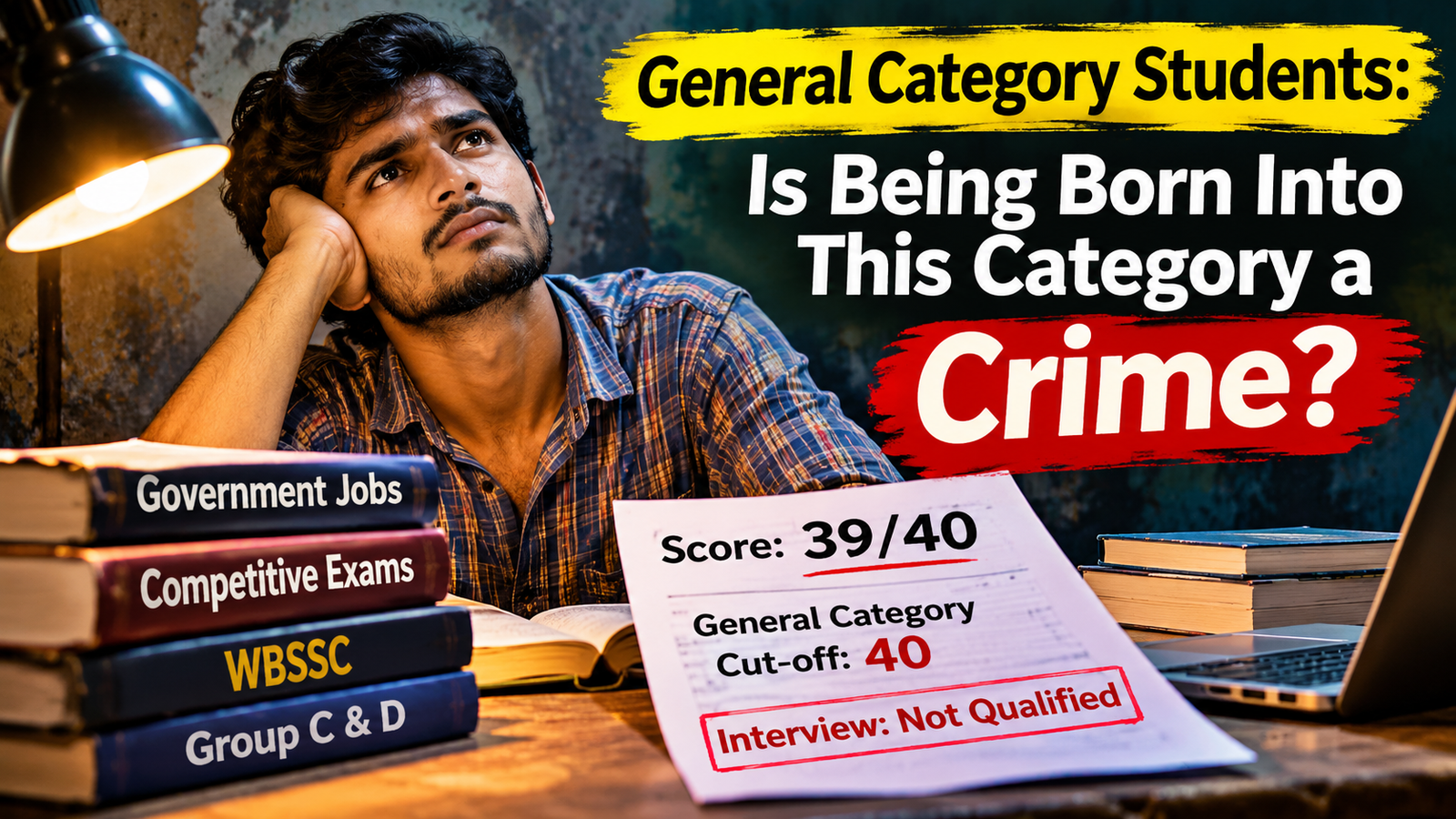
General Category Students: Is Being Born Into This Category a Crime? Scoring 39 Out of 40 Yet Missing the Opportunity for a Government Job!
Imagine scoring 39 out of 40 in a government recruitment examination and still missing the opportunity to move to the next stage by just one mark. What goes through your mind? Is being born into the General Category a disadvantage? And where should General Category students look for motivation?
Government jobs in India are more than just employment opportunities. For millions of young people, they represent financial security, social respect, family stability, and the hope of building a better future.
Students spend years preparing for competitive examinations. Some come from financially comfortable families, while others struggle to afford books, coaching classes, and even basic educational resources.
Yet, they all dream of securing a stable government job.
However, the competition and selection criteria often raise difficult questions, particularly among economically weaker students belonging to the General Category.
Recently, my own experience with the West Bengal School Service Commission (WBSSC) Group C and Group D examination made me think deeply about this issue.
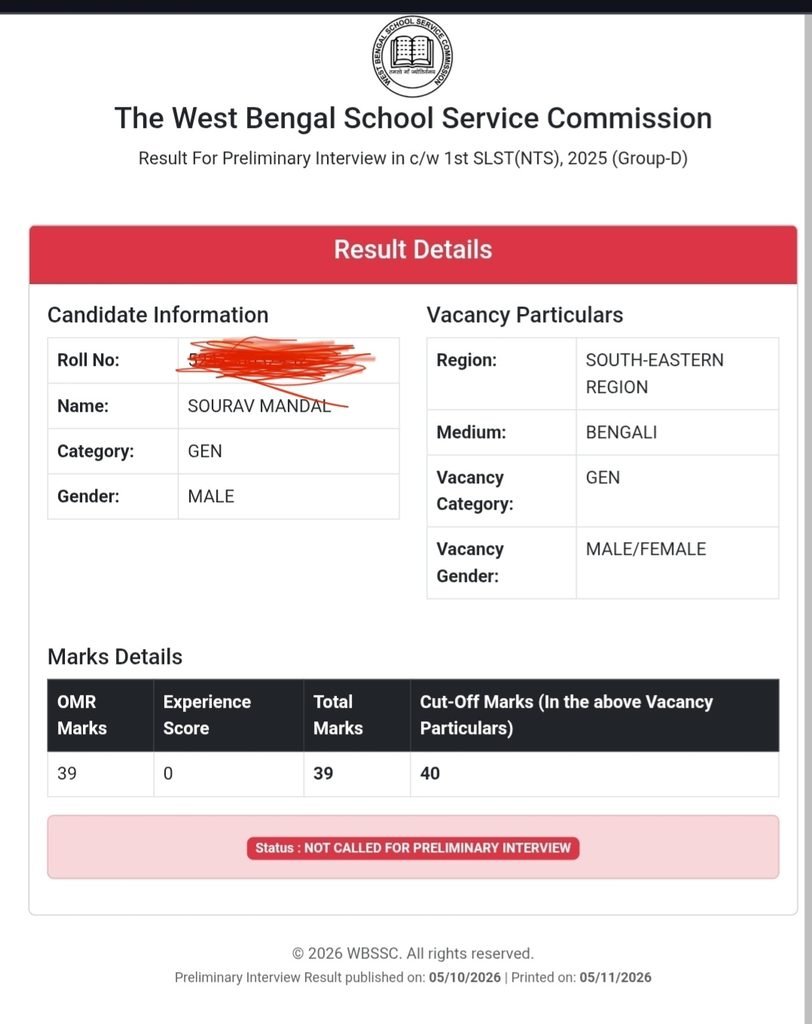
I never spent years preparing for this examination. In fact, I started preparing just five days before the exam by studying selected questions and answers.
Despite such limited preparation, I scored 39 out of 40 in the WBSSC Group D written examination, which is an impressive 97.5%.
However, the General Category cut-off was 40.
That means a General Category candidate needed to score a perfect 40 out of 40 just to qualify for the interview stage.
I missed that opportunity by just one mark.
In Group C, I scored 54 out of 60.
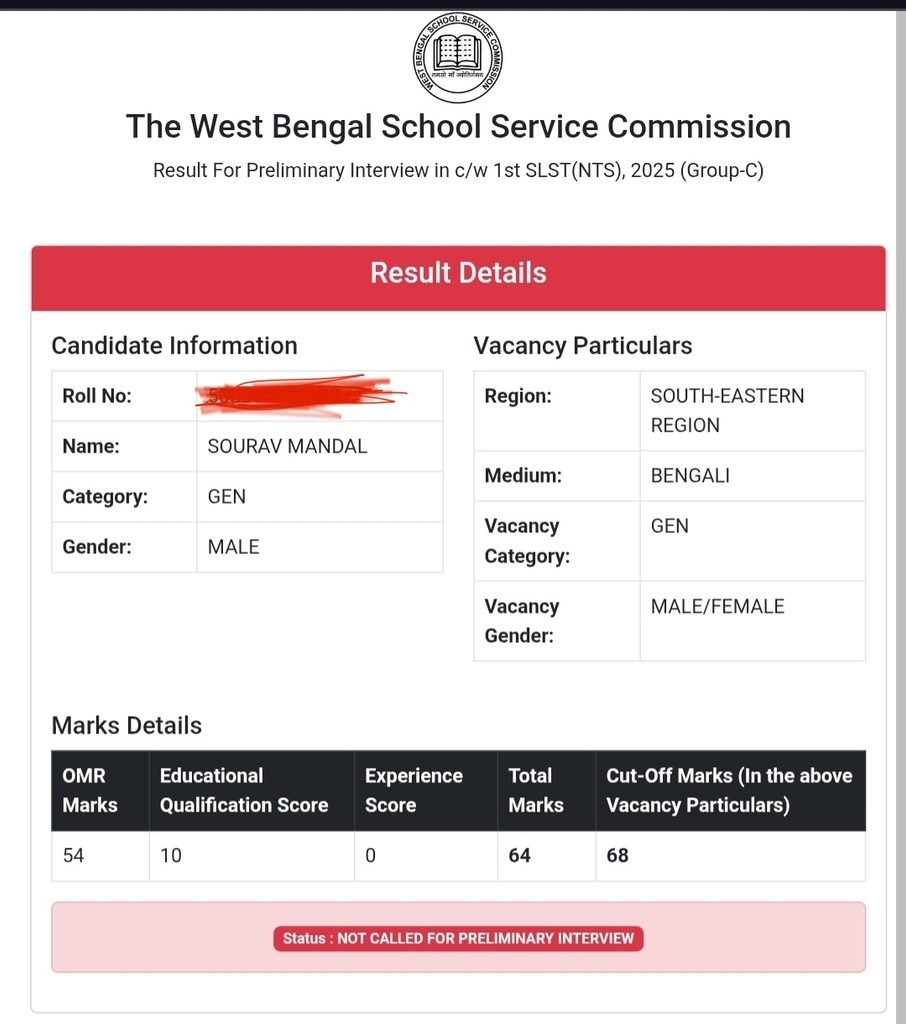
Honestly, I am not particularly disappointed with my personal results because I never invested years in preparing for these examinations.
Now check the cut-off marks for SC, ST, and OBC categories.
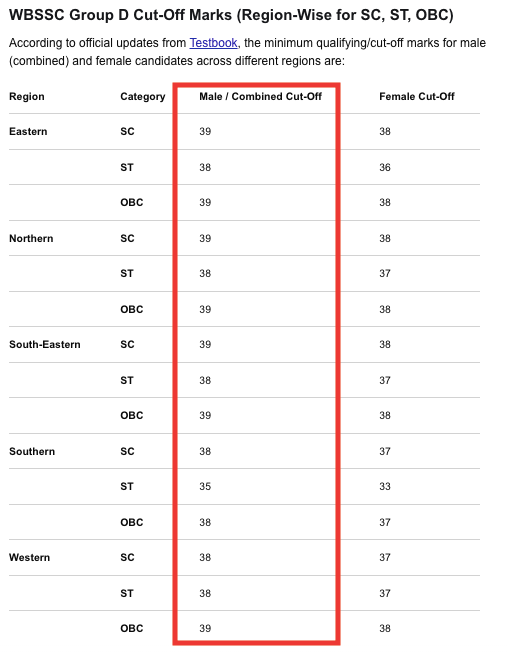
There is another reason why I have never seriously pursued a government job.
I have never been particularly attracted to the idea of spending my entire professional life following the same fixed routine every day. A predictable, structured working life is simply not what I naturally aspire to.
Entrepreneurship and stock market trading have always attracted me far more than a conventional government job. I enjoy the idea of building something of my own, making independent decisions, taking calculated risks, and creating opportunities through my skills and efforts.
So, this examination was never my ultimate career goal.
But it made me think about thousands of young people who have dedicated years of their lives to securing government employment.
What about those who have no alternative career opportunities? What about students whose families have invested their savings and expectations in a single dream?
When someone scores 39 out of 40 but still misses the interview opportunity by one mark, it raises a much bigger question about competition, the reservation system, and motivation.
What motivates General Category students who spend years preparing for government jobs when even a small difference in category-wise cut-offs can determine whether they move forward?
This is not about blaming any community. It is about asking whether economically disadvantaged students from every category are receiving adequate opportunities to build a better future.
Table of Contents
1. Is Being Born Into the General Category a Crime?
India’s reservation system has an important constitutional purpose. It aims to address historical discrimination, improve representation, and provide opportunities to socially and educationally disadvantaged communities.
The importance of these objectives should not be dismissed.
However, there is another reality that deserves attention.
Is every General Category family financially well-off?
Does every General Category student have access to expensive coaching institutes, quality schools, private tutors, and modern educational facilities?
Of course not.
There are thousands of economically struggling families belonging to the General Category.
Some students come from agricultural families. Some have parents who work as daily-wage labourers. Others grow up in households where even paying examination fees can become a financial challenge.
These students also have dreams.
They also work hard, sacrifice their personal interests, and spend countless hours preparing for competitive examinations.
Yet, their economic difficulties do not automatically change their social category.
This raises an important question:
Should an economically disadvantaged student receive less attention simply because they belong to the General Category?
2. Are Economically Weaker General Category Students Being Heard?
A student’s financial background can significantly influence their educational opportunities.
Students from financially secure families can often afford:
- Expensive coaching programmes.
- Private tuition and specialised study materials.
- Online learning subscriptions.
- Better educational environments.
- Multiple attempts at competitive examinations.
On the other hand, economically weaker students may have to manage their studies alongside family responsibilities or part-time work.
Some students help their parents in agricultural activities. Others work to support their education.
For them, preparing for a government examination is not simply an academic challenge. It is also a financial struggle.
This is why economic disadvantage deserves serious attention across all social categories.
Poverty does not belong to any particular caste or category.
An economically weaker General Category student can face many of the same financial barriers that other disadvantaged students experience.
Their difficulties should not be ignored.
3. Reservation and Merit: Can Both Be Discussed Together?
Discussions about reservation in India often become emotionally charged.
Some people emphasise the importance of social justice and historical representation. Others raise concerns about competition and opportunities available to General Category candidates.
However, these discussions should not turn into hostility between communities.
A candidate who receives reservation benefits under applicable rules is not responsible for the existence of the system.
Similarly, a General Category candidate should not be blamed for questioning whether economically disadvantaged students are receiving adequate support.
The real question should be:
Can India strengthen social justice while also improving educational and financial support for economically weaker students from every category?
For example, policymakers could consider:
- Expanding free coaching programmes for economically disadvantaged students.
- Providing financial assistance for competitive examination preparation.
- Improving access to quality online education in rural areas.
- Strengthening awareness and accessibility of existing EWS-related benefits.
- Improving transparency in government recruitment.
- Reducing the educational gap between rural and urban students.
These initiatives could help create better opportunities without treating one community as the enemy of another.
4. What Happens When Someone Misses an Opportunity by Just One Mark?
Imagine a student who has spent three or four years preparing for a government examination.
Their parents have invested their savings in their education. The student has sacrificed holidays, entertainment, and personal interests.
Everyone in the family is waiting for the result.
Finally, the result is published.
The student discovers that his marks are not sufficient to cross the applicable category-wise cut-off.
The difference might be just one or two marks.
For students approaching the upper age limit for recruitment, such results can be particularly discouraging.
The emotional pressure can be significant.
It is not just about losing an opportunity. It is also about dealing with uncertainty regarding the future.
This is why governments and recruitment authorities should ensure that selection procedures are transparent, clearly communicated, and consistently implemented.
At the same time, students should remember that one examination cannot determine their entire worth or potential.
5. Should Financially Weaker General Category Students Receive More Support?
In my opinion, this deserves serious public discussion.
India needs policies that address both historical social disadvantages and economic barriers to education.
Social disadvantage and financial disadvantage are related in many situations, but they are not identical.
A student may belong to a socially disadvantaged community but face economic hardship. Similarly, a student from the General Category may also grow up in severe poverty.
Both situations deserve attention.
The existing EWS framework is one mechanism intended to support eligible economically weaker individuals outside the categories covered by the relevant reservation provisions.
However, simply having a policy is not enough.
Eligible students must be aware of it, understand its requirements, and be able to access the available benefits.
More accessible educational support, scholarships, affordable coaching, and financial assistance could make a meaningful difference.
The objective should be to ensure that no deserving student is prevented from pursuing education simply because their family cannot afford it.
6. Is a Government Job the Only Path to Success?
There is another lesson I have taken from this experience.
In India, government jobs are often considered the ultimate symbol of career stability.
Millions of young people spend years preparing for recruitment examinations, sometimes ignoring other career opportunities.
But a government job is not the only path to a successful life.
Digital marketing, technology, entrepreneurship, online education, content creation, and other skill-based professions offer alternative career opportunities.
Young people should not limit their ambitions to a single examination or recruitment process.
Developing practical skills, building professional experience, and exploring alternative income sources can also help create financial independence.
A failed examination does not mean a failed life.
7. Questions That Deserve Answers
I am not writing this article to attack any caste, community, or reserved category.
I believe that historical discrimination and social inequality must be addressed.
At the same time, I believe that the challenges faced by economically weaker General Category students deserve greater attention.
Here are some questions worth discussing:
- Should the government expand educational assistance for economically weaker General Category students?
- Can more free coaching programmes be introduced for financially disadvantaged candidates?
- Can existing EWS-related educational support become more accessible to eligible students?
- How can India reduce educational inequality between rural and urban students?
- Can social justice and economic assistance work together to create better educational opportunities?
- How can recruitment systems become more transparent and understandable for every applicant?
These questions deserve thoughtful discussion rather than emotional arguments.
Final Thoughts: Being Born Into the General Category Is Not a Crime
My score of 39 out of 40 in the WBSSC Group D written examination may not be a major personal achievement.
However, it made me think about an issue that deserves more public attention.
I do not want one person’s opportunity to be taken away to create an opportunity for someone else.
I do not want any community to be treated unfairly.
I simply want economically weaker General Category students to have access to meaningful educational support and opportunities.
Because poverty does not discriminate by caste or category.
A poor student from the General Category also has dreams. Their parents also hope that their child will build a better future. They also deserve access to quality education, preparation resources, and opportunities for personal growth.
A fair society should recognise that every student deserves a chance to improve their circumstances.
The real objective should not be to create conflict between categories. It should be to build a system where social justice, educational equality, and economic support can work together.
What Do You Think?
Do you believe economically weaker General Category students should receive more educational support and opportunities?
Have you ever experienced a situation where you scored well in a competitive examination but could not move forward because you did not meet your category’s cut-off?
Share your thoughts and experiences in the comments.
Let us have a meaningful discussion based on facts, fairness, and mutual respect rather than hatred or discrimination.
This discussion is not against any community. It is about educational equality, economic hardship, and the future of India’s young generation.
