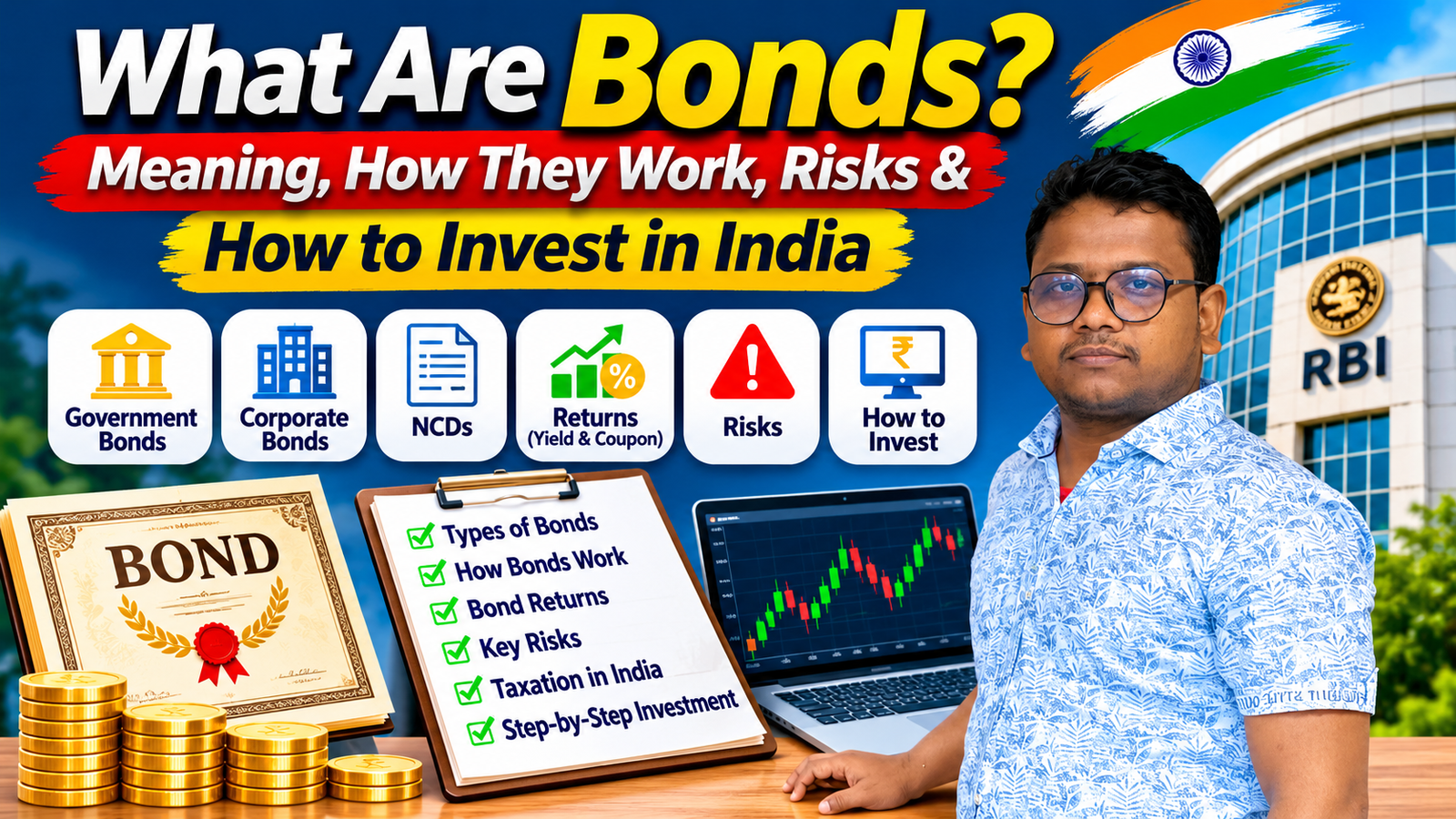
What Are Bonds? Types, Returns, Risks & How to Invest
What Are Bonds? Meaning, How They Work, Risks & How to Invest in India
Bonds are an important part of the financial market, but many beginner investors find them confusing. You may have heard about government bonds, corporate bonds, Treasury Bills, tax-free bonds and Non-Convertible Debentures (NCDs). However, what exactly are bonds, how do they generate returns, and how can you invest in them in India?
In simple terms, a bond is a financial instrument through which you lend money to a government, company or another eligible issuer. In return, the issuer agrees to pay interest according to the bond’s terms and repay the principal on a specified maturity date, subject to its ability and obligation to do so.
Bonds can help investors earn interest, diversify their portfolios and plan for future financial goals. However, they are not completely risk-free. Some bonds carry credit risk, interest-rate risk and liquidity risk, and you can lose money if you sell them at an unfavourable price or the issuer defaults.
In this guide, you will learn what bonds are, how they work, the different types of bonds available in India, how bond returns are calculated, the risks involved, and how to invest through platforms such as RBI Retail Direct.
Table of Contents
What Are Bonds?
A bond is a debt instrument that represents a loan made by an investor to an issuer. The issuer can be the Central Government, a State Government, a public sector undertaking, a bank or a private company.
When you purchase a bond, you become a creditor of the issuer. You do not become an owner of the company, unlike when you purchase its shares.
In exchange for your investment, the issuer may pay periodic interest, known as a coupon. At the end of the bond’s tenure, the issuer is generally required to repay the principal amount according to the bond’s terms.
For example, suppose you purchase a bond with the following features:
| Particulars | Details |
|---|---|
| Face value | ₹10,000 |
| Coupon rate | 8% per year |
| Investment price | ₹10,000 |
| Maturity period | 5 years |
| Annual interest | ₹800 |
| Principal due at maturity | ₹10,000 |
If the bond pays interest annually, you would receive ₹800 every year for five years. At maturity, you would receive the ₹10,000 principal, assuming the issuer fulfils its repayment obligation.
Your total coupon income over five years would be ₹4,000 before tax.
However, actual returns can differ if you buy the bond above or below its face value, sell it before maturity, or purchase a bond with different payment terms.
Why do governments and companies issue bonds?
Governments and companies need money to finance their activities.
Governments may issue bonds to fund infrastructure projects, public expenditure and other borrowing requirements. Companies may issue bonds to expand operations, purchase equipment, refinance existing debt or finance new projects.
Instead of borrowing exclusively from banks, issuers can raise money directly from investors through the bond market.
How Do Bonds Work?
The bond investment process generally involves five stages.
Step 1: An issuer raises money
A government or company decides to borrow money and issues bonds to investors.
For example, a company may issue bonds to raise ₹500 crore for a new manufacturing facility.
Step 2: Investors purchase the bonds
Investors can purchase bonds when they are initially issued or buy existing bonds from other investors in the secondary market.
The first is called the primary market, while the second is called the secondary market.
Step 3: The issuer pays interest
If the bond carries a coupon, the issuer pays interest according to the agreed schedule.
Depending on the bond, payments may be monthly, quarterly, half-yearly or annually. Some bonds do not make periodic interest payments.
Step 4: The bond remains active until maturity
During the bond’s tenure, the investor may receive interest payments and hold the bond until maturity.
Some bonds can also be sold before maturity, provided there is a buyer and a suitable trading facility.
Step 5: The issuer repays the principal
On the maturity date, the issuer is generally expected to repay the principal amount according to the bond’s terms.
However, repayment is not guaranteed for every bond. A company facing financial difficulties may delay or default on its interest or principal payments.
A bond is a debt obligation, not a guaranteed-return savings account. Always understand the issuer’s repayment capacity and the bond’s conditions before investing.
Important Bond Terminology Every Beginner Should Know
Before investing in bonds, you should understand some basic financial terms. These terms help you compare different bonds and calculate their potential returns.
| Term | Meaning |
|---|---|
| Issuer | Government or company that borrows money |
| Face value | Principal amount stated on the bond |
| Coupon rate | Interest rate calculated on the bond’s face value |
| Coupon payment | Actual interest paid to the bondholder |
| Issue price | Price at which the bond is initially issued |
| Market price | Current price at which the bond is available in the market |
| Maturity date | Date on which principal repayment is due |
| Yield | Return measured in relation to the bond’s price and cash flows |
| Yield to maturity (YTM) | Estimated annualised return if the bond is held until maturity, based on its price and expected cash flows |
| Credit rating | Rating agency’s assessment of the issuer’s creditworthiness or the bond’s credit risk |
| Duration | Measure of a bond’s sensitivity to interest-rate changes |
| Accrued interest | Interest accumulated since the previous coupon payment |
Coupon Rate vs Current Yield vs Yield to Maturity
These three terms are particularly important because they are not interchangeable.
Coupon rate: The annual interest rate calculated on a bond’s face value.
Current yield: Annual coupon income divided by the bond’s current market price.
Yield to maturity (YTM): The estimated annualised return from holding a bond until maturity, considering its purchase price, coupon payments, redemption value and payment timing.
Consider this example:
- Face value: ₹1,000
- Annual coupon rate: 8%
- Annual coupon payment: ₹80
- Purchase price: ₹950
The current yield is:
Current yield = (Annual coupon payment ÷ Purchase price) × 100
= (₹80 ÷ ₹950) × 100
= 8.42%
Although the coupon rate is 8%, the current yield is approximately 8.42% because you purchased the bond below its face value.
However, 8.42% is not its YTM. YTM also considers the additional amount you may receive at maturity compared with your purchase price, along with the timing of all payments.
When comparing bonds, do not rely only on the coupon rate. Look at the purchase price and YTM as well.
Types of Bonds in India
The Indian bond market offers several types of debt instruments. They differ in terms of issuer, maturity, interest payments, credit risk and liquidity. Let’s understand the major categories.
Government Bonds (G-Secs)
Government Securities, commonly called G-Secs, are debt instruments issued by the Central Government or State Governments.
When you purchase a government bond, you are effectively lending money to the government.
Central Government securities issued in domestic currency are generally considered to have negligible domestic sovereign credit risk. However, their market prices can fluctuate because of changes in interest rates and market conditions.
Government bonds are commonly used by investors who want exposure to government debt and predictable contractual cash flows.
Treasury Bills (T-Bills)
Treasury Bills are short-term government securities issued by the Central Government.
In India, the commonly used Treasury Bill maturities are:
- 91 days
- 182 days
- 364 days
Unlike ordinary coupon-paying bonds, Treasury Bills are generally issued at a discount to their face value and redeemed at face value on maturity.
For example, suppose you purchase a Treasury Bill for ₹9,800 and receive ₹10,000 at maturity.
Your gross gain would be ₹200, assuming you hold it until maturity and receive the full redemption amount.
Treasury Bills may be useful for investors looking at short-term government securities, but their returns and availability depend on the prevailing market and auction conditions.
State Development Loans (SDLs)
State Development Loans are bonds issued by State Governments to raise funds.
They are used to finance state-level borrowing requirements.
SDLs are different from Central Government-dated securities. Although they are government securities, investors should understand their specific terms, yields, maturity, and liquidity before investing.
Corporate Bonds
Corporate bonds are debt securities issued by companies to raise money.
Companies may use the funds for business expansion, infrastructure development, equipment purchases, working capital, refinancing existing loans and other corporate requirements.
Corporate bonds can offer higher yields than comparable government securities. However, they also carry issuer-specific credit risk.
If the company experiences financial difficulties, it may fail to pay interest or repay the principal.
Therefore, investigate the company’s financial position, credit rating, debt levels and repayment capacity before investing.
Non-Convertible Debentures (NCDs)
Non-Convertible Debentures are debt instruments that cannot be converted into equity shares of the issuing company.
They are commonly issued by companies to raise long-term or medium-term funds.
NCDs may offer:
- Fixed interest payments
- Different maturity periods
- Monthly, quarterly, half-yearly or annual interest options
- Secured or unsecured structures
Secured NCDs: These are backed by specified assets or security, subject to the terms of the issue and applicable legal arrangements.
Unsecured NCDs: These are not backed by specified collateral. Their repayment depends on the issuer’s ability to meet its obligations.
A secured NCD is not automatically risk-free. The value and enforceability of the security, ranking of claims, and the issuer’s financial health all matter.
PSU Bonds
Public Sector Undertakings (PSUs) may issue bonds to raise funds. These bonds are issued by government-owned or government-controlled enterprises.
However, an investment in a PSU bond should not automatically be treated as equivalent to an investment in a Central Government security. A government guarantee exists only when it is explicitly provided under the bond’s terms.
Always check who is legally responsible for repayment.
Municipal Bonds
Municipal bonds are issued by eligible urban local bodies or related entities to raise money for public infrastructure and development projects. The funds may be used for water supply, roads, public transportation, waste management, and urban development.
Their credit risk and repayment structure depend on the issuer and the specific issue.
Tax-Free Bonds
Tax-free bonds are bonds whose interest income receives tax exemption under the applicable provisions of law.
They have historically been issued by certain government-backed entities and public sector organisations.
An important distinction is that tax-free interest does not necessarily mean that every gain associated with the bond is tax-free. Capital gains on selling a bond may have separate tax treatment.
The availability of new issues also depends on actual issuance. Investors may find existing tax-free bonds in the secondary market.
Other Types of Bonds
Bonds can also be classified according to their interest-payment structure and special features.
Fixed-rate bonds: Pay interest at a predetermined rate.
Floating-rate bonds: Their interest rate changes according to a specified benchmark or formula.
Zero-coupon bonds: Do not pay regular interest. They are generally issued at a discount and redeemed at face value.
Convertible bonds: May be converted into equity shares according to the specified terms.
Callable bonds: Allow the issuer to redeem the bond before its scheduled maturity under specified conditions.
Puttable bonds: Give investors the right to request early redemption under specified conditions.
Perpetual bonds: Do not have a conventional fixed maturity date. Their terms and risks can be complex.
These categories can overlap. For example, a corporate bond may also be fixed-rate, secured and callable.
How Do You Make Money From Bonds?
There are several ways investors can earn returns from bonds.
Interest Income
The most familiar way to earn money from a bond is through coupon payments. Suppose you invest ₹50,000 in a bond with a coupon rate of 8%.
Annual interest:
₹50,000 × 8% = ₹4,000
You would receive ₹4,000 in annual interest if the bond pays annually and the issuer fulfils its payment obligations. The actual payment frequency depends on the bond’s terms.
Capital Gains
You may earn a capital gain if you sell a bond for more than your purchase price.
For example:
- Purchase price: ₹9,500
- Selling price: ₹9,800
- Capital gain: ₹300
This gain is before applicable taxes and transaction costs.
Capital Losses
You can also lose money if you sell a bond for less than your purchase price.
For example:
- Purchase price: ₹10,000
- Selling price: ₹9,600
- Capital loss: ₹400
This can happen when interest rates rise, the issuer’s creditworthiness deteriorates or market demand decreases.
Reinvestment Income
If you receive coupon payments and reinvest them, those payments may generate additional income.
This can contribute to the total return of your bond portfolio. However, future reinvestment rates are not guaranteed.
Understanding a Complete Bond Investment Example
Suppose you purchase a five-year bond with these terms:
| Particulars | Amount |
|---|---|
| Face value | ₹10,000 |
| Purchase price | ₹9,600 |
| Annual coupon rate | 8% |
| Annual coupon payment | ₹800 |
| Maturity period | 5 years |
| Redemption amount | ₹10,000 |
If the issuer pays all coupons and repays the full principal:
- Total coupon income over five years: ₹4,000
- Difference between redemption value and purchase price: ₹400
- Total gross gain: ₹4,400
This is a simplified total cash-gain calculation, not an annualised return calculation. To compare it fairly with other investments, calculate the YTM using the timing of each cash flow.
The example also assumes that there is no default, no early redemption, and no reinvestment of coupon payments.
Why Do Bond Prices Go Up and Down?
One important concept in bond investing is the relationship between interest rates and bond prices.
Generally, when market interest rates rise, prices of existing fixed-rate bonds fall, and when market interest rates fall, prices of existing fixed-rate bonds rise. Why does this happen?
Suppose you own an existing bond that pays 8% annual interest. Later, new comparable bonds become available at 9%.
An investor may prefer the new 9% bond instead of purchasing your existing 8% bond at the same price. To attract buyers, the market price of your existing bond may need to fall. The opposite can happen when new comparable bonds offer lower interest rates.
Other factors that affect bond prices
Interest rates are not the only factor influencing bond prices. Other factors include:
Creditworthiness: If an issuer’s financial condition deteriorates, its bond prices may fall.
Inflation expectations: Higher expected inflation can reduce the attractiveness of fixed future payments.
RBI monetary policy: Changes in policy rates and market expectations can influence bond yields.
Market demand and supply: More buyers or sellers can affect prices.
Liquidity: Bonds with limited trading activity may be harder to sell at a fair price.
Remaining maturity: Longer-maturity bonds are generally more sensitive to interest-rate changes.
What Is Bond Duration?
Duration is a measure used to understand how sensitive a bond’s price is to changes in interest rates. In general, bonds with longer durations are more sensitive to interest-rate movements.
For example, a long-term fixed-rate government bond may experience a larger price movement than a short-term bond when market yields change by the same amount.
Investors who may need their money before maturity should pay particular attention to duration and interest-rate risk.
What Are the Risks of Investing in Bonds?
Bonds are often considered less volatile than shares, but that does not mean they are risk-free. Before investing, understand these major risks.
Credit or Default Risk
Credit risk is the possibility that the issuer may fail to pay interest or repay the principal. This risk is particularly important when investing in corporate bonds and NCDs.
A company may face financial problems because of falling sales, excessive borrowing, poor management or unfavourable economic conditions. If the company defaults, investors may lose part or all of their investment.
Interest-Rate Risk
Bond prices generally fall when market interest rates rise. This can create losses for investors who sell their bonds before maturity. Longer-duration bonds are usually more sensitive to interest-rate changes.
Liquidity Risk
Liquidity risk refers to the possibility that you may not find a buyer when you want to sell your bond. Some corporate bonds have limited secondary-market trading. Even if you find a buyer, you may need to accept a lower price than expected.
Inflation Risk
Inflation reduces the purchasing power of money. Suppose a bond pays you 7% interest annually, but inflation is 6%. Your approximate return after inflation is only around 1% before tax, ignoring compounding and other effects. This illustrates why investors should consider inflation when comparing fixed-income investments.
Reinvestment Risk
Reinvestment risk occurs when you receive coupon payments but cannot reinvest them at the same interest rate. For example, if your bond pays 8% interest today but market rates fall to 6%, you may have to reinvest future coupon payments at a lower rate.
Call Risk
Some bonds allow the issuer to repay the bond before its scheduled maturity. An issuer may exercise this option when market interest rates fall, subject to the bond’s terms. You may receive your principal earlier than expected and have to reinvest it at a lower rate.
Rating Downgrade Risk
Credit-rating agencies periodically assess the creditworthiness of issuers and debt instruments. If a company’s financial position weakens, its bond rating may be downgraded. A downgrade can reduce the bond’s market price and make it more difficult to sell.
Are government bonds completely risk-free?
Central Government securities issued in domestic currency are generally treated as having negligible domestic sovereign credit risk. However, their market prices can still fall when interest rates rise. Inflation and liquidity risks also remain.
The RBI explains this distinction in its Government Securities Market primer and Retail Direct material.
How to Check a Bond Before Investing
Choosing a bond simply because it advertises an attractive interest rate is a mistake. You should examine several factors before investing.
Check the Issuer
First, identify the entity borrowing your money. Ask:
- Is it the Central Government, a State Government or a company?
- What is the issuer’s financial position?
- Does it have a history of meeting repayment obligations?
- What is the purpose of the borrowing?
Understanding the issuer is the first step in assessing credit risk.
Check the Credit Rating
Credit-rating agencies assess the creditworthiness of issuers and debt instruments. Common rating categories include:
| Rating category | General interpretation |
|---|---|
| AAA | Highest level of creditworthiness within the rating scale |
| AA | High degree of creditworthiness |
| A | Adequate to strong creditworthiness, with greater sensitivity to adverse conditions |
| BBB | Moderate credit risk; lower end of investment-grade categories in common rating scales |
| BB and below | Higher speculative or credit risk |
| D | Indicates default under the applicable rating definitions |
The exact meaning and outlook depend on the rating agency and its methodology. A higher rating generally indicates lower assessed credit risk, but it does not guarantee repayment. Ratings can also change. Always check the latest rating, rating rationale, and any downgrade history.
Check Whether the Bond Is Secured or Unsecured
A secured bond is backed by specified assets or security. An unsecured bond does not have specified collateral backing it. However, secured does not mean risk-free. You should understand:
- What assets secure the bond?
- What is their estimated value?
- Are other lenders also claiming those assets?
- What is the bond’s ranking in repayment?
- What happens if the issuer defaults?
Check Coupon Rate and YTM
Compare the coupon rate and YTM. A bond with a high coupon rate may not necessarily offer the best return if its purchase price is also high. Similarly, a bond offering a high YTM may carry greater credit or liquidity risk. Understand why the yield is higher before investing.
Check the Maturity Date
Your investment horizon should match the bond’s maturity. For example, if you need money in two years, purchasing a long-term bond may expose you to unnecessary price fluctuations if you need to sell early.
Check Liquidity
Look at:
- Trading volume
- Recent transaction prices
- Bid and ask prices
- Number of active buyers and sellers
- Availability of a realistic exit route
A bond that appears attractive on paper may be difficult to sell.
Read the Offer Document
Before purchasing a corporate bond or NCD, read its offer document or other applicable disclosures. Pay attention to:
- Coupon and payment schedule
- Maturity and redemption terms
- Credit rating
- Security and guarantees
- Default provisions
- Call and put options
- Risks and restrictions
Do not invest solely on the basis of an advertisement or a platform’s summary.
Check the Company’s Financial Health
For corporate bonds, examine basic financial indicators where reliable information is available.
Debt-to-equity ratio: Helps assess the company’s borrowing relative to its equity.
Interest coverage ratio: Indicates how comfortably the company can meet interest expenses from operating earnings.
Cash flow: Helps assess whether the company generates sufficient cash to meet its obligations.
Profitability and repayment history: Provide additional context about financial stability.
No single ratio can establish that a bond is safe. Consider the complete financial picture.
How to Invest in Bonds in India
Indian investors have several ways to invest in bonds, depending on the type of security and their preferences.
Invest Through RBI Retail Direct
RBI Retail Direct is a facility that allows individual investors to buy and sell eligible government securities directly through the Reserve Bank of India’s online platform. Investors can open a Retail Direct Gilt (RDG) account. Depending on the securities and facilities available, investors can access:
- Government of India Treasury Bills
- Government of India dated securities
- State Development Loans
- Other eligible government securities
The general process is:
- Visit the official RBI Retail Direct website.
- Register for an RDG account.
- Complete the required identity and bank verification.
- Log in to the platform.
- Review available government securities and their terms.
- Participate in eligible primary auctions or purchase securities through the secondary-market facility.
- Monitor holdings, payments and maturity details.
Official website: https://rbiretaildirect.org.in/
The RBI’s scheme provides individual investors with access to government securities through a dedicated online account. Check the current platform instructions, eligibility requirements and available instruments before registering.
Invest Through a Stockbroker
Investors may purchase eligible listed bonds through a stockbroker. Depending on the security and trading facility, you may need:
- A Demat account
- A trading account
- A linked bank account
- Completed KYC
Before purchasing, review the bond’s price, YTM, credit rating, maturity, trading activity and transaction costs.
Invest Through SEBI-Registered Online Bond Platform Providers
Online Bond Platform Providers (OBPPs) offer investors an online route to access eligible debt securities. However, not every website or app advertising bonds is necessarily registered. SEBI has warned investors about unregistered online bond platforms.
Before investing, verify the platform’s registration status through the official SEBI or relevant stock-exchange information.
Do not transfer money to an unknown platform or rely only on social-media advertisements promising high fixed returns.
Invest in Corporate Bonds and NCD Public Issues
Companies may issue bonds or NCDs through public issues or other permitted routes.
Before applying:
- Read the offer document.
- Check the credit rating and rating rationale.
- Review the issuer’s financial position.
- Understand whether the NCD is secured or unsecured.
- Compare the coupon, YTM and maturity.
- Check the payment schedule and redemption conditions.
- Understand the tax implications.
A high advertised interest rate should never replace proper credit analysis.
Invest Indirectly Through Debt Mutual Funds
You do not necessarily need to purchase individual bonds to gain exposure to debt securities. Debt mutual funds invest in portfolios of debt instruments, which may include government securities, corporate bonds, Treasury Bills and other money-market instruments, depending on the scheme. Examples of debt mutual fund categories include:
- Liquid funds
- Overnight funds
- Money market funds
- Short-duration funds
- Corporate bond funds
- Gilt funds
- Dynamic bond funds
The risk and return profile depends on the scheme’s portfolio, maturity, credit quality and interest-rate sensitivity. Debt mutual funds do not provide guaranteed returns, and their NAV can rise or fall.
Government Bonds vs Corporate Bonds
Government bonds and corporate bonds differ mainly in their issuers and credit risks.
| Feature | Government bonds | Corporate bonds |
|---|---|---|
| Issuer | Central or State Government | Companies and eligible entities |
| Credit risk | Central Government securities have negligible domestic sovereign credit risk | Depends on issuer and bond structure |
| Interest rate | Depends on market conditions and maturity | Depends on market rates, issuer risk and maturity |
| Liquidity | Varies by security | Can vary considerably |
| Returns | Market-determined | May offer higher yields for higher risk |
| Main risks | Interest-rate, inflation and liquidity risks | Credit, interest-rate, liquidity and other risks |
Corporate bonds may offer higher yields because investors are taking additional credit risk. However, a higher yield does not automatically make a corporate bond a better investment.
Bonds vs Fixed Deposits vs Stocks vs Debt Mutual Funds
Beginners often confuse bonds with fixed deposits and debt mutual funds. Although all these products can play a role in financial planning, their structures and risks are different.
| Feature | Bonds | Fixed deposits | Stocks | Debt mutual funds |
|---|---|---|---|---|
| Investment type | Debt security | Bank deposit | Equity ownership | Portfolio of debt securities |
| Return | Coupon and possible price gain or loss | Contractual interest | Price movement and dividends | Depends on underlying securities and market conditions |
| Risk | Depends on issuer and bond terms | Depends on institution and deposit protection | Market and business risk | Credit and interest-rate risk |
| Liquidity | Depends on security and market | Depends on FD terms | Generally good for actively traded shares | Depends on scheme and exit terms |
| Principal protection | Not universal | Subject to bank obligations and applicable deposit protection | No | No |
| Market price fluctuation | Yes, for traded bonds | Generally no daily market pricing for ordinary FDs | Yes | NAV changes daily |
Are bonds better than fixed deposits?
There is no universal answer. Fixed deposits may be easier for investors who want a familiar bank-deposit product with a defined interest rate and maturity.
Bonds may be useful for investors who want exposure to government or corporate debt securities and understand their pricing, yield and risks.
Bank deposits in India are covered by DICGC insurance up to ₹5 lakh per depositor per insured bank, including principal and interest, subject to applicable rules and aggregation requirements. This protection is different from a bond investment.
Are bonds better than stocks?
Bonds and stocks serve different purposes. A stock represents ownership in a company, while a bond represents a debt obligation.
Stocks may offer higher long-term growth potential but generally involve greater price volatility. Bonds may provide contractual interest payments, but they also carry credit, interest-rate and liquidity risks.
The appropriate choice depends on your financial goals, time horizon and ability to tolerate losses.
How Are Bonds Taxed in India?
Taxation is an important factor when comparing bond investments. The tax treatment depends on the type of bond, the nature of income, the holding period and the applicable tax rules.
Tax on Interest Income
Interest received from ordinary taxable bonds is generally taxable under the applicable income-tax provisions.
For an individual investor, taxable bond interest is generally included in the relevant income calculation and taxed according to the applicable rules and tax regime.
For example, if you receive ₹20,000 in taxable bond interest during a financial year, that amount may increase your taxable income.
The actual tax depends on your overall income, applicable deductions, exemptions and tax regime.
Tax on Capital Gains
If you sell a bond for more than your purchase price, you may earn a capital gain.
If you sell it for less than your purchase price, you may incur a capital loss.
The tax treatment depends on factors such as:
- Whether the bond is listed or unlisted
- The date of acquisition
- The date of sale or transfer
- The applicable holding-period rules
- The type of security
- Relevant provisions of the current income-tax law
Do not assume that all bonds receive the same capital-gains treatment.
Are Tax-Free Bonds Really Tax-Free?
Certain tax-free bonds provide exemption on interest income under the applicable provisions.
However, tax-free interest does not automatically make every gain from the bond tax-free.
For example, a capital gain from selling a tax-free bond in the secondary market may have separate tax implications.
What About TDS?
Tax Deducted at Source may apply to certain bond-interest payments, depending on the security and applicable provisions.
TDS is not necessarily the final tax liability. You may need to report the income and calculate your final tax according to the rules applicable to you.
Important tax note: Income-tax provisions and bond taxation can change. Check the latest Income Tax Department guidance or consult a qualified tax professional before making an investment decision. This article is educational and does not provide individual tax advice.
Who Should Consider Investing in Bonds?
Bonds may be worth considering for investors who understand their risks and want to include debt securities in their portfolios.
They may be relevant for:
Investors seeking periodic income
Some bonds provide regular coupon payments, which may help investors plan their cash flows.
Investors looking to diversify
An equity-heavy portfolio may benefit from exposure to other asset classes, including debt securities. However, diversification does not eliminate investment risk.
Investors with defined financial goals
Investors may consider bonds with suitable maturity dates when planning for future expenses. For example, a person saving for an expense several years away may evaluate a bond whose maturity and cash flows align with that requirement.
Investors who understand credit risk
Corporate bonds may be suitable for investors who can assess issuer quality, repayment capacity and the possibility of default.
Who should be cautious?
Bonds may not be appropriate for everyone. Be particularly cautious if:
- You may need the invested money immediately.
- You do not understand how bond prices change.
- You are investing only because of an unusually high advertised yield.
- You cannot tolerate a loss of principal.
- You have not checked the issuer’s creditworthiness.
- You are investing a large portion of your savings in one company.
Keep your emergency fund separate from investments that may be difficult to sell quickly.
Common Mistakes Beginners Should Avoid
Here are some common mistakes to avoid when investing in bonds.
1. Choosing a bond only because of its high coupon rate
A high coupon does not necessarily mean a high return or a safe investment. Compare YTM and credit risk.
2. Assuming every government-linked issuer has a sovereign guarantee
A PSU or government-owned company is not automatically backed by a Central Government guarantee. Check the actual bond terms.
3. Treating credit ratings as guarantees
Ratings are opinions that can change. They do not eliminate the possibility of default.
4. Confusing coupon rate with YTM
Coupon rate is based on face value. YTM considers the bond’s price and expected cash flows.
5. Ignoring the purchase price
Two investors buying the same bond at different prices can earn different returns.
6. Ignoring liquidity
A bond may be difficult to sell before maturity, particularly if it has limited trading activity.
7. Ignoring maturity
Do not invest in a long-term bond without considering when you may need the money.
8. Forgetting taxes and transaction costs
Your post-tax return may be lower than the advertised yield.
9. Investing too much in one issuer
Concentrating your investment in one company increases issuer-specific risk.
10. Not reading the offer document
Always understand the payment schedule, security, redemption terms and risks before investing.
How to Build a Bond Portfolio
If you decide to include bonds in your portfolio, avoid selecting securities randomly. A thoughtful approach can help you manage maturity, credit and liquidity risks.
Diversify Across Issuers
Avoid concentrating all your corporate-bond investments in one company.
Diversification across issuers and sectors can reduce the impact of problems affecting a single borrower. It cannot eliminate the risk of broader market or economic stress.
Diversify Across Maturities
Investors can consider spreading investments across different maturity dates. This approach is often called bond laddering.
For example, instead of investing the entire amount in one five-year bond, an investor may divide it among securities with different maturities.
When a bond matures, the principal can be used for a financial goal or reinvested at prevailing market rates.
Bond laddering can help manage reinvestment timing and liquidity needs, but it does not guarantee higher returns.
Match Bonds to Your Financial Goals
Your investment period should influence the maturity you choose. If you need money in two years, a long-term bond may expose you to unnecessary market-price risk if you have to sell it early.
Consider the expected maturity proceeds, coupon dates and possible exit requirements before investing.
Balance Government and Corporate Debt
Government securities and corporate bonds have different risk profiles. Government securities may provide exposure to lower domestic sovereign credit risk, while corporate bonds may offer higher yields in exchange for issuer-specific credit risk.
Choose based on your risk tolerance, not simply the highest advertised return.
Frequently Asked Questions About Bonds
What are bonds in simple words?
A bond is a loan that an investor gives to a government, company or another eligible issuer. The issuer agrees to pay interest according to the bond’s terms and repay the principal at maturity, subject to its ability and obligation to do so.
Are bonds safe investments in India?
The safety of a bond depends on its issuer, credit quality, maturity and structure. Central Government securities have negligible domestic sovereign credit risk, but they can still carry interest-rate, inflation and liquidity risks. Corporate bonds carry additional credit risk.
Can I invest ₹1,000 in bonds?
The minimum investment depends on the bond, issue terms and platform. Some products may have relatively low minimum investment requirements, while others require larger amounts. Check the specific bond’s denomination and minimum application size.
How much return can bonds provide?
Bond returns vary according to the issuer, coupon, purchase price, maturity and prevailing market conditions. Corporate bonds may offer higher yields than government securities because of additional credit risk. No single return rate applies to all bonds.
Do bonds pay interest every month?
Some bonds pay interest monthly, while others pay quarterly, half-yearly or annually. Certain bonds, such as Treasury Bills and zero-coupon bonds, do not pay regular coupon interest.
Can I lose money by investing in bonds?
Yes. You can lose money if you sell a bond below your purchase price or if the issuer defaults on interest or principal payments. Bond prices can also fall when market interest rates rise.
Are government bonds risk-free?
Central Government securities issued in domestic currency are generally considered to have negligible domestic sovereign credit risk. However, they are not free from interest-rate, inflation or liquidity risk.
What is the difference between coupon rate and yield?
Coupon rate is the interest rate calculated on the bond’s face value. Yield measures the return relative to the bond’s price and cash flows. YTM estimates the annualised return if the bond is held until maturity, subject to its assumptions.
What is the minimum investment in government bonds?
The minimum investment depends on the type of security and the applicable platform or auction rules. Check the current RBI Retail Direct instructions and the specific security’s terms.
How can I buy government bonds directly from RBI?
You can use the RBI Retail Direct platform. Eligible individual investors can open a Retail Direct Gilt account and access eligible government securities through the available primary and secondary-market facilities.
Can I sell bonds before maturity?
Some bonds can be sold in the secondary market before maturity. However, the availability of buyers and the selling price depend on the bond’s liquidity and prevailing market conditions. You may receive less than your purchase price.
Are bonds better than fixed deposits?
Neither is universally better. Fixed deposits are bank deposits with defined interest terms, while bonds are debt securities whose risks depend on the issuer and market. Compare liquidity, tax treatment, risk and applicable deposit protection before deciding.
Are corporate bonds riskier than government bonds?
Corporate bonds generally carry issuer-specific credit risk. Central Government securities in domestic currency have negligible domestic sovereign credit risk. However, both can be affected by interest-rate and market-price movements.
Is bond interest taxable in India?
Interest from ordinary taxable bonds is generally taxable under the applicable income-tax rules. Certain tax-free bonds may qualify for exemption on interest income. Check the rules applicable to the particular bond and financial year.
What happens if a company defaults on a bond?
If a company defaults, investors may not receive scheduled interest or principal payments. Recovery depends on the security, ranking of claims, available assets, legal proceedings and other applicable arrangements. Investors may lose part or all of their investment.
Can beginners invest in bonds without a Demat account?
It depends on the investment route. RBI Retail Direct uses a dedicated RDG account for eligible government securities. Some other bond investments may require a Demat account, while debt mutual funds can generally be held in a mutual fund folio without a Demat account.
Final Thoughts: Are Bonds Worth Considering?
Bonds are an important investment option for people who want to understand debt markets, receive contractual interest payments or diversify their investment portfolios.
However, not all bonds are the same. Government securities, corporate bonds, NCDs and Treasury Bills have different structures, maturities, risks and return characteristics.
Before investing, understand the issuer, coupon rate, YTM, credit rating, maturity, liquidity and tax treatment. Never choose a bond only because it offers a high advertised interest rate.
For beginners, learning about government securities and understanding how bond prices and yields work can be a useful starting point. As your knowledge grows, you can explore other debt instruments according to your financial goals and risk tolerance.
Remember: The best bond is not necessarily the one offering the highest interest rate. It is the one whose risks, maturity and expected cash flows you understand.
Disclaimer: This article is for educational purposes only. It is not investment, legal or tax advice. Bonds can involve loss of principal, and past performance or credit ratings do not guarantee future results. Review the relevant offer documents and consult a qualified professional when necessary.
Official Sources and Further Reading
For reliable information about bonds and the Indian debt market, refer to these official resources:
- Reserve Bank of India – Government Securities Market in India: A Primer: https://www.rbi.org.in/commonperson/English/Scripts/FAQs.aspx?Id=711
- RBI – Retail Direct Scheme FAQs: https://www.rbi.org.in/commonman/english/scripts/FAQs.aspx?Id=3337
- RBI Retail Direct – Official Portal: https://rbiretaildirect.org.in/
- Income Tax Department: https://www.incometax.gov.in/

You may also like

Investing Basics: A Complete Guide to Getting Started
What Is an ETF? Types & How to Invest