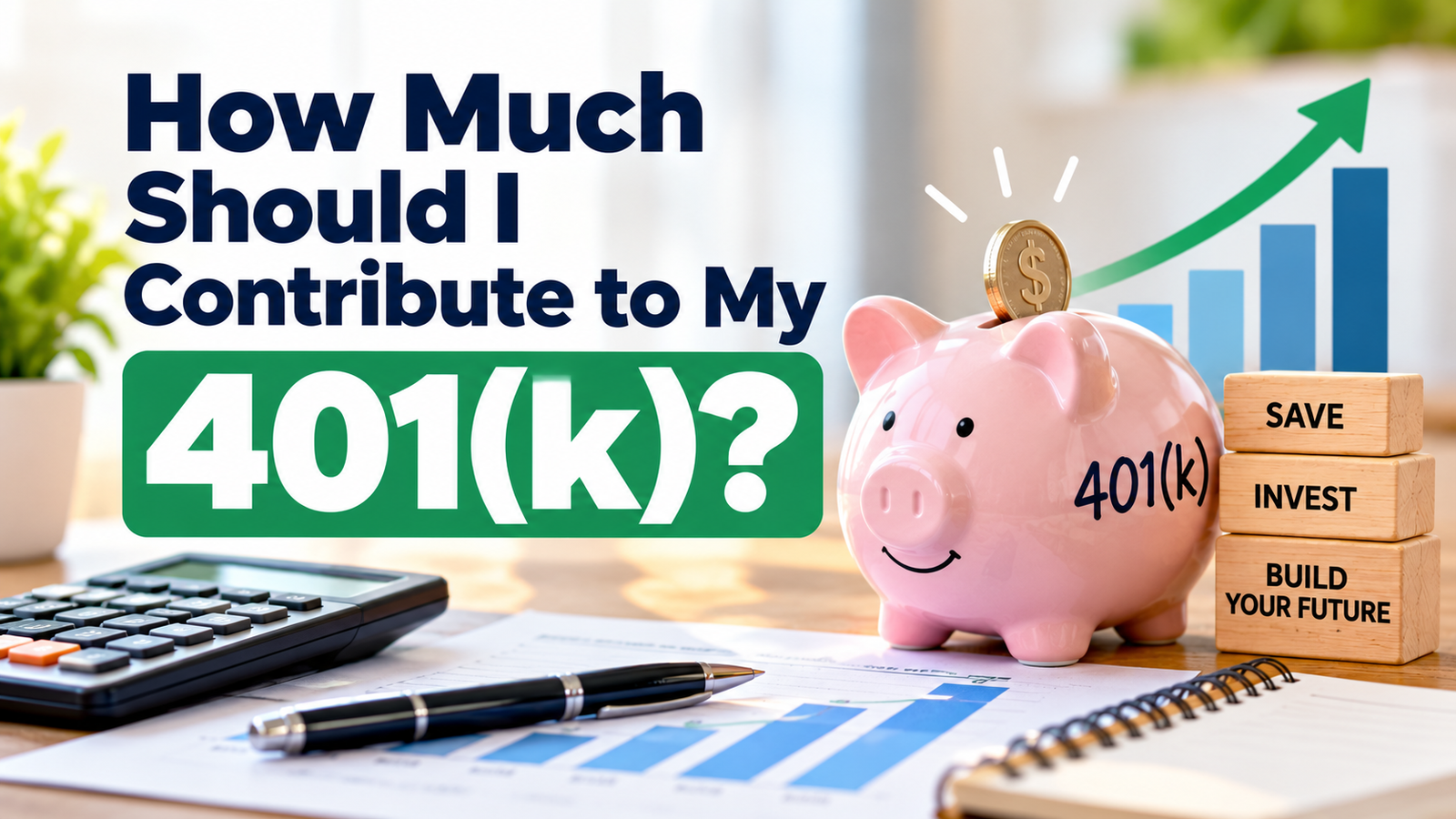
How Much Should I Contribute to My 401(k)?
How Much Should I Contribute to My 401(k)?
If you’re wondering how much you should contribute to your 401(k), a good starting point is to contribute enough to receive your employer’s full matching contribution. From there, aim to save around 12%–15% of your pretax income for retirement, including employer contributions, if your budget allows.
However, the right amount depends on your salary, age, retirement goals, existing savings, debt, and other financial responsibilities. You don’t have to reach your ideal savings rate immediately. Starting with a manageable contribution and increasing it over time can make a meaningful difference.
In this guide, you’ll learn how much to contribute to your 401(k), how to calculate your contribution, how employer matching works, and what to consider when setting your retirement savings target in 2026.
Table of Contents
How Much Should You Contribute to Your 401(k)?
For many workers, these contribution levels provide a useful starting point:
- Minimum starting goal: Contribute enough to qualify for your employer’s full 401(k) match, if available.
- Building savings: Consider contributing 5%–10% of your pretax salary while working toward a higher rate.
- Long-term target: Aim for a total retirement savings rate of approximately 12%–15%, including employer contributions.
- Accelerated savings: Consider contributing more than 15% if you started saving late, want to retire early, or need to catch up.
These are guidelines, not universal rules. Someone who started investing in their 20s and has substantial savings may need a different contribution rate from someone beginning in their 40s.
Fidelity and Vanguard offer retirement savings guidance that supports using a consistent savings target and gradually increasing contributions as your income grows.
How to Calculate Your 401(k) Contribution
Calculating your 401(k) contribution is straightforward. You need your annual salary and the percentage of your salary you want to save.
Use this formula:
Annual 401(k) contribution = Annual salary × Contribution percentage
For example, suppose you earn $60,000 annually and contribute 10% of your salary.
- Annual salary: $60,000
- Contribution rate: 10%
- Annual employee contribution: $6,000
- Monthly equivalent: $500
Your actual paycheck deduction depends on your pay frequency and payroll setup. If you receive 26 paychecks per year, a $6,000 annual contribution would average approximately $230.77 per paycheck.
This calculation excludes any employer matching contribution.
How much should you contribute from each paycheck?
The following table shows how different contribution rates translate into annual savings.
| Annual salary | 5% contribution | 10% contribution | 15% contribution |
|---|---|---|---|
| $40,000 | $2,000 | $4,000 | $6,000 |
| $60,000 | $3,000 | $6,000 | $9,000 |
| $80,000 | $4,000 | $8,000 | $12,000 |
| $100,000 | $5,000 | $10,000 | $15,000 |
| $120,000 | $6,000 | $12,000 | $18,000 |
These figures represent your contributions before employer matching and assume the percentage applies to your full salary. They are illustrative amounts, not investment return projections.
Remember that your take-home pay generally falls by less than your traditional 401(k) contribution because eligible pretax contributions reduce the income subject to current federal income tax. Roth 401(k) contributions are made after tax, so the immediate paycheck effect differs.
How Much Should You Contribute to Your 401(k) to Get the Full Employer Match?
If your employer offers a 401(k) match, understanding the matching formula should be one of your first priorities.
An employer match is money your employer contributes to your retirement account based on your own contributions, subject to the plan’s rules. It can increase your retirement savings without requiring an equivalent increase in your personal contribution.
Example: A 50% employer match on the first 6%
Suppose you earn $60,000 per year, and your employer matches 50% of your contributions on the first 6% of your salary.
If you contribute 6%:
- Your annual contribution: $3,600
- Employer match: $1,800
- Total annual retirement savings: $5,400
If you contribute only 3%, your employer would contribute $900 under this example’s matching formula. You would miss out on the remaining match available when you contribute 6%.
The actual amount depends on your employer’s plan. Some employers match dollar for dollar up to a certain percentage, while others use different formulas.
Important: Check your plan documents for the matching formula, eligibility requirements, vesting schedule, and any rules about when matching contributions are deposited. Some plans also have a year-end matching adjustment known as a true-up.
How Much Should You Contribute to Your 401(k) by Age?
Your age can help you assess whether your current contribution rate is appropriate, but age alone doesn’t determine how much you need to save. Your existing retirement balance, desired retirement age, expected spending, and other retirement income all matter.
In your 20s: Start with what you can afford
If you’re in your 20s, starting early gives your investments more time to potentially grow through compounding.
Try to contribute enough to receive your full employer match, then increase your rate as your salary grows. Even a modest contribution can establish a valuable habit.
In your 30s: Build toward a consistent savings rate
Your 30s can be a good time to increase contributions as your earnings improve.
If you can afford it, work toward saving 12%–15% of pretax income for retirement, including employer contributions. If childcare, housing, or other expenses make that difficult, increase your contribution gradually rather than abandoning the goal.
In your 40s: Review your retirement progress
By your 40s, your ideal contribution rate depends heavily on how much you’ve already saved.
If your retirement balance is below your target, consider increasing your contribution, reducing unnecessary expenses, or reviewing your expected retirement age. You may need to save more than someone who began contributing earlier.
In your 50s and early 60s: Consider catch-up contributions
Workers who qualify can make additional catch-up contributions beyond the standard employee limit.
These contributions can help people who are approaching retirement strengthen their savings. However, whether you need them depends on your existing assets, retirement timeline, and financial circumstances.
What Is the Maximum 401(k) Contribution for 2026?
For 2026, the IRS employee contribution limit for most 401(k) plans is $24,500. Eligible participants age 50 or older can generally contribute an additional $8,000 in catch-up contributions. Eligible participants ages 60–63 may qualify for a higher catch-up limit of $11,250 instead of the standard catch-up amount. Specific eligibility and plan rules apply.
Check the IRS’s official 401(k) contribution limit guidance for the applicable rules.
Your personal maximum may be lower if you earn less than the amount you want to contribute or your plan imposes additional restrictions.
Also, don’t confuse your employee contribution limit with the separate overall limit that can apply to combined employee and employer contributions. Employer matching contributions generally do not count toward your personal elective deferral limit, although they can count toward the plan’s overall annual additions limit.
You do not need to max out your 401(k) to make progress. A consistent contribution that fits your budget is a reasonable starting point.
Should You Max Out Your 401(k)?
Maxing out your 401(k) means contributing the full amount you’re permitted to defer under the applicable rules.
It may make sense if you have a strong income, adequate emergency savings, manageable debt, and a goal of accumulating more retirement assets.
Potential benefits include:
- Saving more for retirement.
- Potentially reducing current federal taxable income through eligible traditional 401(k) contributions.
- Taking advantage of tax-advantaged investment growth.
- Making use of the plan’s available contribution limits.
However, maxing out isn’t necessarily the best immediate choice for everyone. If doing so leaves you unable to cover essential expenses, handle unexpected bills, or pay down expensive debt, a lower contribution may be more sustainable.
First capture the full employer match if possible, then consider increasing your contribution as your financial position improves.
Should You Contribute to Your 401(k) If You Have Debt?
You can save for retirement while paying off debt, but the right balance depends on the type of debt and your overall financial stability.
If you have high-interest credit card debt
Credit card interest can be expensive. Contributing enough to receive an employer match while directing additional money toward high-interest debt may be a reasonable approach.
Compare the guaranteed cost of the debt with the uncertain returns of investing. Investment returns are not guaranteed, so don’t assume your 401(k) will necessarily outperform your interest rate.
If you have no emergency savings
Consider building an emergency fund alongside retirement savings. Without cash reserves, an unexpected expense could force you to borrow money or withdraw retirement funds.
You don’t necessarily need to postpone every retirement contribution until your emergency fund is complete. Focus on balancing immediate financial security with long-term goals.
If you have student loans or a mortgage
Lower-interest debt may allow more flexibility. Continue meeting your required payments, evaluate your interest rates, and consider your employer match, savings needs, and household budget before choosing a contribution rate.
There is no single percentage that works for every person.
Traditional vs. Roth 401(k): Does Your Choice Affect How Much You Should Contribute?
Your 401(k) contribution strategy also depends on whether you choose a traditional 401(k), a Roth 401(k), or a combination of both, if your employer offers the options.
Traditional 401(k): Eligible contributions generally reduce your current federal taxable income, while withdrawals are generally taxable in retirement.
Roth 401(k): Contributions are made with after-tax money. Qualified withdrawals can be tax-free if the applicable requirements are met.
A traditional contribution may be attractive if you want the current tax deduction. A Roth contribution may appeal if you prefer paying taxes now in anticipation of potentially tax-free qualified withdrawals later.
Your current tax bracket, expected retirement tax situation, and cash flow can help guide the decision. The employee contribution limit generally applies across traditional and Roth 401(k) elective deferrals combined, rather than providing a separate full limit for each.
How to Increase Your 401(k) Contribution Without Straining Your Budget
If you can’t currently contribute 12%–15% of your income, you can work toward that goal in manageable steps.
1. Start with a realistic percentage. Choose an amount you can maintain after accounting for essential expenses and debt payments.
2. Increase your rate by 1% at a time. A small change may be easier to manage than a large immediate increase.
3. Increase contributions after a raise. When your salary increases, direct part of the additional income toward retirement savings before your spending rises.
4. Automate contribution increases. If your plan supports automatic escalation, consider scheduling gradual increases.
5. Review your contribution annually. Reassess your rate when your income, household expenses, or retirement goals change.
6. Check your progress against your goal. Include your employer match when measuring your overall retirement savings rate, but remember to distinguish it from your personal contribution.
Small, consistent increases can help you build a sustainable retirement savings habit.
Frequently Asked Questions
Is 10% enough to contribute to a 401(k)?
A 10% employee contribution can be a strong starting point, especially if your employer also contributes. Whether it’s enough depends on your age, current savings, expected retirement spending, and other retirement income. Consider working toward a total retirement savings rate of approximately 12%–15%, including employer contributions, if appropriate for your situation.
Is contributing 15% to a 401(k) enough?
Saving 15% of your pretax income for retirement, including employer contributions, is a common guideline. It may be sufficient for some people, but others may need more or less depending on their goals and financial circumstances.
Should I contribute more than my employer matches?
Often, yes, if your budget allows. After receiving the full available match, consider increasing your contribution toward your retirement savings target. You can also compare other options, such as an IRA, depending on eligibility, fees, investment choices, and your overall financial plan.
What percentage of my paycheck should go into my 401(k)?
Start with the percentage required to receive your full employer match. Then work toward a sustainable long-term savings rate. Your payroll deduction will depend on your salary, contribution percentage, pay frequency, and whether you choose traditional or Roth contributions.
Does my employer match count toward my 401(k) contribution limit?
Employer matching contributions generally don’t count toward your personal employee elective deferral limit. However, they generally count toward the separate overall annual additions limit, subject to applicable rules.
Should I max out my 401(k) before investing in an IRA?
Not necessarily. Consider your employer match, emergency savings, debt, plan fees, available investments, IRA eligibility, and tax situation. Capturing the full employer match is often a sensible first step, after which you can compare additional 401(k) contributions with IRA contributions.
Final Thoughts: Choose a 401(k) Contribution You Can Maintain
For many workers, a sensible approach is to start by contributing enough to receive the full employer match, then work toward saving around 12%–15% of pretax income for retirement, including employer contributions.
If that target feels out of reach, begin with an affordable amount and increase it over time. Review your contribution rate whenever your income or financial situation changes.
The best 401(k) contribution rate isn’t necessarily the highest possible percentage. It’s a sustainable amount that helps you prepare for retirement while allowing you to manage today’s financial responsibilities.
Related Post :

You may also like
Roth IRA vs. 401(k): Differences, Limits & Which Is Better?
What Is a 401(k)? How It Works and Benefits