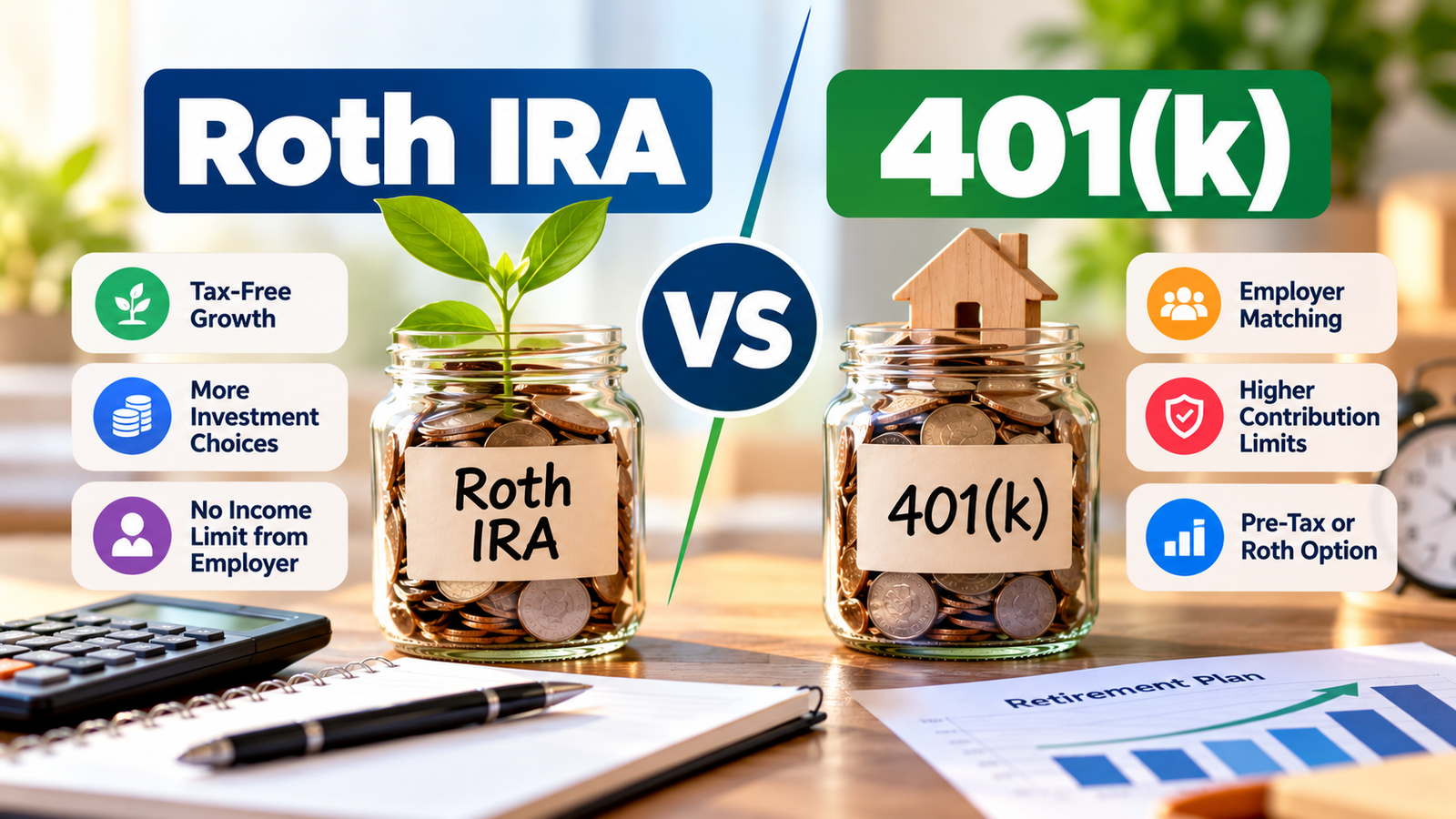
Roth IRA vs. 401(k): Differences, Limits & Which Is Better?
Roth IRA vs. 401(k): Which Is Better for Retirement?
Choosing between a Roth IRA and a 401(k) can feel confusing, especially when both accounts offer tax advantages for retirement investing. The good news is that you usually don’t have to choose just one. If you’re eligible, you can contribute to both in the same year.
For many workers, a sensible strategy is to contribute enough to a workplace 401(k) to receive the full employer match, then consider funding a Roth IRA before increasing 401(k) contributions further. However, the right approach depends on your employer’s plan, tax situation, income, investment options, and financial goals.
In this guide, we’ll compare Roth IRA vs. 401(k), explain the 2026 contribution limits, and help you decide which account to prioritize.
Table of Contents
What Is a Roth IRA?
A Roth IRA is an individual retirement account you open through a brokerage or other eligible financial institution. You contribute money that has already been taxed, choose your investments, and may withdraw your money tax-free in retirement if you meet the requirements for qualified distributions.
Key benefits of a Roth IRA
- Potentially tax-free retirement withdrawals: Qualified distributions of contributions and investment earnings are tax-free.
- Investment flexibility: You generally choose from the investments available through your IRA provider.
- No lifetime required minimum distributions: Original Roth IRA owners aren’t required to take minimum distributions during their lifetimes.
- Flexible access to contributions: Regular Roth IRA contributions can generally be withdrawn without tax or penalty, although special rules apply to conversions and earnings.
Roth IRA eligibility
You generally need taxable compensation to contribute, and direct Roth IRA contributions are subject to income limits. If your income is too high, you may be able to use a backdoor Roth IRA strategy, but it can create tax consequences depending on your existing pretax IRA balances.
A Roth IRA doesn’t provide an immediate federal income tax deduction for contributions. Its primary tax advantage is the possibility of tax-free qualified withdrawals later.
What Is a 401(k)?
A 401(k) is a workplace retirement plan offered by an employer. Employees typically contribute through payroll deductions, and some employers add matching contributions.
Most plans offer a selection of investment options, such as mutual funds and target-date funds. Your available investments and fees depend on your employer’s plan.
There are two main tax options to understand.
Traditional 401(k): Eligible contributions are generally made before federal income tax, reducing current taxable income. Withdrawals are generally taxable in retirement.
Roth 401(k): Contributions are made with after-tax money. Qualified withdrawals, including earnings, can be tax-free when the applicable requirements are met.
A Roth 401(k) is not the same as a Roth IRA. Both use Roth tax treatment, but they have different contribution limits, eligibility rules, and account features.
Why an employer match matters
Suppose your employer matches 50% of your contributions on the first 6% of your salary. If you earn $60,000 and contribute 6%, you put in $3,600 annually, and your employer adds $1,800 under that matching formula.
That additional contribution can make a 401(k) particularly valuable. Check your plan’s matching formula and vesting rules to understand how much you can receive and when employer contributions become yours.
Roth IRA vs. 401(k): Key Differences
| Feature | Roth IRA | Traditional 401(k) |
|---|---|---|
| Where you open it | Brokerage or eligible financial institution | Through your employer |
| Tax treatment of contributions | After-tax | Generally pretax |
| Retirement withdrawals | Qualified withdrawals can be tax-free | Generally taxable |
| Employer matching | No employer match | May be available |
| 2026 standard contribution limit | $7,500 | $24,500 |
| Income restrictions | Direct Roth contributions have income limits | No general income limit for employee deferrals |
| Investment choices | Depends on the provider; often broad | Limited to the plan’s investment menu |
| Access before retirement | Regular contributions generally have flexible withdrawal rules | Withdrawals are subject to plan and tax rules |
| Lifetime RMDs for the original owner | None | Generally required for traditional accounts under applicable rules |
The Roth IRA’s $7,500 limit is shared across your traditional and Roth IRA contributions. The 401(k) employee limit applies across traditional and Roth employee deferrals to applicable workplace plans. Employer matching contributions are treated separately under the relevant plan limits. IRS IRA contribution limits and 401(k) contribution limits provide the official rules.
Roth IRA vs. 401(k): Contribution Limits for 2026
Contribution limits affect how much you can save in each account.
For 2026:
- Roth IRA: Up to $7,500 if you’re under age 50, or $8,600 if you’re age 50 or older, subject to compensation and eligibility rules.
- 401(k): Up to $24,500 in employee contributions for most plans.
- 401(k) catch-up contributions: Eligible participants age 50 and older can generally contribute an additional $8,000. Those ages 60–63 may qualify for a higher $11,250 catch-up limit, subject to plan rules.
The IRA limit applies to your combined traditional and Roth IRA contributions, not $7,500 for each account. Likewise, the standard 401(k) limit is shared across your traditional and Roth employee contributions.
For direct Roth IRA contributions in 2026, the income phase-out range is generally:
- Single filers and heads of household: Modified adjusted gross income of $153,000–$168,000.
- Married couples filing jointly: Modified adjusted gross income of $242,000–$252,000.
Your eligibility depends on your filing status, modified adjusted gross income, and taxable compensation. Consult the IRS’s official IRA rules and current tax guidance before contributing.
Should You Invest in a Roth IRA or 401(k) First?
For many people, the following order is a useful starting point.
Step 1: Contribute enough to get the full 401(k) match
If your employer offers matching contributions, consider contributing enough to receive the full available match. Otherwise, you may miss out on part of your workplace retirement benefit.
However, compare your plan’s fees and conditions, and make sure the contribution fits your budget.
Step 2: Consider funding a Roth IRA
Once you’ve captured the full employer match, a Roth IRA may be attractive if you’re eligible. You can choose your provider, select investments from its available range, and potentially build a source of tax-free qualified retirement income.
This step is particularly appealing if your workplace plan has limited investment options or relatively high fees.
Step 3: Increase your 401(k) contributions
After funding your Roth IRA to your desired level, consider increasing your 401(k) contribution. The higher workplace-plan limit can help you save substantially more for retirement.
If your employer’s plan offers low-cost, diversified investments, continuing to contribute to it may be a strong choice.
Step 4: Adjust the order to fit your situation
This sequence is a guideline, not a strict rule. If your 401(k) has excellent low-cost investment options, you need a larger current-year tax deduction, or you can’t contribute directly to a Roth IRA because of income limits, your preferred strategy may differ.
If you have high-interest debt or no emergency savings, you may also need to balance retirement contributions with near-term financial stability.
Roth IRA vs. Traditional 401(k): Which Is Better for Taxes?
The biggest tax difference is when you pay tax on your retirement savings.
When a traditional 401(k) may be better
A traditional 401(k) may be attractive if you want to reduce your current federal taxable income and expect your tax rate to be lower in retirement. Eligible pretax contributions can reduce your current income subject to federal income tax, although other payroll taxes generally still apply.
For example, if you contribute $5,000 to a traditional 401(k), that amount generally reduces your current federal taxable income by $5,000. Your actual tax savings depend on your tax circumstances, and your take-home pay usually falls by less than the full contribution.
When a Roth IRA may be better
A Roth IRA may be appealing if you prefer paying taxes now in exchange for the possibility of tax-free qualified withdrawals later. It can also offer more control over your investment provider and greater flexibility around withdrawing regular contributions.
This may be useful if you expect your retirement tax rate to be similar to or higher than your current rate, but future tax rates and personal circumstances are uncertain.
Can you split contributions between Roth and traditional accounts?
Yes. If your workplace plan offers both traditional and Roth 401(k) options, you may be able to split your employee contributions between them. You can also contribute to a Roth IRA if eligible.
Using both tax treatments can provide flexibility when managing taxable income in retirement. Remember that the combined employee contribution limits still apply.
Which Account Offers Better Investment Options?
A Roth IRA often gives you more control because you choose the financial institution and investments available through that provider. Depending on the account, choices may include individual stocks, exchange-traded funds, mutual funds, and bonds.
A 401(k), by contrast, usually restricts you to investments selected for the workplace plan. Some plans offer excellent, low-cost index funds and target-date funds; others may have fewer choices or higher fees.
Don’t assume a Roth IRA automatically produces better returns. The results depend on the investments you choose, diversification, fees, market performance, and your behavior as an investor.
Before deciding, compare your 401(k)’s expense ratios, administrative fees, investment selection, and any available target-date funds with the options available in an IRA.
Can You Have Both a Roth IRA and a 401(k)?
Yes. You can contribute to both in the same year if you meet the applicable requirements.
For example, an eligible worker under age 50 could contribute up to $7,500 to a Roth IRA and $24,500 to a 401(k) in 2026, for a total of $32,000 in personal contributions, assuming sufficient eligible compensation and no plan-specific restrictions.
The two accounts have separate contribution limits. Employer matching contributions are additional under the relevant plan rules and do not generally use up your personal 401(k) employee deferral limit.
If you earn too much to contribute directly to a Roth IRA, you might investigate a backdoor Roth IRA. This typically involves making a nondeductible traditional IRA contribution and converting it to a Roth IRA. Existing pretax balances in traditional, SEP, or SIMPLE IRAs can affect the tax result under the pro-rata rule, so get appropriate tax guidance before proceeding.
Which Account Is Better for Different Investors?
A young worker with an employer match: Contribute enough to the 401(k) to receive the full match. Then consider a Roth IRA if eligible, especially if you value investment flexibility and potential tax-free qualified withdrawals.
A worker with no employer match: Compare the 401(k)’s investment options and fees with a Roth IRA. If the plan is expensive or restrictive, an IRA may be an appealing next step. If you want a current-year tax deduction, a traditional 401(k) may still be valuable.
A high-income earner: You may not qualify to contribute directly to a Roth IRA, but you can generally contribute to a workplace 401(k) if eligible. A Roth 401(k) option may be available regardless of income, and a backdoor Roth IRA may be worth exploring with tax guidance.
Someone approaching retirement: Review your expected retirement income, current savings, tax situation, and investment risk. The best account depends on your overall plan, not age alone.
A saver who wants tax flexibility: Using a traditional 401(k) alongside a Roth IRA may provide both tax-deferred savings and a source of potentially tax-free qualified withdrawals in retirement.
Frequently Asked Questions
Is a Roth IRA better than a 401(k)?
Neither account is always better. A 401(k) may be especially valuable when an employer match is available or you want to contribute more than the IRA limit. A Roth IRA may offer more investment control and flexible access to regular contributions. Many investors benefit from using both.
Should I max out my Roth IRA or 401(k) first?
If your employer offers a match, consider contributing enough to receive the full match first. Then compare your Roth IRA eligibility, workplace-plan fees, investment choices, tax goals, and budget before deciding where additional contributions should go.
Can I contribute to both accounts at the same time?
Yes. If you meet the eligibility requirements, you can contribute to a Roth IRA and a 401(k) in the same tax year. Each account has its own annual contribution rules.
Does a Roth IRA have an employer match?
No, a Roth IRA does not have an employer match in the way a workplace 401(k) may. Some financial institutions may offer account incentives, but those are different from an employer retirement-plan match.
Can I withdraw Roth IRA money before retirement?
Regular Roth IRA contributions can generally be withdrawn at any time without income tax or penalty. Earnings and converted amounts have separate rules, and early withdrawals may result in taxes or penalties if the requirements for an exception or qualified distribution aren’t met. It’s usually better to preserve retirement savings when possible.
Is a Roth 401(k) the same as a Roth IRA?
No. Both use after-tax contributions and can offer tax-free qualified withdrawals, but a Roth 401(k) is part of an employer-sponsored plan. A Roth IRA is an individual account with different contribution limits, income eligibility rules, investment options, and withdrawal provisions.
Final Verdict: Roth IRA vs. 401(k)
For many workers, a practical approach is to get the full employer match in a 401(k), consider funding a Roth IRA if eligible, and then increase workplace retirement contributions as the budget allows.
A Roth IRA may offer more investment flexibility and potential tax-free qualified withdrawals. A traditional 401(k) may provide a current tax deduction, higher contribution limits, and employer matching. A Roth 401(k), if available, combines workplace-plan access with Roth tax treatment.
The right decision depends on your income, tax situation, employer benefits, plan fees, and retirement goals. Compare those factors, use the official IRS rules for current contribution limits, and choose a savings strategy you can maintain consistently.
This article is for educational purposes only and is not individualized tax, legal, or investment advice. Consider consulting a qualified tax professional or financial adviser for guidance specific to your circumstances.
Related Post :

You may also like

How Much Should I Contribute to My 401(k)?

What Is a 401(k)? How It Works and Benefits