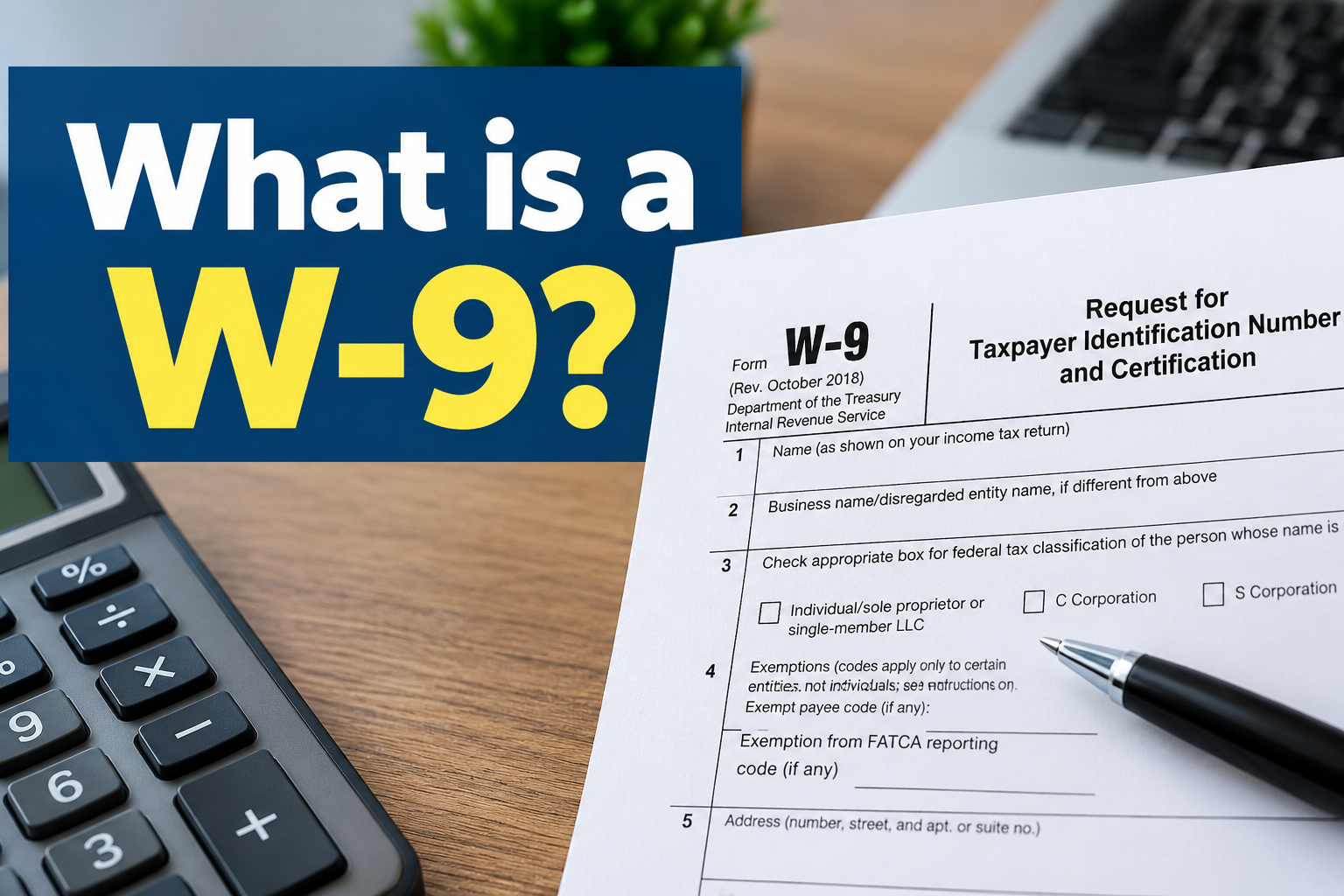
What Is a W-9? Who Needs It and How to Fill It Out
What Is a W-9? Who Needs It and How to Fill It Out
If you’re starting a freelance job, working as an independent contractor, or receiving certain payments in the United States, a client or financial institution may ask you to complete a Form W-9. If you’ve never filled one out before, you might wonder what it is, why someone needs your personal information, and whether completing it means you’ll owe taxes.
Form W-9 is an IRS document used to provide your correct taxpayer identification number and other tax information to a person or business that may need to report payments to the IRS. It is commonly requested from freelancers, contractors, vendors, and certain other payees.
In this guide, you’ll learn what a W-9 is used for, who needs to complete one, how to fill it out correctly, and how it differs from a W-4 and a 1099 form.
Table of Contents
What Is a W-9 Form?
Form W-9 is officially called the Request for Taxpayer Identification Number and Certification. The Internal Revenue Service (IRS) provides it so a business or other requester can collect the correct taxpayer identification number (TIN) and related certifications from a U.S. person.
A TIN may be a Social Security number (SSN), Employer Identification Number (EIN), or Individual Taxpayer Identification Number (ITIN), depending on the taxpayer and circumstances.
For example, imagine a small business hires a freelance graphic designer. The business may ask the designer to complete a W-9 so it has the information needed to prepare an applicable tax information return.
A W-9 is generally given to the requester, not mailed directly to the IRS by the person completing it. The requester uses the information for relevant reporting and recordkeeping. The IRS explains the form’s purpose here.
What Is a W-9 Used For?
Businesses and financial institutions may request a W-9 in several situations.
1. Paying freelancers and independent contractors
A company may request a W-9 before paying a freelance writer, consultant, designer, photographer, or other independent contractor.
The information can help the business determine how to report qualifying payments, including on Form 1099-NEC when required.
2. Reporting interest and dividends
Certain banks, brokers, and other financial institutions may need a taxpayer identification number to report interest, dividends, or other reportable financial activity.
3. Real estate and other financial transactions
A W-9 may also be requested in connection with certain real estate transactions, mortgage interest reporting, cancellation of debt, and other reportable events.
Important: Not every payment or business relationship automatically requires a W-9. The requirement depends on the transaction, the reporting rules, and the circumstances. See the IRS overview of Form W-9.
Who Needs to Fill Out a W-9?
A W-9 is generally completed by a U.S. person when a requester needs their taxpayer identification information for a relevant tax-reporting purpose.
Common examples include:
- Freelancers and independent contractors.
- Self-employed professionals and consultants.
- Vendors and service providers.
- Certain business owners and entities receiving reportable payments.
- U.S. citizens and resident aliens in applicable reporting situations.
- Certain trusts, partnerships, corporations, and other eligible entities.
For example, a marketing consultant working for a U.S. company may be asked to submit a W-9 before receiving payment. The consultant provides the appropriate name, tax classification, address, and taxpayer identification number.
Being asked to complete a W-9 does not automatically determine whether you are an employee or an independent contractor. Worker classification depends on the facts and applicable legal rules, not merely on which form a company requests. The IRS provides guidance on independent contractors and employee classification.
How to Fill Out a W-9 Form Step by Step
You can obtain the form directly from the IRS: Download the official Form W-9 (PDF).
Use the latest official version available on the IRS website. Read the instructions before completing fields that involve business classifications or exemptions.
Line 1: Enter your name
Enter the name associated with the taxpayer identification number you provide. For an individual, this is generally the name shown on the relevant tax records.
Make sure the name and TIN combination is accurate. A mismatch can create reporting problems.
Line 2: Enter your business name, if applicable
If you operate under a business name, trade name, or disregarded-entity name that differs from the name on Line 1, enter the applicable name here.
If you do not have a separate business name, you may leave this line blank.
Line 3a: Select your federal tax classification
Choose the classification that applies to the person or entity identified on Line 1.
Options include:
- Individual or sole proprietor.
- C corporation.
- S corporation.
- Partnership.
- Trust or estate.
- Limited liability company (LLC).
- Other classifications specified on the form.
An LLC’s selection depends on how it is classified for federal tax purposes. An LLC may be taxed as a disregarded entity, partnership, or corporation, depending on its ownership and elections.
Do not select a classification simply because it sounds familiar. If you’re unsure, consult the IRS instructions for Form W-9 or a qualified tax professional.
Line 3b: Certain entities with foreign partners or owners
This field applies to certain flow-through entities that have direct or indirect foreign partners, owners, or beneficiaries, when the form’s conditions are met.
It does not apply to every individual or business. Review the official instructions if you are completing a W-9 for an entity.
Line 4: Enter applicable exemption codes
Certain payees may qualify for an exemption from backup withholding or particular reporting requirements. The form provides spaces for applicable exemption codes.
Many individuals and sole proprietors do not qualify for an exemption. Do not enter a code unless you have established that it applies to your situation.
Lines 5 and 6: Enter your address
Provide the address requested on the form, including your street address and city, state, and ZIP code.
Use accurate information so the requester can maintain reliable tax records and contact you if necessary.
Line 7: Account numbers
This field is optional and may be used if the requester needs to associate the form with a particular account or reference number.
Part I: Enter your taxpayer identification number
Provide the appropriate TIN for the taxpayer identified on the form.
Common types include:
- SSN: Social Security number, commonly used by individuals.
- EIN: Employer Identification Number, often used by businesses and certain other entities.
- ITIN: Individual Taxpayer Identification Number, used by eligible individuals who need a U.S. taxpayer identification number but are not eligible for an SSN.
The correct number depends on the taxpayer and the entity’s federal tax treatment. For a single-member LLC treated as a disregarded entity, for example, the owner’s information may be required rather than the LLC’s EIN. Follow the IRS instructions for your circumstances.
Part II: Sign and certify the form
Read the certification before signing and dating the form.
By signing, you certify certain statements, including that the TIN is correct and that you meet the applicable U.S.-person and withholding certifications, subject to the form’s instructions and any relevant exceptions.
Do not sign a certification you know to be inaccurate. If you have received an IRS notice concerning backup withholding, follow the specific instructions that apply to your situation.
What Is the Difference Between a W-9, W-4, and 1099?
These forms are related to U.S. tax reporting, but each serves a different purpose.
| Form | Main purpose | Who generally uses it? |
|---|---|---|
| W-9 | Provides taxpayer information to a requester | U.S. persons and eligible entities |
| W-4 | Helps determine federal income tax withholding from wages | Employees and their employers |
| 1099-NEC | Reports qualifying nonemployee compensation | Businesses reporting contractor payments |
| W-2 | Reports employee wages and withholding | Employers and employees |
W-9 vs. W-4
A W-9 is generally used to collect taxpayer information from a payee. A W-4 is completed by an employee to help their employer determine how much federal income tax to withhold from wages.
W-9 vs. 1099
A W-9 supplies information to the requester. A 1099 is an information return that may be issued later to report certain payments or transactions.
For example, a freelancer may complete a W-9 when beginning work for a business. If the payments meet the applicable reporting rules, the business may later issue a Form 1099-NEC.
The applicable reporting threshold depends on the tax year and type of payment. Check the IRS guidance on independent contractor payments for the current rules.
Is a W-9 the Same as a Tax Return?
No. A W-9 is not a tax return.
It gives the requester information needed for tax reporting. Completing one does not mean you’ve filed an income tax return, paid your taxes, or automatically created a new tax liability.
However, payments reported using the information on a W-9 may be taxable, depending on the type of income and your circumstances. Independent contractors are generally responsible for understanding their own income tax and self-employment tax obligations.
Keep records of the income you receive and consult IRS guidance when preparing your return.
What Happens If You Don’t Submit a W-9?
If a requester legitimately needs your taxpayer identification number and you do not provide it, several things may happen:
- The requester may be unable to complete required tax reporting.
- Payments may be delayed or the business relationship may be affected.
- Backup withholding may apply to certain reportable payments.
Under current IRS rules, the backup withholding rate is generally 24% when applicable. It can apply in situations such as failure to provide a TIN in the required manner or failure to resolve certain IRS notices about an incorrect TIN.
This does not mean every person who delays returning a W-9 automatically loses 24% of every payment. The rules depend on the payment and the circumstances. The requester may need to withhold from affected payments until the issue is resolved.
See the IRS instructions for Form W-9 for details.
Is It Safe to Give Someone a W-9?
A W-9 can contain sensitive information, especially if it includes your Social Security number. Take reasonable steps to verify the requester and protect the completed form.
Follow these precautions:
- Verify the requester. Confirm that the person or business has a legitimate reason to request the form.
- Use a secure delivery method. If a company offers a secure portal, consider using it instead of sending sensitive information through ordinary email.
- Avoid suspicious links. Do not submit personal information through a website you cannot verify.
- Check the form before sending it. Make sure you have entered only the information required.
- Keep your own records secure. Store copies where unauthorized people cannot access them.
A legitimate business may need your TIN for tax reporting, but that does not mean every request should be trusted automatically.
Can Non-U.S. Individuals Fill Out a W-9?
Form W-9 is generally intended for U.S. persons for federal tax purposes, including U.S. citizens and resident aliens.
Foreign persons who are not eligible to certify U.S.-person status generally need an appropriate form from the IRS Form W-8 series or another applicable document. The correct form depends on the person’s status, income, and circumstances.
Do not use a W-9 simply because a company asks for one if you cannot truthfully make its certifications. Explain your situation to the requester and review the IRS instructions for Form W-9 or seek qualified tax advice.
Frequently Asked Questions About Form W-9
What is a W-9 in simple terms?
A W-9 is an IRS form that lets a requester collect your taxpayer identification number and other tax information for applicable reporting purposes.
Do I send my W-9 to the IRS?
Generally, no. You give the completed form to the business or other requester that needs the information. Keep your own records and follow the requester’s secure submission instructions.
Does filling out a W-9 mean I owe taxes?
No. Completing a W-9 does not itself create a tax bill. Whether the income or transaction is taxable depends on the circumstances and applicable tax law.
Does a W-9 expire?
A W-9 does not have a universal annual expiration date for every situation. However, you may need to provide an updated form if your information changes or the requester needs current information. Follow the requester’s instructions and the applicable IRS rules.
Can I use an EIN instead of my Social Security number?
Sometimes. The appropriate TIN depends on the taxpayer and federal tax classification. Sole proprietors and certain single-member LLC owners may need to use the owner’s SSN or another appropriate TIN, while eligible businesses may use an EIN. Follow the IRS instructions rather than assuming either number is always acceptable.
Where can I get a W-9 form?
Download it directly from the official IRS Form W-9 page. Using the official source helps you find the current version and instructions.
Final Thoughts
Form W-9 is a routine part of many U.S. business and financial transactions. It allows a requester to collect the correct taxpayer identification number and related certifications for tax reporting.
If a client or financial institution asks you for a W-9, verify the request, complete the form accurately, and submit it securely. Pay particular attention to your name, federal tax classification, taxpayer identification number, and signature.
Remember that a W-9 is not a tax return and does not automatically determine how much tax you owe. If you are unsure which tax classification or identification number applies to you, consult the official IRS instructions or a qualified tax professional.
Disclaimer: This article is for general educational purposes only and is not individualized tax or legal advice. Tax forms and reporting rules can change. Confirm current requirements with the IRS or a qualified tax professional.

You may also like

Where’s My Amended Return? Check IRS Status & Refund
Roth IRA vs. 401(k): Differences, Limits & Which Is Better?