
Investing Basics: A Complete Guide to Getting Started
Investing Basics: A Complete Beginner’s Guide to Getting Started
Investing is one of the most important financial habits you can develop to build long-term wealth. Whether you are a student, salaried employee, business owner, or someone planning for retirement, understanding how investing works can help you make better financial decisions.
However, getting started can feel confusing. Should you invest in stocks, mutual funds, fixed deposits, gold, or government bonds? Do you need a Demat account? How much money should you invest every month? And how can you avoid losing your hard-earned money?
The good news is that you do not need to be a financial expert to understand investing. You can begin with a few basic concepts and gradually develop your knowledge.
Investing means putting your money into financial assets with the expectation of earning returns over time. These assets may include stocks, mutual funds, exchange-traded funds (ETFs), bonds, and other investment products.
Every investment has different risks, potential returns, costs, and time requirements. Some investments focus on preserving capital, while others aim to generate long-term growth.
In this guide, you will learn investing basics, understand different investment options, discover how to start investing step by step, and explore ways to manage investment risks.
Table of Contents
What Is Investing and How Does It Work?
Investing is the process of using your money to purchase assets that may increase in value or generate income over time. For example, suppose you have ₹10,000 that you do not need immediately. Instead of keeping all of it unused, you could invest it in a suitable mutual fund or another financial asset after understanding its risks.
If the underlying investments perform well, your investment value may increase. However, if market conditions become unfavorable, its value may decline.
How do investors make money?
Investors can earn returns in several ways.
1. Capital appreciation
Capital appreciation happens when an investment increases in market value. For example, suppose you purchase 10 shares of a company at ₹200 each. Your total investment is:
10 × ₹200 = ₹2,000
If the share price increases to ₹250, your investment becomes ₹2,500. Your unrealized profit is ₹500, excluding applicable costs and taxes. You generally realize this gain when you sell the shares.
2. Dividends
Some companies distribute a portion of their profits to shareholders. These payments are called dividends. For example, if a company declares a dividend of ₹5 per share and you own 100 eligible shares, you may receive ₹500 before applicable taxes. However, companies are not required to distribute dividends, and dividend payments can change.
3. Interest income
Certain investments generate interest income. Examples include: Fixed deposits, Government securities, Corporate bonds, Certain savings schemes. The interest rate and payment terms depend on the particular investment.
4. Reinvestment and compounding
When you reinvest your investment earnings, those earnings can generate additional returns over time. This is known as compounding.
Why should you start investing?
Investing can help you:
- Build wealth over the long term.
- Work toward financial independence.
- Prepare for retirement.
- Save for major financial goals.
- Potentially grow your money faster than inflation over extended periods.
- Benefit from compounding.
However, investment returns are never guaranteed. Your investment strategy should match your financial situation, goals, and ability to handle risk.
Saving vs. Investing vs. Trading
These three activities are related, but they serve different purposes.
| Feature | Saving | Investing | Trading |
|---|---|---|---|
| Main purpose | Preserve money | Build wealth | Profit from price movements |
| Time horizon | Usually short-term | Usually medium to long term | Usually shorter term |
| Risk | Generally lower | Varies by investment | Can be high |
| Common options | Savings accounts, FDs | Stocks, mutual funds, ETFs | Stocks, futures, options |
| Main focus | Financial security | Long-term financial goals | Market opportunities |
Saving helps you maintain financial stability. Investing helps you pursue long-term financial goals, while trading involves buying and selling financial instruments to benefit from price movements. You do not need to become a trader to build long-term wealth.
Understand the Indian Financial Market
Before investing in stocks, you should understand how the Indian financial market operates. The Indian securities market connects companies that need capital with investors who want to invest their money.
What is the Indian stock market?
The stock market is a marketplace where investors buy and sell shares of publicly listed companies. When you purchase shares of a company, you become a partial owner of that business.
For example, if you purchase shares of a listed Indian company, you participate in its ownership. If the company grows and its financial performance improves, its share price may increase.
However, poor business performance, economic uncertainty, or negative market conditions can cause the share price to decline.
What are NSE and BSE?
India has two major stock exchanges:
National Stock Exchange (NSE): One of India’s leading stock exchanges, known for its electronic trading platform.
Bombay Stock Exchange (BSE): One of the oldest stock exchanges in Asia.
Both exchanges provide platforms for trading listed securities. Companies can be listed on one or both exchanges, subject to applicable requirements.
What are Nifty 50 and Sensex?
You will frequently hear about Nifty 50 and Sensex when following the Indian stock market. Nifty 50 is a benchmark index of the National Stock Exchange that represents 50 selected companies across different sectors.
Sensex is a benchmark index of the Bombay Stock Exchange that tracks 30 selected companies. These indexes help investors understand the performance of a segment of the Indian equity market.
For example, if Nifty 50 rises by 1% during a trading session, it indicates that the index has increased by approximately 1%. It does not mean every stock in the index has increased.
Primary market vs. secondary market
The stock market has two important segments.
Primary market: Companies issue securities to investors to raise capital. An Initial Public Offering (IPO) is a common example.
Secondary market: Investors buy and sell securities that have already been issued and listed on an exchange.
For example, when a company launches an IPO, investors can apply for shares in the primary market. After listing, eligible investors can trade those shares in the secondary market.
Who regulates the Indian stock market?
The Securities and Exchange Board of India (SEBI) is India’s securities market regulator. Its responsibilities include regulating securities markets, protecting investors, and promoting the development of the securities market. You can find educational material and investor information on the official SEBI Investor website.
What Are the Different Types of Investments in India?
India offers several investment options. Each has different characteristics, risks, liquidity requirements, and potential returns. Understanding these options can help you choose investments that match your financial goals.
Stocks or equity shares
Stocks represent ownership in a company. When you purchase shares of a listed company, you become a shareholder. You may earn money through capital appreciation and dividends. Indian stocks are commonly classified by market capitalization.
- Large-cap stocks: Shares of relatively large, established companies.
- Mid-cap stocks: Shares of medium-sized companies.
- Small-cap stocks: Shares of smaller companies.
Small-cap companies may offer growth opportunities, but their shares can also experience significant volatility and liquidity risks. Before purchasing individual stocks, learn about the company’s business model, revenue, profitability, debt, cash flow, management, and valuation.
Mutual funds
A mutual fund collects money from multiple investors and invests it in a portfolio of securities. A professional fund manager generally manages the portfolio according to the fund’s investment objective. Common mutual fund categories include:
Equity mutual funds: Invest primarily in shares of companies. They generally carry market risk and are commonly used for long-term growth objectives.
Debt mutual funds: Invest in fixed-income instruments such as government securities, corporate bonds, and money market instruments. They carry interest-rate and credit risks.
Hybrid mutual funds: Invest in a combination of equity and debt securities.
Mutual funds can make diversification easier, but their performance and risks vary. Before investing, review the scheme’s investment objective, portfolio, expense ratio, riskometer, and other relevant disclosures.
What is SIP investment?
SIP stands for Systematic Investment Plan. It is a method of investing a fixed amount in a mutual fund at regular intervals, often monthly.
For example, suppose you start a monthly SIP of ₹2,000.
Your contributions would be:
| Period | Total contribution |
|---|---|
| 1 year | ₹24,000 |
| 5 years | ₹1,20,000 |
| 10 years | ₹2,40,000 |
| 20 years | ₹4,80,000 |
Your actual investment value will depend on market performance, expenses, and the timing of investments. SIPs can encourage financial discipline and help investors spread their purchases over time. However, they do not guarantee profits or protect investors from market losses.
Calculate Your Investment Returns Using this SIP Calculator
SIP Calculator
Estimate how your monthly investments could grow over time.
Estimated Future Value
Disclaimer: This calculator provides illustrative estimates only. It assumes investments are made at the end of each month and returns compound monthly at a constant rate. Mutual fund returns are market-linked and are not guaranteed. Actual returns may vary. Taxes, fees and inflation are not included.
SIP vs. lump-sum investment
| Feature | SIP | Lump sum |
|---|---|---|
| Investment method | Regular contributions | One-time investment |
| Amount | Usually fixed periodically | Larger amount at once |
| Discipline | Encourages regular investing | Requires planning |
| Market exposure | Spread over time | Begins with the initial investment |
| Suitable for | Regular income earners | Investors with available capital |
Neither method is universally better. The choice depends on your available funds, financial goals, and comfort with market fluctuations.
SIP vs. Lump-Sum Investment: Which Could Build More Wealth?
SIP vs. Lump-Sum Calculator
Compare two investment strategies with your own investment amounts.
Side-by-Side Comparison
Disclaimer: This calculator provides illustrative estimates, not guaranteed returns. It assumes monthly SIP investments are made at the end of each month and the lump sum is invested at the beginning of the period. Both use a constant assumed annual return compounded monthly. Actual market returns fluctuate. Taxes, fees and inflation are excluded. The two investments may involve different total contributions; compare the invested amounts as well as final values.
Exchange-Traded Funds (ETFs)
An ETF is an investment fund that trades on a stock exchange. It may hold stocks, bonds, gold-related assets, or other securities, depending on its investment objective. Common ETF categories in India include: Nifty 50 ETFs, Sensex ETFs, Gold ETFs, Banking ETFs, and other sector-based ETFs.
ETFs can offer convenient market exposure and diversification through a single investment. However, investors should examine the expense ratio, liquidity, tracking error, and underlying holdings before investing.
Fixed Deposits (FDs)
Fixed deposits are offered by banks and certain other financial institutions. You deposit money for a predetermined period and receive interest according to the applicable terms.
For example, if you deposit ₹1,00,000 in an FD offering 7% annual interest for one year, the interest would be approximately ₹7,000 before applicable taxes, assuming simple interest for illustration. Actual maturity amounts depend on the bank's compounding method, tenure, payout option, and terms.
Important considerations include: Interest rate, Deposit tenure, Premature withdrawal rules, Taxation of interest, Deposit insurance eligibility.
Eligible bank deposits are insured by the Deposit Insurance and Credit Guarantee Corporation (DICGC), generally up to ₹5 lakh per depositor per insured bank, including principal and interest, subject to applicable rules.
Public Provident Fund (PPF)
The Public Provident Fund is a government-backed long-term savings scheme. Its key characteristics include: A 15-year maturity period, subject to scheme rules; government-declared interest rates that may change; annual contribution limits; specific withdrawal and loan provisions; and Tax benefits subject to applicable tax rules.
PPF may be useful for people seeking a long-term savings option with government backing. Check the current contribution limit, interest rate, and tax treatment before investing.
Employees' Provident Fund (EPF)

The Employees' Provident Fund is a retirement savings arrangement for eligible employees. Both employees and employers generally contribute according to applicable rules. EPF helps employees accumulate retirement savings through contributions and interest.
Important features include: Employee and employer contributions, Interest credited according to applicable rules, Account transfers when changing eligible employment, Withdrawal provisions, and Tax rules based on applicable conditions. You can learn more through the official EPFO website.
National Pension System (NPS)
The National Pension System is a retirement-focused investment scheme regulated by the Pension Fund Regulatory and Development Authority (PFRDA).
NPS offers investment exposure through different asset categories, including: Equity, Corporate debt, Government securities, Alternative investment funds, subject to applicable options and limits.
NPS has different account structures, including Tier I and Tier II. Tier I is primarily designed for retirement savings and has specific withdrawal and tax rules. Tier II offers more flexible withdrawals, subject to its rules. Understand the charges, asset allocation, withdrawal conditions, and tax treatment before investing.
For more details, read this post: National Pension Pervice (NPS) Explained :Tax Benefits, Returns & Withdrawal Rules
Also use this NPS Calculator to know your pension amount and return of investment: NPS Calculator: Plan Your Retirement
Government bonds and Treasury Bills
The Government of India issues securities to borrow money. These include:
- Treasury Bills.
- Government dated securities.
- State Development Loans.
- Other government savings instruments.
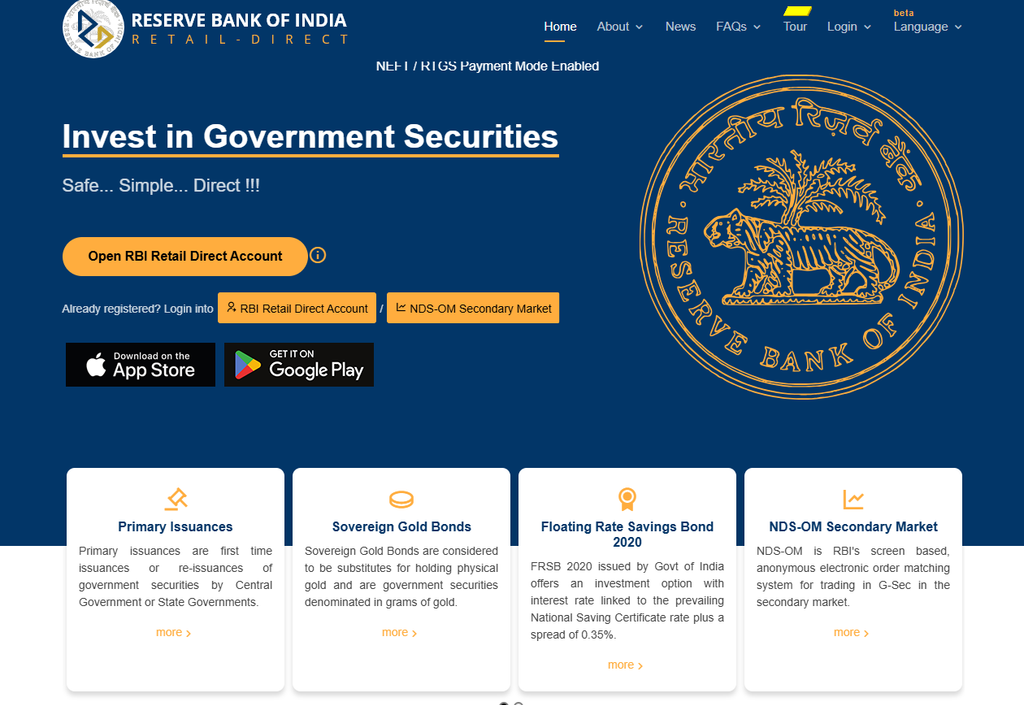
Government securities carry very low domestic sovereign credit risk, but their market prices can fluctuate, particularly when interest rates change. Retail investors can access eligible government securities through the RBI Retail Direct platform. Visit RBI Retail Direct to understand available products and account-opening requirements.
Gold investments
Gold is another investment option available to Indian investors. Common ways to invest in gold include:
Physical gold: Gold jewellery, coins, and bars. Making charges, purity, storage, and resale deductions should be considered.
Gold ETFs: Exchange-traded funds that provide exposure to gold-related assets according to their investment structure.
Gold mutual funds: Mutual fund schemes that generally invest in gold ETFs or related instruments.
Sovereign Gold Bonds (SGBs): Government securities linked to the price of gold, issued under specific terms. New issuance availability should not be assumed; existing bonds may have different maturity, interest, and trading conditions.
Gold prices can fluctuate, and gold does not provide the same income characteristics as interest-bearing investments.
REITs and InvITs
Real Estate Investment Trusts (REITs) and Infrastructure Investment Trusts (InvITs) allow investors to gain exposure to income-generating real estate and infrastructure assets through market-traded units. REITs may hold commercial properties such as offices and shopping centres.
InvITs may hold infrastructure assets such as roads, power transmission networks, and other eligible projects. Their prices and distributions can be affected by interest rates, asset performance, debt, occupancy, and market conditions.
Insurance and investment products
Insurance and investment serve different financial purposes. Term life insurance primarily provides financial protection to beneficiaries if the insured person dies during the policy term, subject to policy conditions.
Investment-linked insurance products, such as Unit Linked Insurance Plans (ULIPs), combine insurance coverage with investment exposure.
Before purchasing an insurance-linked investment product, examine:
- Premiums.
- Insurance coverage.
- Charges.
- Lock-in period.
- Surrender conditions.
- Investment risks.
- Tax treatment.
Do not purchase an insurance product simply because it is presented as an investment.
Understand Risk, Return, and Inflation
Understanding investment risk is essential before putting your money into financial markets. Every investment involves uncertainty. Even products considered relatively conservative may carry inflation, liquidity, interest-rate, or other risks.
What is investment risk?
Investment risk is the possibility that your investment may perform differently from what you expect, including losing money.
Common types include:
- Market risk: The possibility of losses due to market movements.
- Company risk: The possibility that a particular business performs poorly.
- Credit risk: The possibility that a borrower fails to make payments.
- Interest-rate risk: The possibility that changing interest rates affect bond prices.
- Liquidity risk: The possibility that you cannot sell an investment quickly at a reasonable price.
- Inflation risk: The possibility that rising prices reduce your purchasing power.
Risk vs. return
Potential returns and investment risks are generally related. For example, equity investments may offer higher long-term growth potential than traditional savings products, but their market values can fluctuate considerably.
A fixed deposit may offer more predictable interest, but its returns may not always keep pace with inflation. No legitimate investment can guarantee high returns without risk.
What is risk tolerance?
Risk tolerance refers to how much uncertainty and potential loss you can accept when investing. Consider two important factors:
Financial capacity: Can you afford to lose some of your investment without affecting essential expenses or financial responsibilities?
Emotional comfort: Can you remain calm if your investment portfolio declines during a market downturn?
Your financial situation and emotional response both matter when choosing investments.
What is an investment time horizon?
Your investment time horizon is the period for which you expect to keep your money invested.
- Short-term goals: Money needed relatively soon.
- Medium-term goals: Money needed after several years.
- Long-term goals: Retirement and other distant financial objectives.
Money needed soon generally should not be exposed to unnecessary market volatility.
How inflation affects your investments
Inflation reduces the purchasing power of money over time. Suppose an item costs ₹100 today. If inflation averages 6% annually, its approximate price after 10 years would be ₹179.
This means your money needs to grow to maintain its purchasing power. Investors should therefore consider inflation-adjusted returns, not just the nominal percentage increase in their investment.
Understand the Power of Compounding
Compounding is one of the most important concepts in long-term investing. It occurs when your investment earns returns and those earnings remain invested, allowing future returns to build on both the original investment and accumulated gains.
Simple example of compounding
Suppose you invest ₹10,000 and earn a hypothetical 10% annual return. After the first year, your investment becomes ₹11,000. If you earn another 10% during the second year, your balance becomes ₹12,100.
The second year's return is calculated on ₹11,000 rather than the original ₹10,000. This is the basic principle of compounding.
Example: Investing ₹1,000 per month
Suppose you invest ₹1,000 at the end of every month and earn a hypothetical 10% annualized return, compounded monthly.
| Investment period | Total contribution | Approximate investment value |
|---|---|---|
| 10 years | ₹1,20,000 | ₹2.05 lakh |
| 20 years | ₹2,40,000 | ₹7.65 lakh |
| 30 years | ₹3,60,000 | ₹22.79 lakh |
These figures are illustrations based on a constant monthly rate equivalent to 10% annually. Actual mutual fund and stock market returns fluctuate and are not guaranteed.
The example demonstrates how time and consistent contributions can influence long-term wealth accumulation.
Why starting early matters
Starting early gives your investments more time to grow. For example, someone who begins investing at age 25 has more time for potential compounding than someone who starts at age 40, assuming other factors are similar.
You do not need to invest a large amount initially. Starting with a manageable contribution and gradually increasing it can be a practical approach.
What Are Asset Allocation and Diversification?
Asset allocation and diversification help investors manage portfolio risk.
What is asset allocation?
Asset allocation means dividing your investment money among different asset categories. These may include:
- Equity.
- Debt.
- Gold.
- Cash and cash equivalents.
- Other investments.
Your asset allocation should depend on your financial goals, time horizon, and risk tolerance. For example, a person investing for retirement several decades away may choose a different allocation from someone saving for a house purchase in three years.
What is diversification?
Diversification means spreading your investments across different companies, sectors, and asset classes.
Imagine investing all your money in one banking stock. If that company experiences serious financial problems, your portfolio could suffer significantly. A diversified portfolio may include:
- Shares from different sectors.
- Equity mutual funds.
- Debt investments.
- Gold exposure.
- Cash for liquidity.
Diversification can reduce concentration risk.
Example of a diversified portfolio
Consider this hypothetical allocation:
| Asset category | Allocation |
|---|---|
| Equity | 60% |
| Debt | 25% |
| Gold | 10% |
| Cash | 5% |
| Total | 100% |
This is an educational example, not a recommended portfolio. Your suitable allocation may be different.
What is portfolio rebalancing?
Over time, some investments may grow faster than others, changing your original allocation.
For example, suppose you start with 60% equity and 40% debt. After a strong stock market period, equity may represent 70% of your portfolio. Rebalancing means bringing your portfolio closer to your intended allocation.
You may do this by directing new contributions toward underweighted assets or selling some holdings that have become overweight. Also consider taxes, transaction costs, and your investment goals before rebalancing.
Before You Start Investing: Prepare Your Finances
Opening a Demat account should not necessarily be your first financial step. Before investing, make sure your financial situation can support it.
Build an emergency fund
An emergency fund provides money for unexpected expenses, such as medical emergencies, Job loss, Vehicle repairs, and urgent household expenses.
Without emergency savings, you may have to sell investments during a market decline to cover an urgent need. Keep emergency money in an accessible and relatively stable place, such as an appropriate savings account or other suitable short-term option.
Pay attention to high-interest debt
High-interest debt can make wealth creation difficult. For example, suppose you have credit card debt charging 30% annual interest. Investing money in an asset that may generate 10% returns does not reliably compensate for that borrowing cost.
Investment returns are uncertain, while interest charges on outstanding debt can continue accumulating. Consider prioritizing expensive debt while maintaining an appropriate emergency reserve.
Set clear financial goals
Decide what you are investing for. Common goals include:
- Retirement.
- Buying a home.
- Children's education.
- Building long-term wealth.
- Starting a business.
- Other major financial requirements.
Your goal determines how long you can invest and how much risk may be appropriate.
Decide how much money you can invest
Review your monthly income, expenses, debt payments, and savings needs. Choose an amount you can invest consistently without affecting essential expenses. Do not invest money that you may need immediately for rent, food, healthcare, or other financial responsibilities.
How to Start Investing in India: Step-by-Step Guide
Once your financial foundation is ready, you can start exploring investment accounts and products.
Step 1: Decide your investment goal
Identify your financial goal and the approximate date you expect to need the money. For example, investing for retirement involves a different time horizon from saving for a vehicle purchase. Your goal helps determine the type of investment that may be appropriate.
Step 2: Understand different investment accounts
Different investments require different accounts.
Bank account: Used to deposit and withdraw money and make or receive investment-related payments.
Demat account: Holds securities such as shares and eligible other investments in electronic form.
Trading account: Used to place buy and sell orders through a stockbroker.
Mutual fund folio: An account record maintained for an investor's mutual fund holdings.
A Demat account is generally required to hold listed shares in electronic form. However, it is not necessary for every investment. For example, investors can purchase mutual fund units directly through eligible platforms without necessarily opening a separate Demat account.
Step 3: Open a Demat and trading account
If you want to invest directly in listed shares, you generally need:
- A bank account.
- A trading account with a registered stockbroker.
- A Demat account with a registered Depository Participant.
- PAN and applicable KYC documentation.
India has two major securities depositories National Securities Depository Limited (NSDL) and Central Depository Services (India) Limited (CDSL). These institutions facilitate the holding and transfer of securities in electronic form.
Step 4: Choose a SEBI-registered stockbroker
A stockbroker provides the platform through which you can buy and sell eligible securities.
When comparing brokers, examine Brokerage charges, Account maintenance charges, Demat transaction charges, Platform reliability, Customer support, Research and educational resources, Available investment products, and Security features.
Do not select a broker only because it offers zero brokerage on a particular type of transaction. Read the complete tariff schedule before opening an account.
Step 5: Understand investment costs
Stock market investing involves several possible charges.
| Charge | What it means |
|---|---|
| Brokerage | Fee charged by the broker |
| STT | Securities Transaction Tax |
| Exchange transaction charges | Charges imposed by the exchange |
| GST | Applicable tax on specified services and charges |
| Stamp duty | Applicable duty on securities transactions |
| SEBI charges | Regulatory transaction charges |
| DP charges | Charges associated with certain Demat transactions |
The applicable charges depend on the security, transaction type, broker, and current regulations. Always check the latest broker tariff and applicable statutory charges.
Step 6: Learn how to research an investment
Before purchasing a stock, understand the business. Some important factors include:
Business model: What does the company sell, and how does it earn money?
Revenue: Is the company's revenue growing or declining?
Profitability: Is the company generating consistent profits?
Debt: Does the company have a manageable debt burden?
Cash flow: Is the business generating cash from its operations?
Management: Does the company have a credible management team and good corporate governance?
Valuation: Is the share price reasonable relative to the company's financial performance and prospects?
You can use company annual reports, exchange filings, and official disclosures to conduct research.
Step 7: Make your first investment
Once your account is funded, you can place an investment order. Two common order types are:
Market order: An instruction to buy or sell immediately at the best available market price. The execution price may differ from the last displayed price.
Limit order: An instruction to buy or sell at a specified price or better. The order may not execute if the market does not reach your specified price.
Before submitting an order, confirm the stock symbol, quantity, price, and order type.
For beginners, it is important to understand the difference between delivery-based investing and intraday trading. Buying shares for delivery means you intend to hold them beyond the trading session, while intraday positions are opened and closed within the same trading day.
Step 8: Start investing regularly
You can develop an investing habit by making regular contributions. For example, you might invest a fixed amount every month in a mutual fund through a SIP. You can also make periodic investments in other suitable products. Regular investing can encourage discipline, but it does not eliminate market risk.
Step 9: Review and monitor your portfolio
Review your portfolio periodically to check whether it still matches your financial goals. Avoid making investment decisions based on every daily market movement.
How Much Money Do You Need to Start Investing in India?
There is no universal minimum amount required to begin investing. Some mutual funds offer relatively small minimum investments, while individual stocks have market prices that determine how much you need to purchase a share. Your starting amount depends on the investment and its applicable rules.
Can you start investing with ₹100?
Yes, it may be possible to start with ₹100 in certain mutual fund schemes or investment products, depending on their minimum investment requirements. However, minimum SIP and lump-sum amounts vary between schemes.
Indian listed shares generally trade in whole units on the exchange. Fractional share investing is not generally available for ordinary domestic listed equities through the standard Indian exchange mechanism.
What if you have ₹500, ₹1,000, or ₹5,000?
A small investment can help you learn how the market works. For example, you might research a diversified mutual fund or begin with a suitable SIP, subject to the scheme's minimum amount. Avoid purchasing too many different investments simply to make your portfolio appear diversified.
How much should a beginner invest monthly?
Your monthly investment amount should depend on Income, Household expenses, Outstanding debt, Emergency savings, Financial goals, and Investment time horizon. You could begin with a manageable amount and increase it as your income grows. There is no single percentage or amount that is appropriate for every investor.
Popular Investment Strategies for Beginners
Different investors follow different strategies depending on their goals and experience.
Long-term buy-and-hold investing
Buy-and-hold investors purchase investments and hold them for an extended period. The strategy focuses on long-term wealth creation rather than frequent buying and selling. However, investors should still review their holdings periodically to ensure they remain suitable.
SIP investing
SIP investing involves contributing a fixed amount to a mutual fund at regular intervals. It can help develop financial discipline and spread investment purchases over time. However, SIPs do not guarantee positive returns.
Passive investing
Passive investing involves tracking a market index through index funds or ETFs. For example, an investor may choose a Nifty 50 index fund to obtain exposure to companies included in that index.
Passive investing generally aims to match the benchmark's performance before fees and tracking differences rather than outperform it.
Active investing
Active investing involves selecting individual securities in an attempt to outperform a market benchmark or achieve a particular investment objective. It requires research, time, discipline, and an understanding of investment risks.
Dividend investing
Dividend investing focuses on companies that distribute a portion of their earnings to shareholders. Investors may receive dividend income or reinvest those payments. However, dividends are not guaranteed. A company can reduce or suspend dividend payments.
Value investing
Value investing involves identifying securities that an investor believes are trading below their estimated intrinsic value. Value investors often examine:
- Earnings.
- Cash flow.
- Assets and liabilities.
- Business quality.
- Valuation ratios.
- Long-term business prospects.
Value investing requires research and does not guarantee that an undervalued stock will increase in price.
Investment Fees, Taxes, and Other Costs in India
Investment expenses and taxes can significantly affect your final returns.
Common investment charges
Expense ratio: The annual operating expenses charged by a mutual fund.
Exit load: A charge that may apply when you redeem certain mutual fund units before a specified period.
Brokerage: A fee charged by a broker for executing transactions.
Demat charges: Fees associated with maintaining a Demat account or processing certain transactions.
STT and stamp duty: Statutory charges applicable to specified securities transactions.
Before investing, understand the total cost rather than looking only at the advertised brokerage or expense ratio.
Direct vs. regular mutual fund plans
Mutual funds in India commonly offer direct and regular plans. Both plans of the same scheme generally have the same portfolio and fund manager, but their expense ratios differ.
Direct plans: Investors purchase units directly from the asset management company without using a distributor for that investment. These plans generally have lower expense ratios.
Regular plans: Investments are made through a distributor or intermediary, and the expense ratio generally includes distribution-related costs.
The choice depends on whether you prefer to manage your investments independently or receive distribution-related assistance.
Capital gains tax in India
Profits from selling investments may be taxable under Indian income tax rules. Tax treatment depends on the type of investment, holding period, transaction conditions, and applicable tax provisions.
For specified listed equity shares, equity-oriented mutual funds, and business trust units where the relevant Securities Transaction Tax conditions are met, the commonly applicable rates under the current capital-gains framework include:
- Short-term capital gains: 20% for qualifying transfers on or after July 23, 2024.
- Long-term capital gains: 12.5% on qualifying gains exceeding the aggregate annual threshold of ₹1.25 lakh.
These rates are subject to applicable conditions, surcharge, and cess. Other investments may have different holding-period rules and tax treatment. For example, debt mutual funds, gold-related investments, interest income, and government savings products may be taxed differently.
Tax rules can change, so verify the applicable law for the financial year in which you sell the investment. Refer to the Income Tax Department's capital gains guidance and tax guidance on sale of shares.
Common Investing Mistakes Beginners Should Avoid
Many beginners make avoidable mistakes because they focus on potential profits rather than understanding risk. Here are some common mistakes to watch for.
1. Investing without financial goals: Buying investments without knowing why you are investing can lead to inconsistent decisions.
2. Using emergency savings: Money needed for emergencies should generally remain accessible instead of being exposed to market volatility.
3. Buying stocks based on tips: Never purchase a stock simply because someone recommends it on social media or in a messaging group.
4. Chasing market trends: Buying an asset just because its price has recently increased can expose you to excessive risk.
5. Panic-selling during market declines: Selling investments out of fear without reviewing your financial goals may lock in losses.
6. Ignoring fees: Brokerage charges, expense ratios, and other costs reduce investment returns.
7. Concentrating money in one stock: A single company's poor performance can significantly affect a concentrated portfolio.
8. Overdiversifying: Holding too many overlapping funds can make a portfolio unnecessarily complicated.
9. Confusing investing with intraday trading: Long-term investing and short-term trading require different strategies and risk management.
10. Using borrowed money without understanding leverage: Borrowing to invest can magnify losses and create additional financial pressure.
11. Entering futures and options without sufficient knowledge: Derivatives are complex instruments and can result in substantial losses. Beginners should understand how they work and the risks involved before considering them.
12. Expecting guaranteed returns: No genuine market-linked investment can guarantee a specific return.
How to Avoid Stock Market Scams in India
Investment scams can target both beginners and experienced investors. Be especially careful when someone promises guaranteed profits or pressures you to invest immediately.
Common investment fraud warning signs
Watch out for:
- Guaranteed high returns.
- WhatsApp and Telegram stock tips promising easy profits.
- Fake trading applications.
- Unregistered investment advisers.
- Pump-and-dump schemes.
- Fake IPO offers.
- Requests to transfer money to personal bank accounts or UPI IDs.
- Pressure to share OTPs, passwords, or account credentials.
How to verify a broker or financial adviser
Before trusting an investment professional:
- Check the person's or firm's registration status with SEBI.
- Verify stockbroker and exchange membership details.
- Use official broker websites and payment channels.
- Read fee disclosures and service agreements.
- Avoid anyone promising guaranteed market returns.
What should you do if you face an investment scam?
- Preserve transaction records, screenshots, and messages.
- Contact the relevant broker or financial intermediary.
- Use the appropriate exchange grievance process where applicable.
- Submit eligible securities market complaints through SEBI.
- Report cyber financial fraud promptly through official government channels, including the national cybercrime helpline 1930 where applicable.
Do not wait if money has been transferred fraudulently. Take action immediately.
What Should a Beginner Invest in First?
There is no single investment that is best for every beginner. The right choice depends on your financial goals, time horizon, risk tolerance, liquidity requirements, and understanding of the investment. Here are some options worth researching:
| Investment | What it offers | Main consideration |
|---|---|---|
| Broad-market index mutual fund | Diversified equity exposure | Market risk |
| Index ETF | Exposure to a market index | Liquidity and tracking error |
| Individual stocks | Direct company ownership | Company-specific risk |
| Debt mutual fund | Exposure to debt securities | Credit and interest-rate risk |
| Fixed deposit | Interest according to agreed terms | Inflation and withdrawal conditions |
| PPF | Long-term government-backed savings | Lock-in and withdrawal rules |
| Gold ETF | Exposure to gold-related assets | Gold price fluctuations |
For someone new to the market, understanding diversified investments may be a useful starting point. For example, a broad-market index fund provides exposure to multiple companies through a single investment. However, it can still lose value when the underlying market declines. Before investing, examine the investment objective, holdings, fees, risks, and tax treatment.
Frequently Asked Questions About Investing Basics
What is investing in simple terms?
Investing means using money to purchase assets such as stocks, bonds, mutual funds, and ETFs with the goal of earning returns over time. Investments can increase or decrease in value, so they involve risk.
How can a beginner start investing in India?
Start by understanding your financial goals, building an emergency fund, and addressing high-interest debt. Then learn about different investment products, choose an appropriate account, and begin with an amount you can comfortably afford.
How much money is required to start investing?
There is no universal minimum. Certain mutual fund schemes allow relatively small investments, while the amount needed for stocks depends on their market prices and applicable trading requirements.
Can I start investing with ₹100?
Yes, certain mutual fund schemes and investment products may allow investments starting at ₹100. However, minimum amounts vary, so check the specific scheme's requirements.
Is a Demat account necessary for investing?
No. A Demat account is generally needed to hold listed shares electronically, but it is not necessary for every investment. You can invest in mutual funds through eligible platforms without necessarily opening a separate Demat account.
What is the difference between a Demat and trading account?
A Demat account holds securities in electronic form, while a trading account allows you to place buy and sell orders through a stockbroker.
What is the safest investment in India?
There is no investment that is completely risk-free in every respect. Eligible bank deposits have DICGC protection within applicable limits, while government securities carry very low domestic sovereign credit risk but may still experience market-price fluctuations. Consider inflation, liquidity, and other risks.
Is SIP better than lump-sum investing?
Neither is universally better. SIPs allow regular investments over time, while lump-sum investing puts available money into the market at once. Your choice should depend on your financial situation, available capital, and comfort with market risk.
What is the difference between stocks and mutual funds?
Stocks represent ownership in individual companies. Mutual funds pool money from multiple investors and invest in a portfolio of securities. Mutual funds can offer diversification, while individual stocks require company-specific research.
Are ETFs suitable for beginners?
Some diversified ETFs may be useful for beginners, but not all ETFs are suitable. Examine their underlying holdings, liquidity, expense ratio, and tracking error before investing.
What are Nifty 50 and Sensex?
Nifty 50 and Sensex are major Indian stock market benchmark indexes. Nifty 50 tracks selected companies listed on NSE, while Sensex tracks selected companies listed on BSE.
How does compound interest work?
Compounding occurs when investment earnings remain invested and generate additional returns. Over time, your investment may grow on both the original amount and accumulated earnings.
Can you lose money in mutual funds?
Yes. Mutual funds are market-linked investments, and their NAV can decline. The level of risk depends on the fund's investment category, holdings, and market conditions.
How long should I hold my investments?
The holding period depends on your financial goal and the investment itself. Long-term investments may be held for many years, but you should review whether they remain suitable for your circumstances.
Is investing the same as trading?
No. Investing generally focuses on building wealth over a longer period, while trading focuses on profiting from shorter-term price movements. Both involve risk but require different approaches and levels of involvement.
What is the difference between equity and debt investments?
Equity investments represent ownership in businesses, while debt investments involve lending money to an issuer. Equity generally carries market risk and potential growth opportunities, while debt investments carry risks such as interest-rate and credit risk.
How can I check whether a financial adviser is SEBI-registered?
You can verify registration information through SEBI's official website and check the relevant intermediary category and registration details before taking services.
Final Thoughts: Start Investing With Knowledge and a Plan
Understanding investing basics is the first step toward building a stronger financial future. You do not need to become an expert in the stock market before getting started. However, you should understand the difference between stocks, mutual funds, ETFs, bonds, and other investment products.
Before investing, prepare your finances, establish clear goals, and choose investments that match your time horizon and risk tolerance.
Start with an amount you can comfortably afford. Focus on diversification, understand investment costs, and avoid decisions based on market hype or unrealistic promises. Most importantly, remember that investing is not a shortcut to becoming rich overnight.
Successful long-term investing requires knowledge, patience, discipline, and the ability to manage risk.
Learn the fundamentals first, make informed decisions, and give your investments time to work toward your financial goals.
Disclaimer: This article is for educational purposes only and does not constitute personalized financial, investment, tax, or legal advice. Investments are subject to market risks, including the possible loss of principal. Past performance does not guarantee future returns. Tax rates, regulations, product features, and eligibility requirements may change. Verify current information with official authorities and consult a qualified professional before making investment decisions.

You may also like
What Is an ETF? Types & How to Invest

What Are Bonds? Types, Returns, Risks & How to Invest