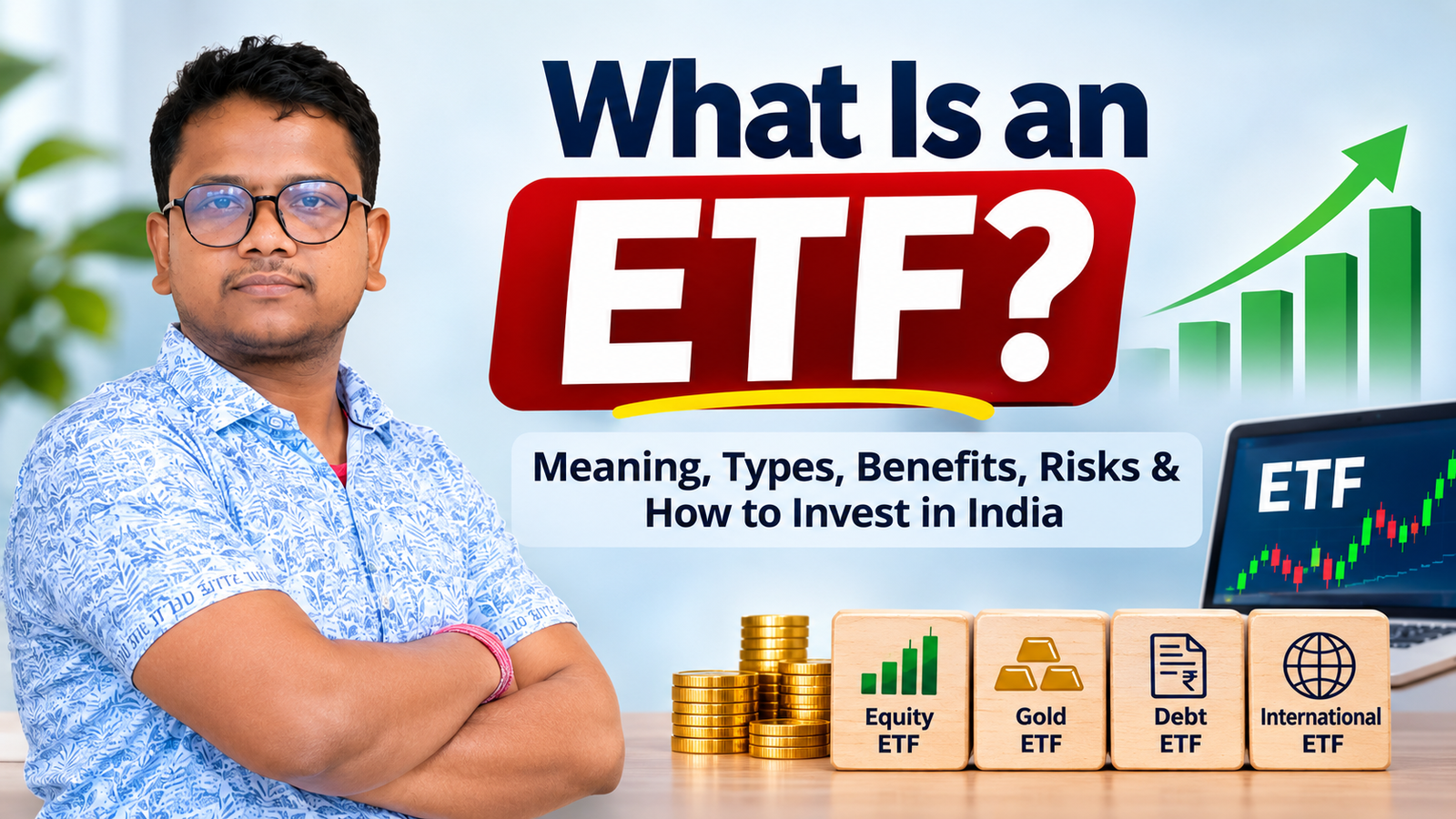
What Is an ETF? Types & How to Invest
What Is an ETF? Meaning, Types, Benefits, Risks & How to Invest in India
Have you ever wanted to invest in multiple companies without purchasing their shares individually? Or invest in gold without buying physical gold?
An Exchange-Traded Fund (ETF) makes this possible.
An ETF is an investment fund whose units are listed and traded on a stock exchange, just like shares. Depending on its investment objective, an ETF can provide exposure to stock market indices, government securities, corporate bonds, gold, silver and international markets.
For example, instead of purchasing shares of all 50 companies in the Nifty 50 individually, you can buy units of a Nifty 50 ETF that aims to track the index.
ETFs combine the diversification of an investment fund with the flexibility of stock exchange trading. However, they also carry risks, including market fluctuations, tracking differences and liquidity issues.
In this guide, you will learn what ETFs are, how they work, their types, benefits, risks and how to invest in ETFs in India.
Table of Contents
What Is an ETF?
ETF stands for Exchange-Traded Fund.
It is an investment fund that holds a portfolio of assets and allows investors to buy and sell its units on a stock exchange during market hours.
Most ETFs in India follow a particular index, sector, investment strategy or asset class.
For example, a Nifty 50 ETF aims to track the Nifty 50 Index. Instead of purchasing shares of 50 companies individually, you can buy units of the ETF through your trading account.
Other examples include:
- Gold ETF: Provides exposure to gold prices.
- Silver ETF: Provides exposure to silver prices.
- Bank ETF: Tracks a banking-sector index.
- Debt ETF: Invests in eligible debt securities.
- International ETF: Provides exposure to overseas markets.
When you purchase an ETF, you own units of the fund, not the underlying shares directly.
How Does an ETF Work?
An ETF is managed by an Asset Management Company (AMC). Its working process can be understood in five steps.
- Fund launch: An AMC launches an ETF with a specific investment objective and benchmark.
- Investment: The ETF invests in underlying assets according to its scheme mandate.
- Stock exchange listing: ETF units are listed on an exchange such as NSE or BSE.
- Buying and selling: Investors purchase or sell units through a stockbroker.
- Price movement: The ETF’s market price changes during trading hours based on underlying asset values and market demand.
How are ETF units created?
ETFs also have a creation and redemption mechanism involving eligible institutional participants called Authorised Participants.
They can exchange a specified basket of securities or cash with the fund for ETF units, according to the scheme’s rules. This mechanism helps adjust the supply of units and supports price alignment with the underlying portfolio.
However, an ETF’s market price may still differ from its NAV.
Types of ETFs Available in India
Different ETFs provide exposure to different investment categories.
Equity ETFs
Equity ETFs invest primarily in shares and generally track stock market indices. Examples include: Nifty 50 ETFs, Nifty Next 50 ETFs, Nifty Bank ETFs, Nifty Midcap ETFs, Sensex ETFs. They provide exposure to multiple companies through a single investment.
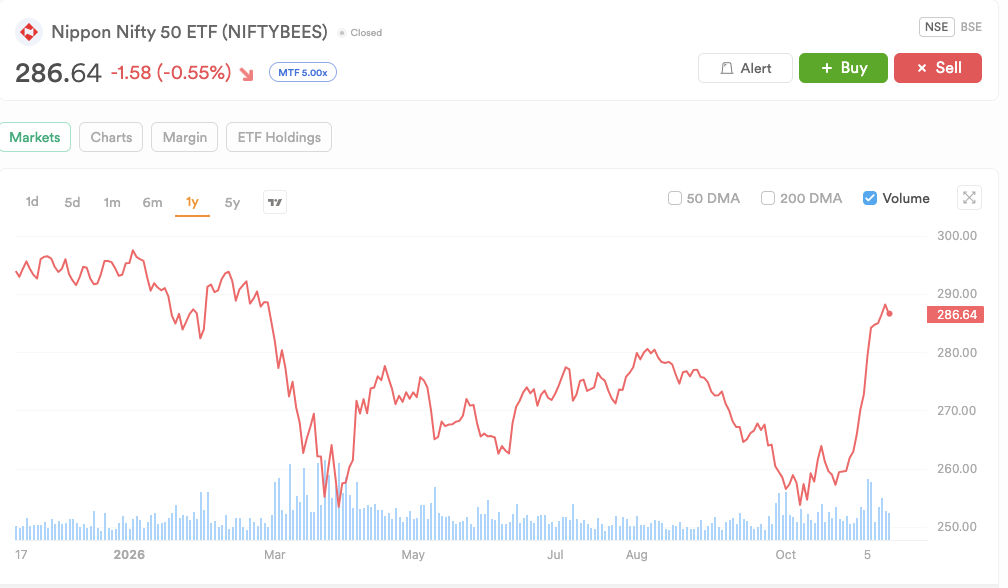
The image below is of Nifty Bees, which tracks the Nifty 50 Index.
Gold ETFs
Gold ETFs provide exposure to gold prices without requiring investors to purchase and store physical gold. Their advantages include convenient exchange-based trading and no need for personal storage. However, their prices can fall when gold prices decline.
Silver ETFs
Silver ETFs provide exposure to silver prices through an exchange-traded investment structure. Silver prices can be volatile because of changes in industrial demand, supply and global economic conditions.
Debt ETFs
Debt ETFs invest in portfolios of debt securities such as government securities, Treasury Bills and corporate bonds. They are subject to interest-rate, credit and liquidity risks.
International ETFs
These ETFs provide exposure to overseas markets, companies or indices. They can help diversify investments beyond India but also involve currency and international market risks.
Sectoral and Thematic ETFs
These ETFs focus on particular industries or investment themes, such as banking, IT, healthcare and infrastructure. They may carry higher concentration risk than broad-market ETFs.
Smart Beta ETFs
Smart Beta ETFs follow predefined investment strategies based on factors such as value, momentum, quality, low volatility, or equal weight. Their performance can differ significantly from traditional market-cap-weighted index ETFs.
ETF vs Mutual Fund vs Index Fund
An ETF is itself a type of mutual fund scheme. The more useful comparison is between an ETF and a conventional open-ended mutual fund.
| Feature | ETF | Index Mutual Fund |
|---|---|---|
| Buying and selling | Stock exchange | AMC or investment platform |
| Price | Live market price | Applicable NAV |
| Demat account | Generally required | Generally not required |
| Intraday trading | Yes | No |
| SIP | Yes | Commonly available |
| Trading costs | Brokerage and other charges may apply | Depends on scheme and investment route |
ETF: Suitable for investors comfortable with exchange trading, limit orders and market prices.
Index Mutual Fund: May be more convenient for investors who want a simple monthly SIP without managing exchange orders.
What is an ETF Fund of Fund?
An ETF Fund of Fund (FoF) is a mutual fund scheme that invests in an underlying ETF. Investors purchase FoF units through the mutual fund route rather than buying ETF units directly on the exchange.
A FoF may be convenient for investors without a Demat account, but its expenses and taxation can differ from direct ETF investing.
Benefits of Investing in ETFs
ETFs offer several advantages:
1. Diversification: One ETF can provide exposure to multiple securities or assets.
2. Trading flexibility: ETF units can be bought and sold during exchange trading hours.
3. Potentially lower expenses: Many passive ETFs have relatively low expense ratios, although total costs should also include brokerage and trading spreads.
4. Transparency: Investors can review scheme holdings, benchmarks, and other disclosures.
5. Multiple asset classes: ETFs provide access to equity, debt, gold, silver, and international markets.
6. Passive investing: Index ETFs allow investors to follow a benchmark rather than selecting individual stocks.
Risks and Disadvantages of ETFs
Before investing, understand these important risks.
Market Risk
If the underlying index or asset declines, the ETF’s value may also fall.
Tracking Error
Tracking error measures the variability in the difference between an ETF’s returns and its benchmark’s returns. A lower tracking error generally indicates more consistent benchmark replication.
Tracking Difference
Tracking difference is the actual return gap between an ETF and its benchmark over a period.
For example:
- Benchmark return: 12%
- ETF return: 11.5%
- Tracking difference: -0.5 percentage points
Liquidity Risk
Some ETFs have low trading volumes. You may struggle to buy or sell units at a reasonable price.
Bid–Ask Spread
The bid–ask spread is the difference between the best buying and selling prices.
For example, if the best bid is ₹100 and the best ask is ₹101, the spread is ₹1. A wider spread increases your effective transaction cost.
Premium and Discount Risk
An ETF can trade above or below its underlying portfolio value. Buying at a significant premium may reduce your potential return.
Other Risks include Currency risk in international ETFs, Concentration risk in sectoral ETFs, Commodity-price risk in Gold and Silver ETFs, Interest-rate and credit risk in debt ETFs, and brokerage and other transaction costs.
What Are NAV, iNAV and ETF Market Price?
Understanding these three terms can help you avoid paying an unreasonable price.
NAV (Net Asset Value): The value of a fund’s net assets divided by its outstanding units.
iNAV (Indicative Net Asset Value): An estimate of an ETF’s underlying portfolio value during trading hours.
Market Price: The actual price at which ETF units are available for buying or selling on the exchange.
Example of ETF Premium
Suppose:
| Particulars | Amount |
|---|---|
| ETF iNAV | ₹100 |
| ETF market price | ₹102 |
| Premium | 2% |
The ETF is trading at a 2% premium to its indicative value. If you purchase it at ₹102, you are paying more than the estimated underlying value of ₹100.
If the premium later disappears, the market price could fall even if the underlying portfolio value remains unchanged. Remember that iNAV is indicative and may not perfectly reflect every underlying asset’s real-time value.
How to Choose the Right ETF in India
Do not select an ETF only because it has recently delivered high returns. Compare these factors:
- Underlying benchmark: Understand which index or assets the ETF tracks.
- Expense ratio: Compare annual scheme expenses.
- Tracking error: Examine how consistently it tracks its benchmark.
- Tracking difference: Compare actual returns against the benchmark.
- Liquidity: Check trading volume and available buyers and sellers.
- Bid–ask spread: Prefer reasonable spreads.
- AUM: Check the fund’s size, but remember that large AUM does not guarantee liquidity.
- Market price vs iNAV: Avoid unusually high premiums.
- Scheme documents: Read the investment objective, portfolio, risks and other disclosures.
ETF selection checklist
Before buying, ask: Do I understand the underlying assets? Is the expense ratio competitive? Is tracking performance reasonable? Is the ETF sufficiently liquid? Is the bid–ask spread acceptable? Is the market price close to iNAV? Does the investment match my financial goals?
How to Invest in ETFs in India
You generally need a Demat and trading account to purchase exchange-listed ETFs directly.
Follow these steps:
Step 1: Open a Demat and trading account with a SEBI-registered stockbroker.
Step 2: Complete the required KYC verification.
Step 3: Research the ETF’s benchmark, expenses, tracking difference and liquidity.
Step 4: Search for the ETF using its name or exchange symbol.
Step 5: Compare its market price with iNAV and check the order book.
Step 6: Place your buy order.
You can generally use two common order types:
- Market order: Attempts to execute at the best available market price.
- Limit order: Allows you to specify the maximum buying price or minimum selling price.
A limit order can be useful for ETFs with low liquidity or wide bid–ask spreads, although execution is not guaranteed.
Step 7: After settlement, the ETF units are credited to your Demat account.
Step 8: Periodically review your investment and the ETF’s portfolio, expenses and tracking performance.
How Much Money Do You Need to Start Investing in ETFs?
There is no universal minimum investment amount for all ETFs. The amount depends on the ETF’s market price and applicable trading conditions. For example, if an ETF trades at ₹20 per unit, purchasing four units would cost: 4 × ₹20 = ₹80. This is before applicable charges.
ETFs are generally purchased in whole units through normal exchange trading, unlike conventional mutual funds that may allow fixed-rupee investments.
Can You Start an SIP in ETFs?
You can invest in ETFs periodically, but direct ETF investing works differently from a conventional mutual fund SIP. Some brokers provide recurring or automated ETF purchase facilities. Others require investors to place orders manually.
For example, if you want to invest ₹2,000 monthly in an ETF trading at ₹250, you can purchase eight units. If the price increases to ₹270, ₹2,000 will not buy exactly the same number of units.
If you prefer fixed-amount monthly investments, an index mutual fund or an eligible ETF Fund of Fund may be more convenient.
How Are ETFs Taxed in India?
ETF taxation depends on the scheme’s classification, underlying assets, acquisition date, holding period and applicable income-tax provisions.
India’s Income-tax Act, 2025 framework applies from 1 April 2026. Therefore, older tax articles should not be followed without checking the current law.
- Equity ETFs: Qualifying equity-oriented ETFs may receive the capital-gains treatment applicable to equity-oriented mutual fund units, subject to statutory conditions.
- Gold and Silver ETFs: Their tax treatment depends on the applicable classification and holding-period rules.
- Debt ETFs: Certain specified mutual fund schemes may have gains taxed at the investor’s applicable slab rate, subject to the relevant provisions.
- International ETFs: Tax treatment depends on the scheme’s legal and tax classification.
- IDCW distributions: Distributions may be taxable in the investor’s hands under applicable provisions.
Do not assume all ETFs have the same tax rate. Check the latest Income Tax Department guidance or consult a qualified tax professional. Official website: https://www.incometax.gov.in/
Common ETF Investing Mistakes to Avoid
Avoid these mistakes:
- Buying an ETF only because its unit price is low.
- Selecting an ETF only on past returns.
- Ignoring tracking error and tracking difference.
- Purchasing an illiquid ETF.
- Ignoring bid–ask spreads.
- Paying a high premium over iNAV.
- Choosing sector ETFs without understanding concentration risk.
- Ignoring brokerage and other charges.
- Confusing ETFs with individual stocks.
- Forgetting the tax implications.
Frequently Asked Questions About ETFs
What is the full form of ETF?
ETF stands for Exchange-Traded Fund.
Is an ETF a mutual fund?
Yes. An ETF is a type of mutual fund scheme whose units trade on stock exchanges.
Are ETFs safe for beginners?
Their risk depends on the underlying assets. Equity ETFs, commodity ETFs and debt ETFs have different risk profiles.
Can I invest ₹500 in an ETF?
It may be possible if the ETF’s unit price and trading conditions allow a purchase within ₹500.
Do I need a Demat account to invest in ETFs?
Generally, yes, for direct exchange-traded ETF investing. An ETF Fund of Fund may provide an alternative through a mutual fund account.
What is a Nifty 50 ETF?
A Nifty 50 ETF aims to track the Nifty 50 Index and provides exposure to its constituent companies through one investment.
Can I sell ETF units anytime?
You can generally place a sell order during exchange trading hours, but execution depends on liquidity and available buyers.
Are ETFs better than mutual funds?
Neither is universally better. ETFs offer exchange-trading flexibility, while conventional mutual funds may provide a simpler SIP process.
Do ETFs guarantee returns?
No. ETFs are subject to market risks and investors can lose money.
What happens if an ETF is closed?
The scheme is dealt with according to applicable regulations and scheme documents. Investors may receive liquidation proceeds after applicable expenses and liabilities.
Final Thoughts: Are ETFs Worth Considering?
ETFs provide Indian investors with a convenient way to access stock market indices, bonds, gold, silver and international markets through exchange-traded units. However, choosing an ETF requires more than looking at its recent returns or unit price.
Understand its benchmark, expense ratio, tracking performance, liquidity, bid–ask spread and tax treatment before investing. For beginners, broad-market index ETFs can be a useful starting point for learning about passive investing. Specialised products such as sectoral and international ETFs require additional research.
The best ETF is not necessarily the one with the highest recent return or lowest unit price. It is the one whose underlying assets, costs and risks you understand and that fits your investment goals.
Disclaimer: This article is for educational purposes only and does not constitute investment, financial or tax advice. ETFs are subject to market risks, and investors may lose money. Review scheme documents and consult a qualified professional when necessary.
Official Sources and Further Reading
- SEBI – https://investor.sebi.gov.in/
- NSE – https://www.nseindia.com/
- NISM – https://www.nism.ac.in/
- Income Tax Department – https://www.incometax.gov.in/

You may also like

Investing Basics: A Complete Guide to Getting Started
What Are Bonds? Types, Returns, Risks & How to Invest