What Is EBITDA? Meaning, Formula, Calculation & Examples
What Is EBITDA? Meaning, Formula, Calculation, Margin & Examples
If you are learning fundamental analysis, EBITDA is one of the most important financial metrics to understand. It is frequently used to evaluate operating performance, compare companies, analyze debt and calculate valuation multiples such as EV/EBITDA.
But EBITDA is also one of the most misunderstood metrics in finance. EBITDA is not the same as net profit, operating cash flow, or free cash flow.
This guide explains what EBITDA means, how to calculate it, how to interpret EBITDA margin, how EBITDA differs from EBIT and net profit, and how investors can use it responsibly when analyzing a business.
Table of Contents
What Is EBITDA?
EBITDA stands for Earnings Before Interest, Taxes, Depreciation, and Amortization. It is a profitability measure that shows a company’s earnings before deducting interest, taxes, depreciation and amortization.
In simple terms, EBITDA attempts to show how profitable a company’s underlying operations are before considering its financing structure, tax burden and certain accounting charges related to long-term assets.
The basic formula is:
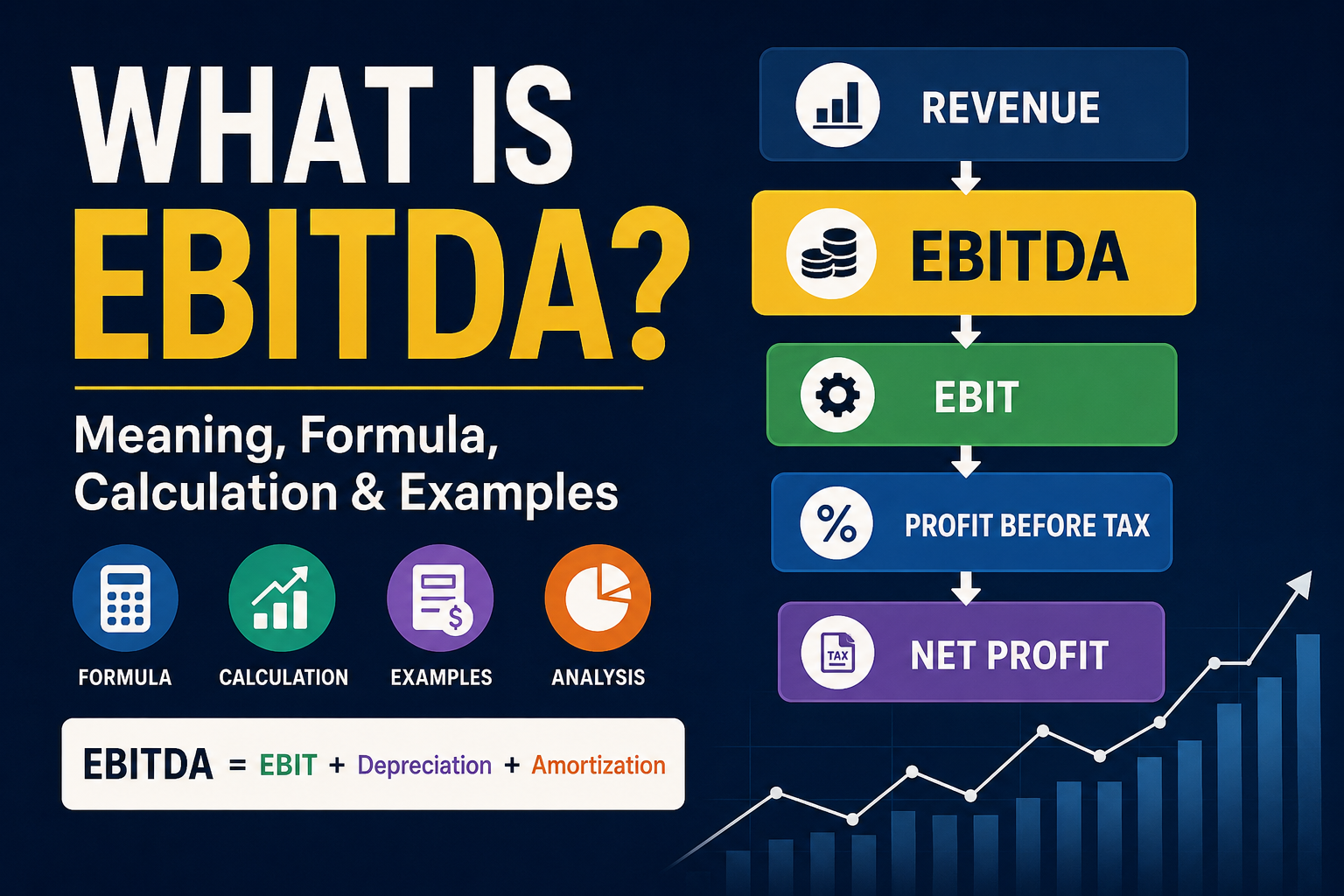
EBITDA = EBIT + Depreciation + Amortization
It can also be calculated from net income:
EBITDA = Net Income + Interest + Taxes + Depreciation + Amortization
For example, if a company has ₹100 crore of EBIT and ₹20 crore of depreciation and amortization:
EBITDA = ₹100 crore + ₹20 crore = ₹120 crore
However, EBITDA should not be interpreted as the company’s actual cash profit. A company can have strong EBITDA and still have weak cash flow or even a net loss.
What Does EBITDA Stand For?
The word EBITDA is an acronym:
- E — Earnings
- B — Before
- I — Interest
- T — Taxes
- D — Depreciation
- A — Amortization
Each component tells us something different about a company’s financial performance.
Earnings
Earnings generally refer to the company’s profit measure before the specified deductions are considered.
Interest
Interest is the cost a company pays on borrowed money.
Two companies can have identical operations but very different interest expenses because one has significantly more debt.
EBITDA excludes interest so that analysts can initially examine operating performance without the effect of financing decisions.
Taxes
Companies pay taxes on taxable income. Tax rates can differ based on geography, tax rules, incentives and other circumstances.
EBITDA excludes taxes to make operating comparisons less affected by differences in tax structures.
Depreciation
Depreciation is an accounting method used to allocate the cost of tangible assets such as machinery, buildings and equipment over their useful lives.
Amortization
Amortization generally refers to allocating the cost of certain intangible assets over time.
Because depreciation and amortization are deducted when calculating EBIT, they are added back when calculating EBITDA.
EBITDA in Simple Terms
Imagine a manufacturing company.
It sells products and earns ₹500 crore in revenue. After paying employees, raw-material costs, electricity, selling expenses and other operating costs—but before depreciation and amortization—it has ₹150 crore remaining.
That ₹150 crore represents its EBITDA in this simplified example.
The company then has ₹30 crore of depreciation and amortization.
So:
EBITDA = ₹150 crore
EBIT = ₹150 crore − ₹30 crore = ₹120 crore
The company then pays interest and taxes before arriving at its final net profit.
This gives us a useful financial-statement progression:
Revenue → EBITDA → EBIT → Profit Before Tax → Net Profit
And from a cash perspective, another important progression is:
EBITDA → Operating Cash Flow → Free Cash Flow
These are different measures and should not be treated as interchangeable.
EBITDA Formula
There are two commonly used approaches to calculating EBITDA.
EBITDA Formula Using EBIT
The simplest formula is:
EBITDA = EBIT + Depreciation + Amortization
For example:
- EBIT = ₹80 crore
- Depreciation = ₹15 crore
- Amortization = ₹5 crore
Therefore:
EBITDA = ₹80 crore + ₹15 crore + ₹5 crore = ₹100 crore
EBITDA Formula Using Net Income
You can also work backward from net income:
EBITDA = Net Income + Interest + Taxes + Depreciation + Amortization
Suppose:
- Net income = ₹60 crore
- Interest = ₹15 crore
- Taxes = ₹15 crore
- Depreciation = ₹8 crore
- Amortization = ₹2 crore
Then:
EBITDA = ₹60 + ₹15 + ₹15 + ₹8 + ₹2 = ₹100 crore
When the financial statements are classified consistently, both methods should arrive at the same EBITDA.
How Is EBITDA Calculated?
Calculating EBITDA becomes easier when you understand the company’s income statement.
Step 1: Find Revenue
Revenue represents the income generated from selling products or services.
Suppose a company generates:
Revenue = ₹500 crore
Revenue alone doesn’t tell us whether the business is profitable.
A company can have very high revenue but very low profitability.
Step 2: Account for Operating Expenses
The company incurs costs to run its operations.
These could include:
- employee costs
- raw materials
- electricity
- transportation
- selling expenses
- administrative expenses
- other operating costs
After accounting for relevant operating costs, the company arrives at an operating-profit measure.
Step 3: Find EBIT
EBIT means Earnings Before Interest and Taxes.
A simplified relationship is:
EBIT = EBITDA − Depreciation − Amortization
Therefore:
EBITDA = EBIT + Depreciation + Amortization
Step 4: Add Back Depreciation and Amortization
This produces EBITDA.
The important point is that depreciation and amortization are accounting expenses, but that does not mean the underlying economic cost of assets can simply be ignored.
A factory may not require ₹30 crore of cash depreciation this year, but the company may eventually need to spend substantial cash replacing machinery.
That is one reason EBITDA should not be confused with free cash flow.
EBITDA Calculation Example
Consider a hypothetical Indian manufacturing company.
| Particular | Amount |
|---|---|
| Revenue | ₹500 crore |
| Operating expenses excluding D&A | ₹350 crore |
| EBITDA | ₹150 crore |
| Depreciation & amortization | ₹30 crore |
| EBIT | ₹120 crore |
| Interest | ₹25 crore |
| Profit before tax | ₹95 crore |
| Tax | ₹24 crore |
| Net profit | ₹71 crore |
Let’s calculate EBITDA from EBIT:
EBITDA = EBIT + D&A
= ₹120 crore + ₹30 crore
= ₹150 crore
We can also calculate it from net profit:
EBITDA = Net Profit + Interest + Tax + D&A
= ₹71 crore + ₹25 crore + ₹24 crore + ₹30 crore
= ₹150 crore
Both approaches arrive at the same result.
Notice something important.
The company has:
EBITDA = ₹150 crore
but:
Net Profit = ₹71 crore
Therefore, EBITDA is clearly not the same as net profit.
What Does EBITDA Tell You About a Company?
EBITDA is primarily useful for understanding a company’s operating profitability before certain expenses.
It can answer questions such as:
- How much earnings does the business generate from its operations?
- Is operating profitability improving?
- How does the company’s operating performance compare with similar businesses?
- How much EBITDA does the business generate relative to its revenue?
However, EBITDA doesn’t answer every financial question.
It doesn’t tell you exactly how much cash the company generates.
It also doesn’t tell you how much debt the company has, how much capital expenditure it requires, or how much money ultimately belongs to shareholders.
EBITDA Helps Compare Similar Companies
One reason EBITDA is widely used is that companies can have different financing structures.
Suppose Company A has ₹100 crore of EBITDA and very little debt.
Company B also has ₹100 crore of EBITDA but has significant debt and therefore much higher interest expenses.
Their EBITDA is identical, but their financial structures are very different.
By looking at EBITDA separately from interest, an analyst can first compare the operating businesses before examining financing differences.
However, this doesn’t mean the two companies are equally attractive.
Debt still matters.
EBITDA Can Help Analyze Operating Trends
Suppose a company’s EBITDA is:
- Year 1: ₹50 crore
- Year 2: ₹60 crore
- Year 3: ₹75 crore
- Year 4: ₹90 crore
That indicates EBITDA has increased substantially.
But a good analyst wouldn’t stop there.
You should also ask:
Did revenue grow at the same rate?
Did EBITDA margin improve?
Did operating cash flow improve?
Did debt increase?
Did capital expenditure increase?
Did the company achieve growth by taking on excessive financial risk?
This is why a single EBITDA figure is rarely enough for investment analysis.
What Is EBITDA Margin?
EBITDA margin measures EBITDA as a percentage of revenue.
The formula is:
EBITDA Margin = EBITDA ÷ Revenue × 100
Suppose:
- EBITDA = ₹150 crore
- Revenue = ₹500 crore
Then:
EBITDA Margin = ₹150 ÷ ₹500 × 100
= 30%
This means the company generates ₹30 of EBITDA for every ₹100 of revenue in this simplified example.
What Does a High EBITDA Margin Mean?
A higher EBITDA margin generally means a company retains more operating earnings relative to its revenue before interest, taxes, depreciation and amortization.
But higher is not automatically better.
Different industries naturally have different cost structures.
A software company, retailer, airline, bank and steel manufacturer can have very different margins.
Therefore, EBITDA margin is generally more meaningful when compared with:
- the company’s own historical margins
- similar companies
- industry economics
- revenue growth
- capital requirements
- cash generation
What Is a Good EBITDA Margin?
There is no universal EBITDA margin that can be called “good.”
A 20% EBITDA margin could be excellent for one industry but weak for another.
Instead of asking only:
“Is this EBITDA margin high?”
ask:
“Is this EBITDA margin appropriate for this business, and is it improving or deteriorating?”
For example, if a company has increased its EBITDA margin from 12% to 20% while maintaining healthy cash flow and sustainable growth, that may indicate improving operating economics.
Conversely, a company with a 30% margin could still be financially risky if it has enormous debt and capital requirements.
EBITDA vs EBIT vs Net Profit
These three metrics measure different stages of profitability.
EBITDA vs EBIT
The primary difference is depreciation and amortization.
EBITDA = EBIT + Depreciation + Amortization
EBIT includes depreciation and amortization.
EBITDA excludes them.
For example:
- EBITDA = ₹100 crore
- D&A = ₹20 crore
Then:
EBIT = ₹80 crore
EBITDA vs Operating Profit
Operating profit is commonly associated with EBIT.
Therefore, EBITDA should not simply be called “operating profit.”
A useful relationship is:
EBITDA = Operating Profit/EBIT + D&A
Terminology can vary depending on financial-statement presentation, so it’s better to examine the underlying numbers rather than rely only on labels.
EBITDA vs Net Profit
Net profit is the amount remaining after accounting for expenses such as interest, taxes, depreciation and amortization, along with other applicable income and expenses.
Therefore:
EBITDA > EBIT > Net Profit
can occur in a simplified conventional example, but the exact relationship can differ when there are unusual income or expense items.
Net profit is much closer to the final accounting earnings attributable to shareholders.
EBITDA vs Cash Flow
This is perhaps the most important distinction to understand.
EBITDA is not cash flow.
A company could report ₹100 crore of EBITDA but generate substantially less operating cash flow.
Why?
Because actual cash generation can be affected by factors such as:
- changes in working capital
- taxes paid
- interest paid
- inventory investment
- receivables
- payables
- capital expenditure
For example, imagine a company sells ₹100 crore of products but customers have not yet paid for them.
The company may recognize revenue and generate EBITDA, but it hasn’t necessarily received ₹100 crore in cash.
That’s why serious financial analysis goes beyond EBITDA and examines operating cash flow and free cash flow.
Why Is Depreciation Added Back to EBITDA?
To understand this, consider a company that buys a machine for ₹100 crore.
The machine may be expected to last 10 years.
Instead of recording the entire ₹100 crore as an expense in the year of purchase, accounting rules generally spread the cost over the asset’s useful life through depreciation.
Suppose annual depreciation is ₹10 crore.
That ₹10 crore reduces accounting profit.
When calculating EBITDA, depreciation is added back because EBITDA is designed to measure earnings before depreciation and amortization.
But there is an important caveat.
The company still purchased a machine.
And eventually, it may need to spend money replacing that machine.
Therefore:
“Depreciation is non-cash” does not mean “the economic cost is irrelevant.”
This distinction is critical when evaluating capital-intensive businesses.
Why Do Investors and Businesses Use EBITDA?
EBITDA has several practical applications.
Comparing Operating Businesses
Analysts can use EBITDA to compare operating profitability before financing and certain accounting effects.
Evaluating Business Performance
Management teams may monitor EBITDA and EBITDA margin to understand changes in operating performance.
Business Valuation
EBITDA is frequently used with enterprise value to calculate the EV/EBITDA multiple.
Debt Analysis
Lenders and analysts may use EBITDA-related leverage measures when assessing a company’s ability to support debt.
However, EBITDA should be considered alongside actual cash generation and debt obligations.
Mergers and Acquisitions
EBITDA is commonly discussed in business transactions because buyers may want to assess the operating earnings of a business separately from the seller’s financing structure.
What Is EV/EBITDA?
EV/EBITDA is one of the most widely used valuation multiples.
The formula is:
EV/EBITDA = Enterprise Value ÷ EBITDA
Enterprise value broadly represents the value of the operating business available to both debt and equity providers.
A simplified formula is:
Enterprise Value ≈ Market Capitalization + Debt − Cash
For example:
- Market capitalization = ₹1,000 crore
- Debt = ₹300 crore
- Cash = ₹100 crore
Then:
Enterprise Value = ₹1,000 + ₹300 − ₹100
= ₹1,200 crore
If EBITDA is ₹100 crore:
EV/EBITDA = ₹1,200 ÷ ₹100 = 12×
Why Use Enterprise Value Instead of Market Capitalization?
Market capitalization represents the value of the company’s equity.
But two companies can have the same market capitalization and very different debt levels.
Enterprise value attempts to account for the capital structure when evaluating the value of the operating business.
That’s why EV/EBITDA can be useful when comparing companies with different levels of debt and cash.
What Does a High or Low EV/EBITDA Mean?
A low EV/EBITDA multiple does not automatically mean a stock is cheap.
Likewise, a high multiple does not automatically mean a stock is expensive.
A company might deserve a higher multiple because of:
- stronger growth
- higher margins
- better competitive advantages
- stronger balance sheet
- better cash generation
- lower business risk
Another company might trade at a low multiple because its earnings are declining or because the business requires significant future investment.
Therefore, EV/EBITDA should be interpreted in context.
What Is Adjusted EBITDA?
Adjusted EBITDA is EBITDA modified to exclude or adjust for certain items that management or analysts consider unusual, non-recurring or not representative of normal operations.
For example, a company might adjust EBITDA for a particular restructuring expense or another unusual item.
The purpose is generally to estimate a more “normalized” operating result.
However, investors should be careful.
A company repeatedly reporting supposedly “one-time” expenses deserves scrutiny.
If an expense occurs every year, calling it non-recurring doesn’t necessarily make it economically irrelevant.
Therefore, when reading Adjusted EBITDA, ask:
What exactly has been adjusted?
Is the adjustment genuinely unusual?
Does the company provide evidence supporting it?
How does reported EBITDA compare with Adjusted EBITDA?
This is particularly important when comparing companies.
What Is LTM EBITDA?
LTM stands for Last Twelve Months.
LTM EBITDA represents EBITDA generated over the most recent twelve-month period.
For example, if a company’s financial year ends in March, its latest annual report may not capture developments from the subsequent months.
An LTM calculation can incorporate the latest available quarterly results to provide a more current historical measure.
LTM EBITDA is particularly useful when analyzing valuation multiples because:
Enterprise Value ÷ LTM EBITDA
can provide a trailing valuation multiple based on recent operating performance.
What Is Forward EBITDA?
Forward EBITDA is an estimate of EBITDA expected in the future.
For example, an analyst might estimate that a company will generate ₹150 crore of EBITDA over the next financial year.
That is not historical fact.
It is an estimate based on assumptions about:
- revenue
- operating costs
- margins
- demand
- pricing
- economic conditions
Therefore, always distinguish between:
Historical EBITDA = what the company actually reported
and:
Forward EBITDA = what someone expects the company to generate
Forward valuation multiples can change significantly when earnings estimates change.
Limitations of EBITDA
EBITDA can be useful, but it has significant limitations.
EBITDA Is Not Cash Flow
This is the biggest limitation.
EBITDA doesn’t account for all the cash required to operate and maintain a business.
Working capital and capital expenditure can consume substantial cash.
EBITDA Ignores Interest Expense
Interest is a real financial obligation.
This matters enormously for highly leveraged companies.
Two companies with identical EBITDA can have completely different financial risk if one has much more debt.
EBITDA Ignores Taxes
Taxes represent real obligations that can reduce the cash available to a company.
Therefore, EBITDA shouldn’t be interpreted as the amount shareholders can take home.
EBITDA Ignores Capital Expenditure
This is particularly important for businesses requiring heavy investment in factories, equipment, infrastructure or other physical assets.
A company could report excellent EBITDA while spending most of its cash on maintaining its asset base.
EBITDA Can Make Debt-Heavy Companies Look More Attractive
Because interest is excluded, EBITDA can make two companies appear similar even when one has a much more burdensome debt position.
That doesn’t make EBITDA useless.
It means the metric should be combined with balance-sheet analysis.
EBITDA Can Be Misleading for Capital-Intensive Businesses
Depreciation can represent the gradual consumption of assets required to generate revenue.
Adding depreciation back can therefore make operating profitability look stronger than the economics of the business may actually be.
EBITDA Is Not a Standard GAAP Profit Measure
EBITDA is a widely used analytical measure, but it is not a standardized GAAP profitability measure.
This means definitions and adjustments can vary, especially when companies report their own versions of adjusted EBITDA.
For that reason, investors should understand exactly how a company’s EBITDA was calculated.
Can a Company Have Positive EBITDA but Negative Net Profit?
Yes.
Consider this simplified example:
- EBITDA = ₹50 crore
- Depreciation = ₹25 crore
- Interest = ₹40 crore
- Other expenses = ₹5 crore
The company can end up with a loss despite generating positive EBITDA.
This demonstrates why EBITDA should never be used as a replacement for net profit.
A business can have positive operating earnings before certain costs while still losing money after accounting for depreciation, interest and other expenses.
Can EBITDA Be Negative?
Yes.
Negative EBITDA means the company’s relevant operating expenses exceed its operating earnings before depreciation and amortization.
For example:
- Revenue = ₹100 crore
- Operating expenses before D&A = ₹120 crore
Then:
EBITDA = −₹20 crore
Negative EBITDA is not automatically proof that a business is doomed.
A young company might intentionally spend heavily to build its business.
But persistent negative EBITDA can indicate that the underlying business model is not yet generating sufficient operating earnings.
The important questions are:
Why is EBITDA negative?
Is it improving?
How much cash is the company consuming?
How much funding does it need?
When, if ever, is the business expected to become sustainably profitable?
How to Analyze EBITDA From a Company’s Annual Report
For Indian investors, one of the most useful skills is learning to calculate or verify financial metrics directly from company filings.
Don’t rely blindly on a financial website’s EBITDA figure.
Look at the company’s annual report and financial statements.
Find Revenue
Start with revenue from operations and understand whether the company has other income that should be treated separately.
Find Operating Profit or EBIT
Depending on the presentation, you may need to work through the income statement to determine operating profit.
Find Depreciation and Amortization
Look at the financial statements and accompanying notes.
Depreciation may appear separately, while amortization can sometimes be embedded in relevant disclosures.
Find Finance Costs
Indian companies commonly use the term finance costs.
This can include interest and other financing-related costs, depending on the company’s reporting.
Recalculate the Number
If a company reports EBITDA, compare it with the underlying financial statements.
For example:
EBIT + D&A = calculated EBITDA
If management reports a significantly different Adjusted EBITDA, investigate the adjustments.
This habit can help investors distinguish between a simple accounting calculation and a management-defined performance metric.
EBITDA Analysis: A Practical Framework for Investors
Rather than asking whether a company’s EBITDA is “good,” analyze it systematically.
Check EBITDA Growth
Look at several years rather than one quarter.
A rising EBITDA can be encouraging, but determine whether the growth comes from sustainable business expansion, cost reductions, acquisitions or temporary factors.
Check EBITDA Margin
Compare EBITDA with revenue.
An increasing margin can indicate improving operating economics.
A declining margin can indicate rising costs, pricing pressure or weaker operating efficiency.
Compare EBITDA Growth With Revenue Growth
Suppose revenue grows 20% but EBITDA grows only 5%.
That could mean margins are under pressure.
If revenue grows 10% while EBITDA grows 25%, operating leverage may be improving.
The reasons behind the change matter.
Compare EBITDA With Operating Cash Flow
This is essential.
If EBITDA is consistently increasing but operating cash flow remains weak, investigate why.
Working-capital requirements may be absorbing cash.
Examine Capital Expenditure
A capital-intensive company may require large investments to maintain its existing operations.
Therefore, EBITDA should be considered alongside capital expenditure and free cash flow.
Examine Debt
Check:
- total debt
- net debt
- interest expense
- debt maturity
- leverage
A company with ₹500 crore of EBITDA and ₹100 crore of debt is very different from one with ₹500 crore of EBITDA and ₹5,000 crore of debt.
Examine Valuation
Finally, consider valuation.
EV/EBITDA can help compare companies, but it should be considered alongside growth, profitability, cash flow, debt and business quality.
EBITDA Example: Two Companies With the Same EBITDA but Different Financial Health
Consider two hypothetical companies.
| Metric | Company A | Company B |
|---|---|---|
| EBITDA | ₹100 crore | ₹100 crore |
| Debt | ₹50 crore | ₹500 crore |
| Capital expenditure | ₹10 crore | ₹90 crore |
| Operating cash flow | Strong | Weak |
At first glance, both companies have exactly the same EBITDA.
But they don’t necessarily have the same financial health.
Company B has significantly more debt and substantially higher capital requirements.
Therefore, its EBITDA may not translate into as much cash available for shareholders.
This illustrates one of the most important lessons in financial analysis:
The same EBITDA does not necessarily mean the same business quality.
Common EBITDA Mistakes Beginners Make
Thinking EBITDA Is Net Profit
It isn’t.
Net profit comes after many expenses that EBITDA excludes.
Thinking EBITDA Is Cash Flow
It isn’t.
Actual cash generation depends on working capital, taxes, interest, capital expenditure and other factors.
Assuming Higher EBITDA Always Means Better
A larger company naturally tends to generate more EBITDA.
Compare margins, growth, returns and cash generation—not just absolute EBITDA.
Comparing Completely Different Industries
A 15% EBITDA margin means different things in different industries.
Industry economics matter.
Assuming Low EV/EBITDA Means Cheap
A low multiple can reflect weak growth, high risk, declining earnings or heavy capital requirements.
Ignoring Debt
Interest is excluded from EBITDA, but debt still has to be repaid.
Accepting Adjusted EBITDA Without Question
Always investigate what management has removed or adjusted.
EBITDA in One Minute
EBITDA = Earnings Before Interest, Taxes, Depreciation and Amortization.
The most commonly used formula is:
EBITDA = EBIT + Depreciation + Amortization
EBITDA helps analysts understand operating profitability before financing, taxes and D&A.
EBITDA Margin = EBITDA ÷ Revenue × 100
EBITDA is frequently used for company comparisons, debt analysis and valuation through EV/EBITDA.
But remember:
EBITDA ≠ Net Profit
EBITDA ≠ Operating Cash Flow
EBITDA ≠ Free Cash Flow
A complete analysis should consider EBITDA alongside EBIT, net profit, cash flow, capital expenditure, debt and valuation.
Frequently Asked Questions About EBITDA
What does EBITDA stand for?
EBITDA stands for Earnings Before Interest, Taxes, Depreciation, and Amortization. It is a measure used to assess a company’s operating profitability before these expenses.
What is EBITDA in simple words?
EBITDA is a measure of a company’s earnings from its operations before interest, taxes, depreciation and amortization are deducted. It helps analysts examine operating performance without some effects of financing and accounting decisions.
What is the formula for EBITDA?
The most common formula is:
EBITDA = EBIT + Depreciation + Amortization
It can also be calculated as:
EBITDA = Net Income + Interest + Taxes + Depreciation + Amortization
Is EBITDA the same as operating profit?
Not exactly. Operating profit is generally associated with EBIT, while EBITDA adds depreciation and amortization back to EBIT.
EBITDA = EBIT + D&A
Is EBITDA the same as net profit?
No. Net profit is calculated after accounting for interest, taxes, depreciation, amortization and other applicable income and expenses.
Is EBITDA the same as cash flow?
No. EBITDA is a profitability measure, not a cash-flow measure. Working capital, taxes, interest and capital expenditure can cause substantial differences between EBITDA and actual cash generation.
Why is EBITDA important?
EBITDA can help analysts compare operating performance, evaluate operating margins, analyze leverage and calculate valuation multiples such as EV/EBITDA.
What is a good EBITDA margin?
There is no universal good EBITDA margin. The appropriate margin depends on the industry, business model, competitive position, growth, capital requirements and historical performance.
What is the difference between EBIT and EBITDA?
EBIT includes depreciation and amortization, while EBITDA adds those expenses back.
EBITDA = EBIT + Depreciation + Amortization
Why can EBITDA be misleading?
EBITDA excludes several real economic costs, including interest, taxes and the effects of depreciation and amortization. It also doesn’t account for working-capital requirements or capital expenditure, so it shouldn’t be treated as cash flow.
Can EBITDA be negative?
Yes. Negative EBITDA means operating expenses exceed operating earnings before depreciation and amortization. The significance depends on the company’s business model, growth stage and path toward profitability.
What is EV/EBITDA?
EV/EBITDA is a valuation multiple calculated as:
EV/EBITDA = Enterprise Value ÷ EBITDA
It is commonly used to compare the valuation of companies while taking debt and cash into account through enterprise value.
What is Adjusted EBITDA?
Adjusted EBITDA is EBITDA modified for selected items that management or analysts consider unusual, non-recurring or not representative of normal operations. Investors should examine these adjustments carefully.
What is LTM EBITDA?
LTM EBITDA means Last Twelve Months EBITDA. It measures EBITDA generated during the most recent twelve-month period.
Is EBITDA important for stock analysis?
Yes, EBITDA can be useful in fundamental analysis, but it should never be considered in isolation. Investors should also examine revenue growth, EBIT, net profit, operating cash flow, free cash flow, debt, capital expenditure, return metrics, and valuation.
Conclusion: EBITDA Is Useful, But Never Use It Alone
EBITDA is a powerful financial-analysis tool because it provides a way to examine operating earnings before interest, taxes, depreciation and amortization.
But its usefulness comes with an important limitation: EBITDA is only one piece of the financial picture.
A company can have:
- strong EBITDA but weak cash flow,
- rising EBITDA but rising debt,
- positive EBITDA but negative net profit,
- high EBITDA margins but enormous capital requirements.
Therefore, don’t stop at EBITDA.
A stronger financial-analysis process looks at the entire chain:
Revenue → EBITDA → EBIT → Net Profit → Operating Cash Flow → Free Cash Flow → Debt → Valuation
Once you understand how these measures connect, EBITDA becomes much more useful—and much less likely to mislead you.
For investors, the goal should not be to find a single metric that tells you whether a stock is “good” or “bad.” The goal is to understand how the business makes money, how much cash it generates, how much capital it requires, how much debt it carries, and what price the market is asking for that business.
EBITDA can help you answer part of that question, but it cannot answer all of it.
Related Posts:
- Financial Ratios Explained: PE, PB, ROE & How to Analyze Any Stock
- Price to Sales Ratio (P/S): Formula, Meaning & Calculation
- What Is the Price-to-Book Ratio? Formula, Meaning & Examples
- P/E Ratio: Meaning, Formula, Examples & How to Analyze It
- P/E Ratio vs EV/EBITDA: Differences, Formulas & Examples
- What Is the PEG Ratio? Formula, Calculation, Meaning, and How to Use It
- What Is EPS? Earnings Per Share Explained With Formula, Examples & How to Analyze It
- How to Value a Stock: Complete Stock Valuation Guide

You may also like

Price to Sales Ratio (P/S): Formula, Meaning & Calculation

What Is the Price-to-Book Ratio? Formula, Meaning & Examples